Action-Reaction Pairs
Interactive passage with audio narration, comprehension questions, and printable PDF.
By completing this purchase you agree to our Terms of Use and Privacy Policy. Your subscription renews automatically until you cancel. You can cancel anytime from your account settings. All sales are final and non-refundable. Digital content is available for download in your account immediately upon purchase.
What's included
Action-Reaction Pairs preview and details
About this printable Action-Reaction Pairs science reading passage, NGSS-aligned (Grades 5-8)
Sample passage and quiz from Action-Reaction Pairs
Reading passage and comprehension quiz preview
Action-Reaction Examples
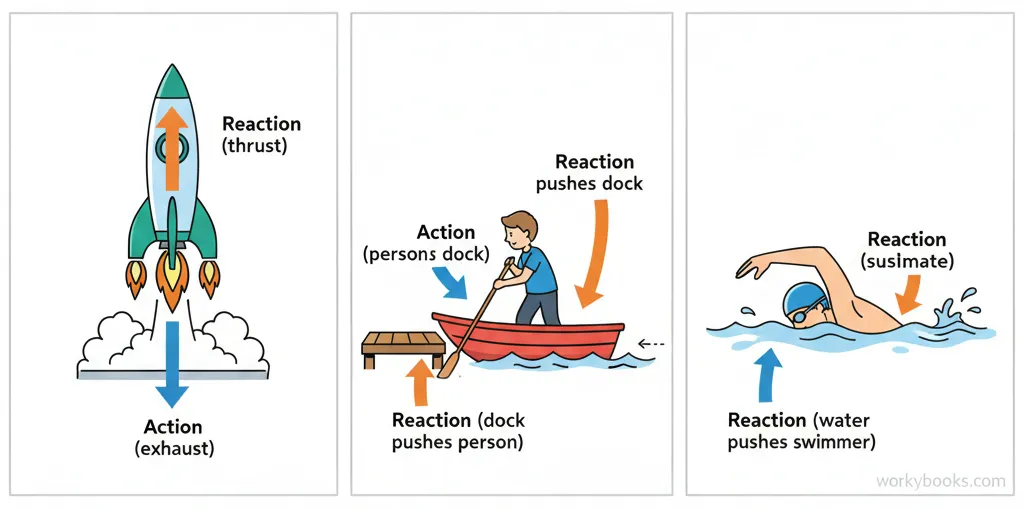
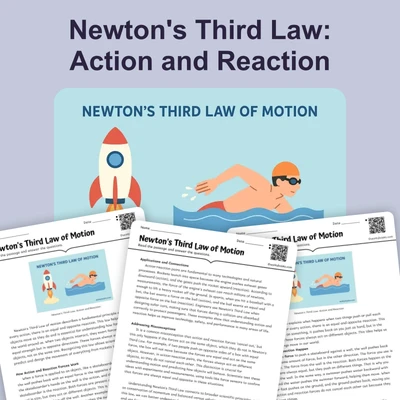
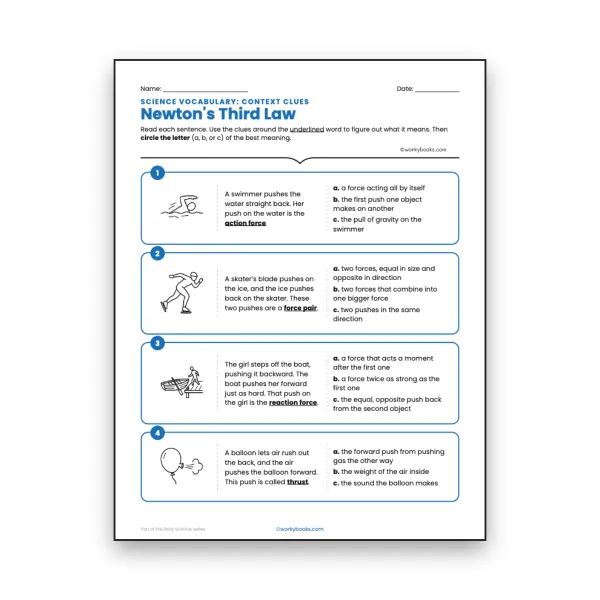
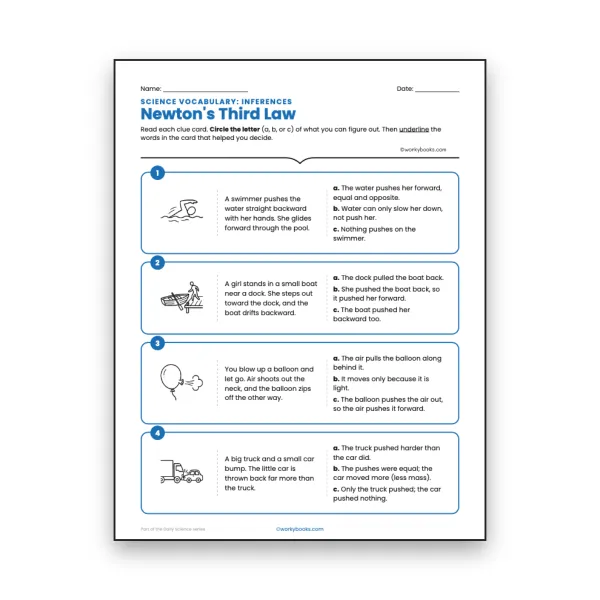
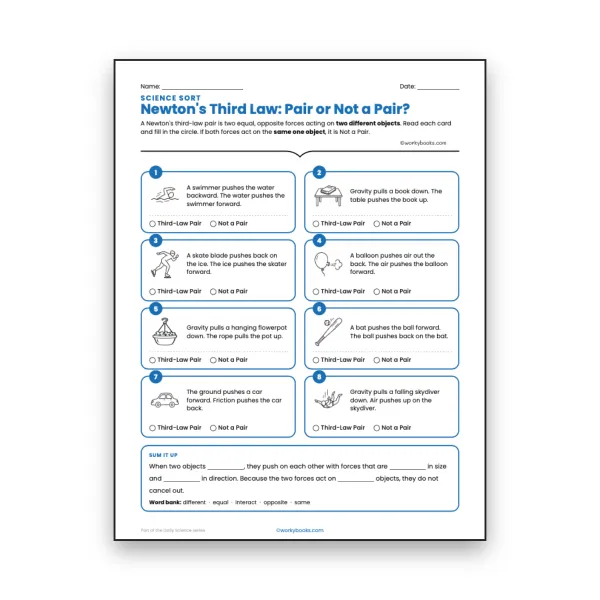
Newton’s Third Law of Motion states that forces always occur in equal and opposite pairs. This law is fundamental to understanding how objects interact in our world, from launching rockets to the way animals move. Whenever one object exerts a force on a second object, the second object exerts an equal force in the opposite direction on the first. These are called action-reaction pairs. This principle helps scientists and engineers design vehicles, study animal movement, and even predict how sports work.
How Action-Reaction Works
When a rocket launches, hot gases rush downwards out of its engines. According to Newton’s Third Law, the rocket pushes on the gases, and the gases push back with an equal force, but in the opposite direction. This reaction force propels the rocket upward into the sky. In every example of motion, there is a pair of forces acting on two different objects. Scientists represent these forces using force diagrams, which use arrows to show the direction and size of the forces. The action and reaction forces are always the same strength, but they act on different objects.
Examples in Everyday Life
Jumping off the ground is a familiar example of Newton’s Third Law. When you jump, your legs push down on the Earth. At the same time, the Earth pushes you back up with an equal force. Because the Earth is so massive compared to your body, you move upward while the Earth hardly moves at all. This connects to Newton’s Second Law, which explains that an object’s acceleration depends on both the force applied and its mass. The same action-reaction principle applies when a bird pushes air downward with its wings; the air pushes the bird upward. Similarly, a fish pushes water backward with its tail, and the water pushes the fish forward.
Mass and Motion: Why Some Objects Move More
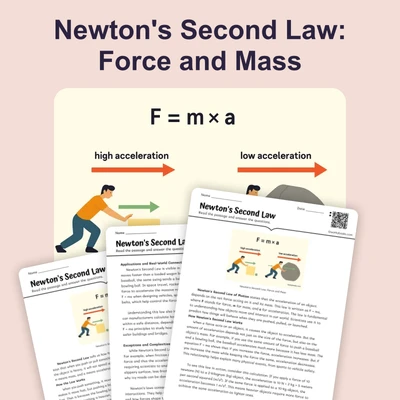
Although action and reaction forces are equal, the resulting motion depends on the mass of each object. For example, when you jump, you accelerate much more than the Earth because your mass is far less. In rocket launches, the mass of the exhaust gases is much smaller than the rocket, but the high speed of the gases creates enough reaction force to lift the heavy rocket. This relationship is described mathematically by the formula F = ma, where F is force, m is mass, and a is acceleration. Understanding this helps engineers build safer vehicles and helps biologists study animal movement more effectively.
Newton’s Third Law connects to many areas of science and technology. From designing airplanes to understanding how fish swim efficiently, recognizing action-reaction pairs helps us solve problems and innovate. As we continue to explore space and develop new technologies, applying these principles will remain essential.
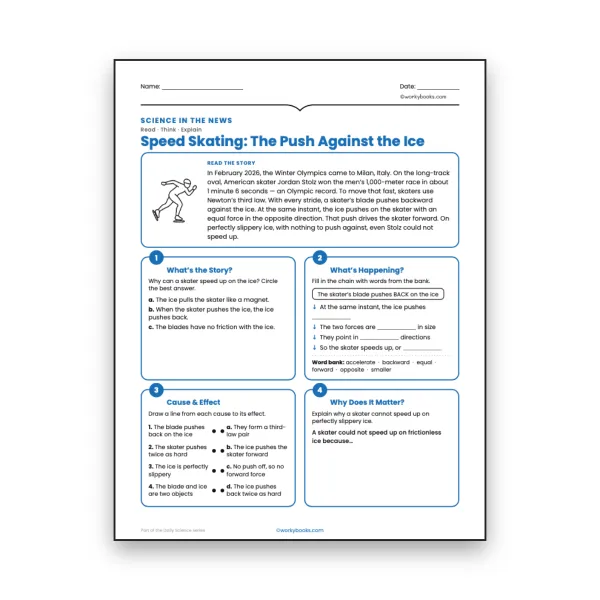
Interesting Fact: Newton’s Third Law is even at work when you walk—each step you take pushes the ground backward, and the ground pushes you forward with equal force!
Comprehension quiz (10 questions)
1. What does Newton’s Third Law state?
2. In a rocket launch, what is the action force?
3. Which diagram do scientists use to show the size and direction of forces?
4. What happens when a bird pushes air downward with its wings?
5. According to the passage, why does the Earth barely move when you jump?
6. What does the formula F = ma describe?
7. Which is an example of an action-reaction pair?
8. Why can a rocket lift off even though it is very heavy?
9. True or False: Action and reaction forces act on the same object.
10. True or False: When you walk, you push the ground backward and the ground pushes you forward.
Perfect for the way you teach
- Build comprehension skills
- Auto-graded quiz
- Differentiated reading
- Read together at home
- Improve fluency
- Quiet reading time
- Reading curriculum support
- Independent practice
- Track Lexile growth