What Is Net Force
Interactive passage with audio narration, comprehension questions, and printable PDF.
By completing this purchase you agree to our Terms of Use and Privacy Policy. Your subscription renews automatically until you cancel. You can cancel anytime from your account settings. All sales are final and non-refundable. Digital content is available for download in your account immediately upon purchase.
What's included
What Is Net Force preview and details
About this printable What Is Net Force science reading passage, NGSS-aligned (Grades 5-8)
Sample passage and quiz from What Is Net Force
Reading passage and comprehension quiz preview
Net Force
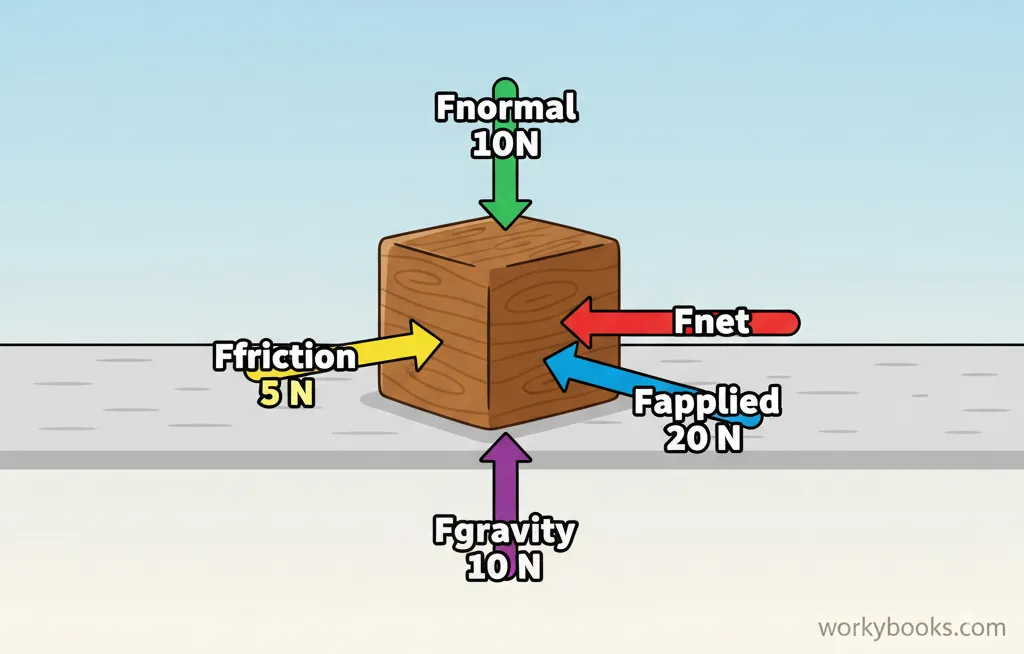
Net force is the main factor that determines how an object moves when more than one force acts on it. In physical science, understanding how multiple forces combine is essential for explaining motion. When objects experience pushes or pulls from different directions, the way these forces add or oppose each other can change the object’s speed or direction. The total, or net, force acting on an object is not always just a simple sum; it depends on both the size and direction of each individual force. This concept helps scientists and engineers predict how objects will behave in real-world situations.
How Forces Combine: The Mechanism of Net Force
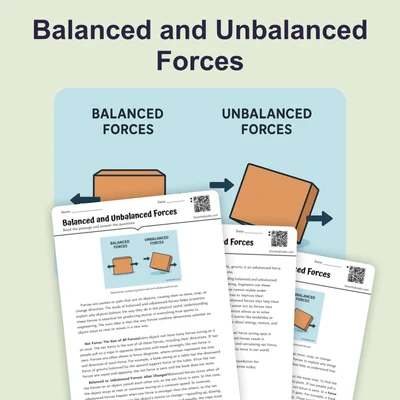
When two or more forces act on an object, they can work together or against each other. If the forces act in the same direction, you add their strengths to find the net force. For example, if two people push a box to the right with 10 newtons (N) and 5 N, the net force is 15 N to the right. However, if the forces act in opposite directions, you subtract the smaller force from the larger one. If one person pushes a box right with 10 N and another pushes left with 4 N, the net force is 6 N to the right. The object will move in the direction of the greater force, showing a direct relationship between net force and motion. Scientists use force diagrams to visualize these situations, using arrows (called vectors) to show both size and direction.
Forces at Angles and Real-World Applications
Sometimes forces act at angles rather than directly in line. In these cases, the net force is found using more advanced methods, but the basic principle remains the same: direction and magnitude must be considered. A common example is a parachute slowing a skydiver. Gravity pulls the skydiver down while air resistance from the parachute pushes upward. If these forces are equal in size but opposite in direction, the net force is zero, and the skydiver falls at a constant speed called terminal velocity. If the upward force is less than gravity, the net force is downward, and the skydiver still accelerates, but more slowly. Engineers and scientists often use calculations of net force to design safe vehicles, sports equipment, and even amusement park rides.
Complexity and Broader Scientific Principles
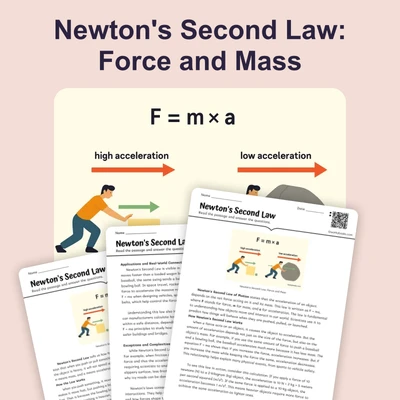
Not all situations are simple. Multiple forces can act at different angles or change over time. In some cases, friction, gravity, and applied forces all interact, making calculations more complex. However, the guiding principle is always the same: the net force determines the change in motion, according to Newton’s Second Law of motion. This law states that the acceleration of an object depends on the net force acting on it and the object’s mass. Understanding net force helps explain phenomena from launching rockets to everyday tasks like riding a bike or opening a door.
Net force is a vital concept for predicting and controlling motion in our world. By analyzing forces and their directions, scientists and engineers can design safer, more efficient systems. Learning to calculate and understand net force builds a strong foundation for further study in physics and engineering.
Interesting Fact: The largest net force ever measured in a laboratory experiment was created in a particle accelerator, where subatomic particles are sped up close to the speed of light!
Comprehension quiz (10 questions)
1. What does 'net force' determine about an object?
2. Which of the following is true when two forces act in the same direction?
3. What is a force diagram used for according to the passage?
4. What happens if the upward force from a parachute is equal to gravity?
5. What does 'vector' mean in the context of the passage?
6. Which word best describes 'terminal velocity' as used in the passage?
7. Why do scientists and engineers use calculations of net force?
8. What law explains the relationship between net force, mass, and acceleration?
9. True or False: If two forces of equal size act in opposite directions, the net force is zero.
10. True or False: Net force can be calculated only when forces are in the same direction.
Perfect for the way you teach
- Build comprehension skills
- Auto-graded quiz
- Differentiated reading
- Read together at home
- Improve fluency
- Quiet reading time
- Reading curriculum support
- Independent practice
- Track Lexile growth