Types of Forces
Interactive passage with audio narration, comprehension questions, and printable PDF.
By completing this purchase you agree to our Terms of Use and Privacy Policy. Your subscription renews automatically until you cancel. You can cancel anytime from your account settings. All sales are final and non-refundable. Digital content is available for download in your account immediately upon purchase.
What's included
Types of Forces preview and details
About this printable Types of Forces science reading passage, NGSS-aligned (Grades 5-8)
Sample passage and quiz from Types of Forces
Reading passage and comprehension quiz preview
Types of Forces
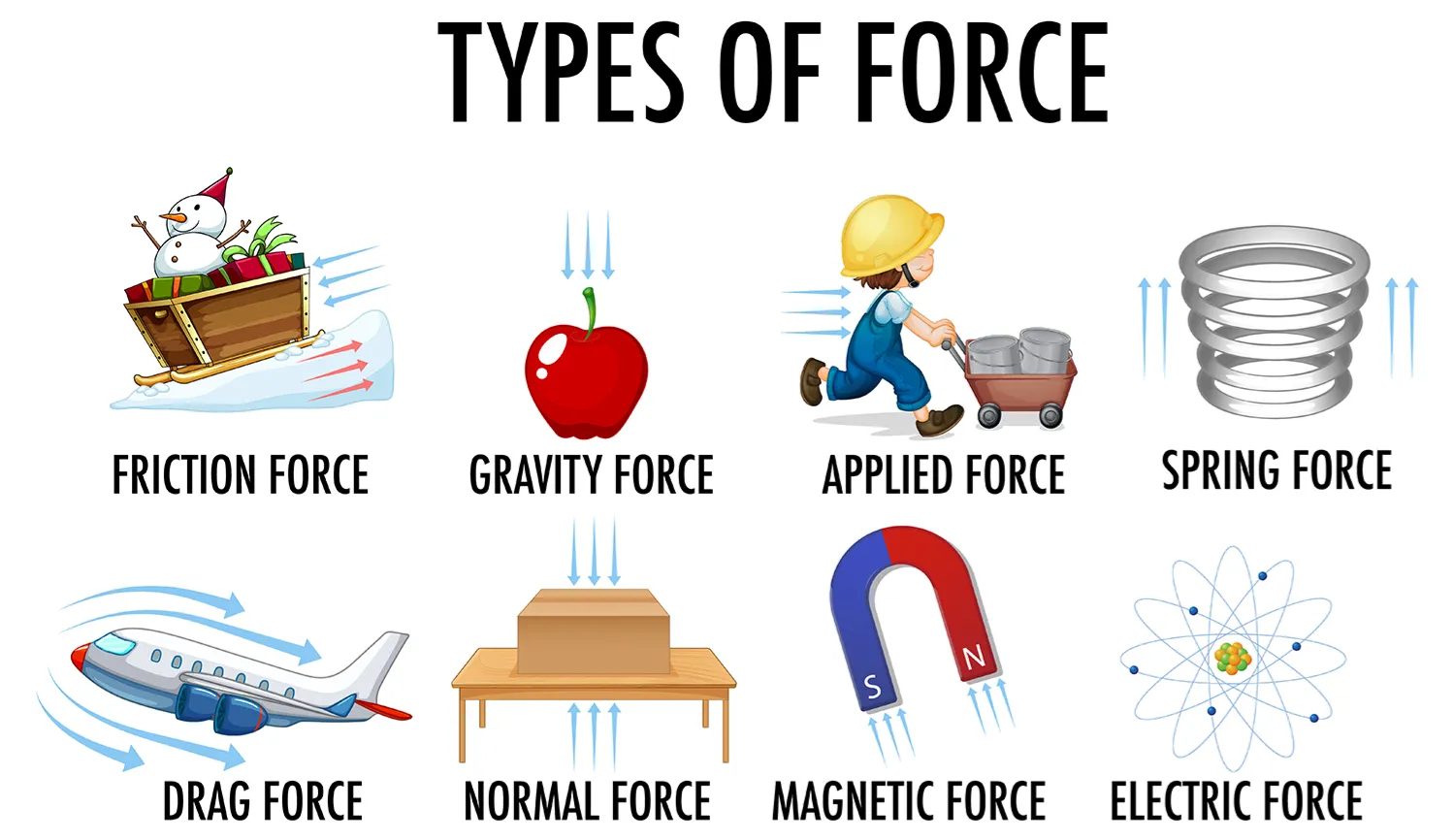
Forces shape the motion and behavior of everything in the physical world, from a soccer ball rolling across a field to the planets orbiting the Sun. Understanding the different types of forces is essential for explaining everyday events and for developing new technologies. Forces can act through direct contact or at a distance, producing changes in motion, direction, or shape. Scientists study forces to uncover the mechanisms that govern the universe, and their discoveries have led to important advances in engineering, transportation, and safety.
Mechanisms of Contact Forces
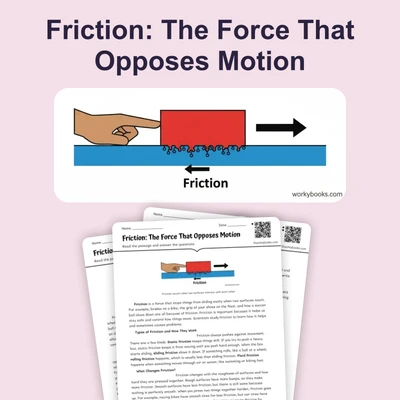
Contact forces require objects to touch in order to interact. One of the most common is the applied force, such as when you push a door open. When you slide a book across a table, friction acts in the opposite direction of the book’s motion, slowing it down. Normal force is the support force from a surface, like the table pushing up on the book. Tension occurs when a rope or cable is pulled tight, as when holding up a hanging swing. Spring force is exerted by stretched or compressed springs, returning them to their original shape. Air resistance is a type of friction that objects experience as they move through the air, which is why a parachute slows a skydiver’s fall. Each of these contact forces involves physical interaction between objects and often depends on the materials involved, the surfaces’ roughness, or how hard the objects are pressed together.
Field (Non-Contact) Forces and Interactions
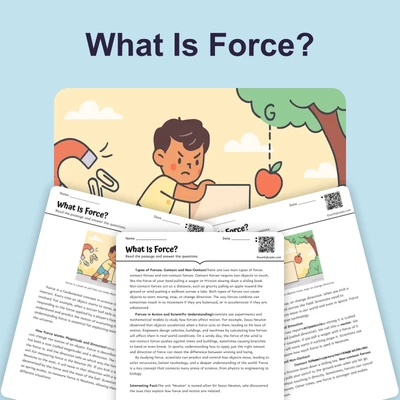
Some forces act even when objects are not touching. These are called non-contact forces or field forces. The most familiar is gravitational force, which pulls objects toward each other. For example, gravity keeps us on the ground and causes an apple to fall from a tree at about 9.8 meters per second squared on Earth. Magnetic force is another field force, attracting or repelling magnets and magnetic materials even at a distance. Electrostatic force causes objects with electric charge to attract or repel each other, like when a balloon sticks to a wall after being rubbed. Scientists use sensitive instruments to measure and study these invisible forces, which play critical roles in natural and technological systems.
Interactions and Applications of Forces
In real-world systems, multiple forces often act at once. When riding a bicycle, applied force from pedaling, friction from the tires, air resistance, and gravity all combine to determine your speed and direction. Engineers must consider these interacting forces when designing bridges, vehicles, and safety equipment. For example, car brakes use friction to slow down, while seatbelts use tension to keep passengers secure during sudden stops. By analyzing the balance and direction of forces, scientists can predict and control motion, contributing to safer structures and efficient machines.
Understanding the types of forces and their interactions is fundamental to physics and to solving real-world problems. As we explore more complex systems, this knowledge helps us innovate and adapt to new challenges, from launching spacecraft to building earthquake-resistant buildings.
Interesting Fact:
The largest recorded tension force on a cable was over 300,000 Newtons—the amount needed to support an entire suspension bridge!
Comprehension quiz (10 questions)
1. What is a force?
2. Which of the following is an example of a contact force?
3. What does the term 'air resistance' mean as used in the passage?
4. In the passage, what is the best definition of 'tension'?
5. Why is gravity considered a non-contact force?
6. Which set of forces would act together when a person rides a bicycle?
7. What is the purpose of a normal force?
8. Which is true about all contact forces?
9. Friction can slow down moving objects. (True/False)
10. Magnetic force is a contact force. (True/False)
Perfect for the way you teach
- Build comprehension skills
- Auto-graded quiz
- Differentiated reading
- Read together at home
- Improve fluency
- Quiet reading time
- Reading curriculum support
- Independent practice
- Track Lexile growth