Newton's Second Law
Interactive passage with audio narration, comprehension questions, and printable PDF.
By completing this purchase you agree to our Terms of Use and Privacy Policy. Your subscription renews automatically until you cancel. You can cancel anytime from your account settings. All sales are final and non-refundable. Digital content is available for download in your account immediately upon purchase.
What's included
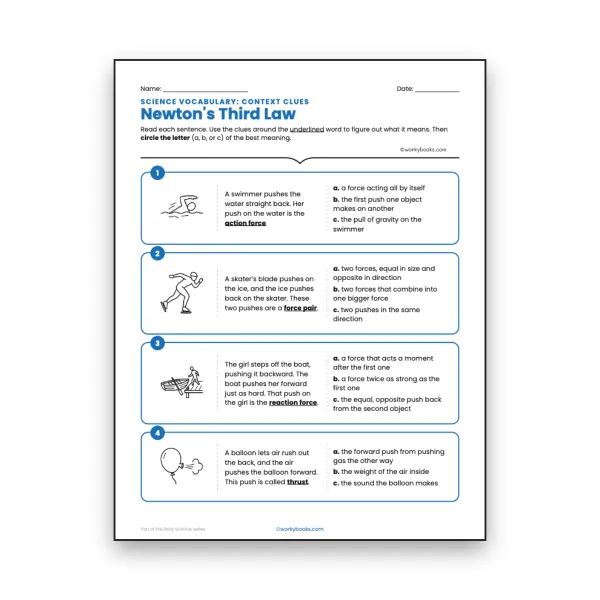
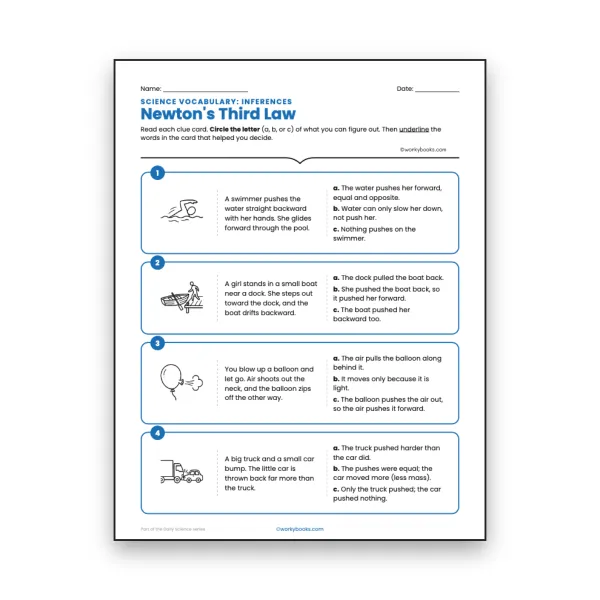
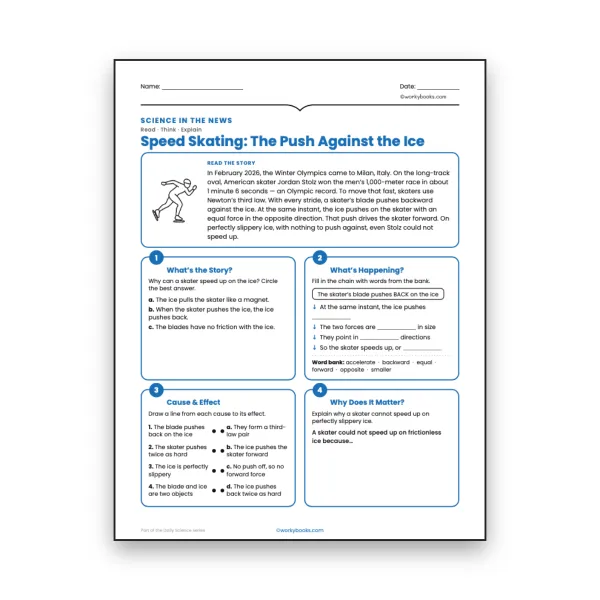
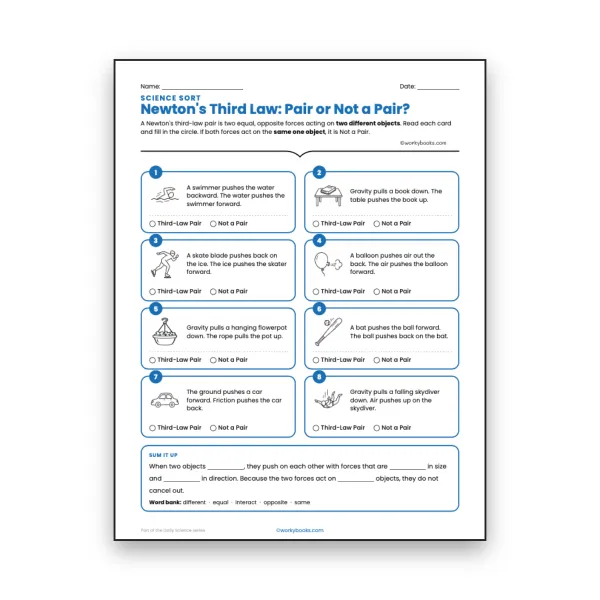
Newton's Second Law preview and details
About this printable Newton's Second Law science reading passage, NGSS-aligned (Grades 5-8)
Sample passage and quiz from Newton's Second Law
Reading passage and comprehension quiz preview
Newton's Second Law
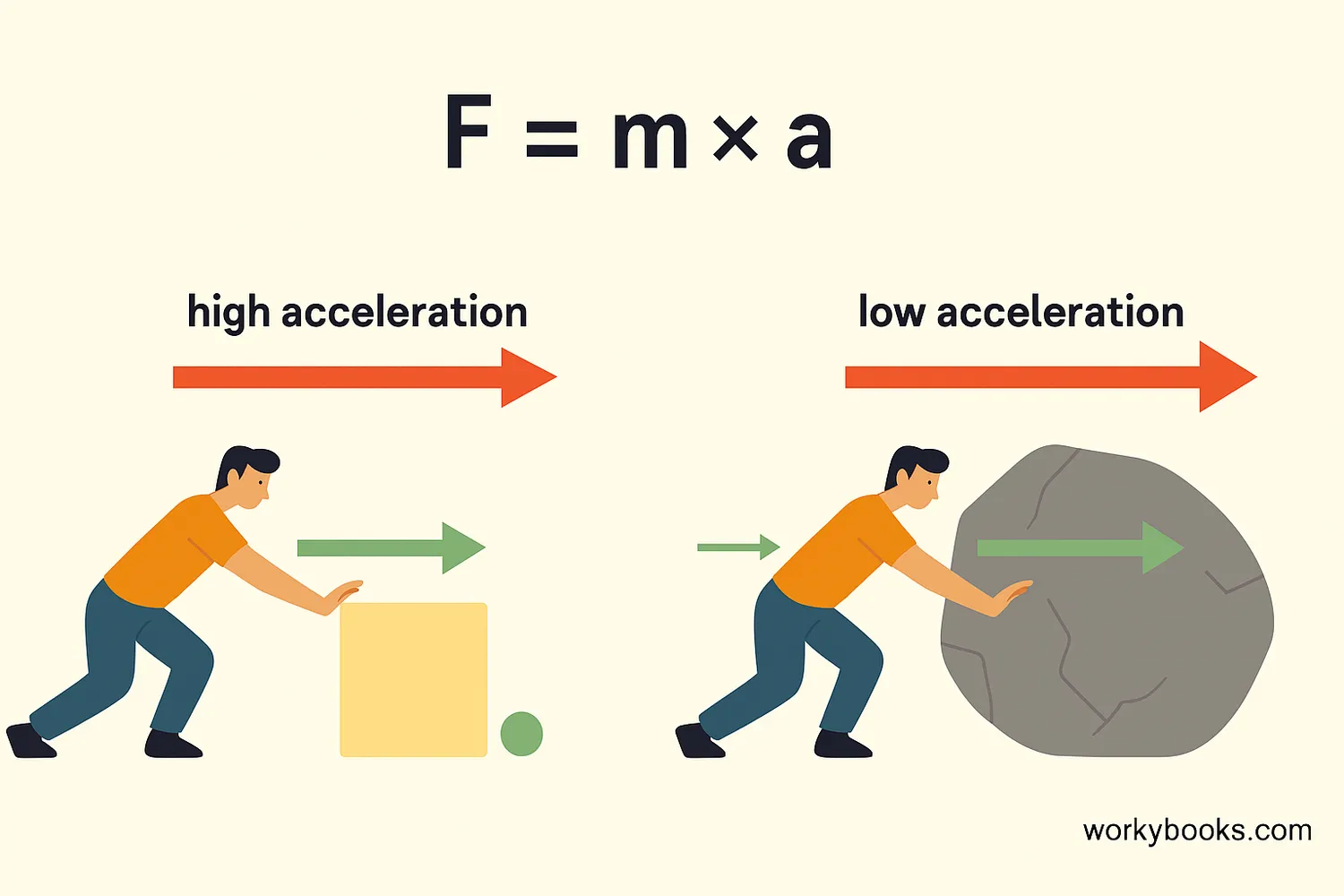
Newton's Second Law of Motion states that the acceleration of an object depends on the net force acting on it and its mass. This law is written as F = ma, where F stands for force, m for mass, and a for acceleration. The law is fundamental to understanding how objects move and interact in our world. Scientists use it to predict how things will behave when they are pushed, pulled, or launched.
How Newton's Second Law Works
When a force acts on an object, it causes the object to accelerate. But the amount of acceleration depends not just on the size of the force, but also on the object's mass. For example, if you use the same amount of force to push a baseball and a bowling ball, the baseball accelerates much more because it has less mass. The equation F = ma shows that if you increase the force, acceleration increases. But if you increase the mass while keeping the force the same, acceleration decreases. This relationship helps explain many physical events, from sports to vehicle safety.
To see this law in action, consider this calculation: If you apply a force of 10 newtons (N) to a 2-kilogram (kg) object, the acceleration is 10 N ÷ 2 kg = 5 meters per second squared (m/s²). If the same force is applied to a 10-kg object, the acceleration becomes 1 m/s². This means heavier objects require more force to achieve the same acceleration as lighter ones.
Applications and Real-World Connections
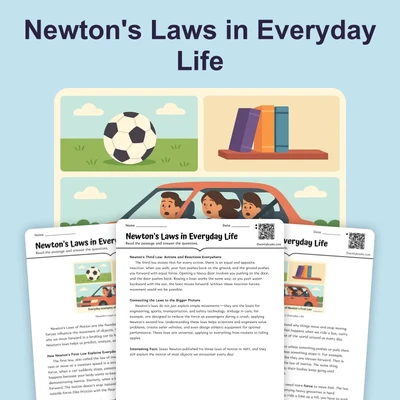
Newton's Second Law is visible in everyday life. When you push an empty wagon, it moves faster than a loaded wagon because the loaded wagon has more mass. In baseball, the same swing sends a baseball flying, but barely moves a much heavier bowling ball. In space travel, rockets rely on the law: the engines provide a large force to accelerate the massive rocket and overcome Earth's gravity. Engineers use F = ma when designing vehicles, sports equipment, and safety features like seat belts, which help control the forces on passengers during sudden stops or collisions.
Understanding this law also improves our ability to solve problems. For example, car manufacturers calculate how much force is needed to stop a moving vehicle within a safe distance, depending on its mass and speed. Environmental scientists use F = ma principles to study how wind or water can move objects, helping to design safer buildings and bridges.
Exceptions and Complexities
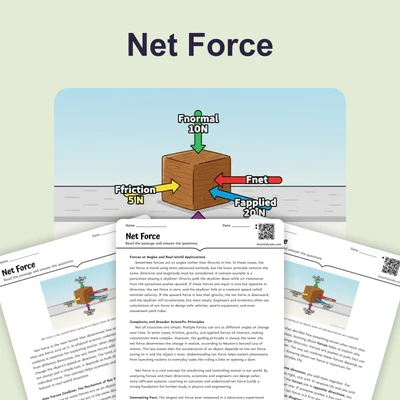
While Newton's Second Law explains most everyday motion, there are exceptions. For example, when friction or air resistance is significant, it can change the net force and thus the acceleration. In some cases, forces act in different directions, requiring scientists to analyze each one before calculating the net force. On a slippery surface, less friction means less force is needed for acceleration, which is why icy roads can be dangerous.
Newton’s laws connect to broader scientific ideas about systems and interactions. They help us understand how energy is transferred, why machines work, and how forces shape the universe. Newton’s Second Law remains a foundation of physics and engineering, shaping technology and safety in our lives.
Interesting Fact:
NASA engineers use Newton’s Second Law to calculate exactly how much fuel is needed to launch a spacecraft into orbit!
Comprehension quiz (10 questions)
1. What is the formula for Newton's Second Law of Motion?
2. According to Newton's Second Law, what happens to acceleration if mass increases but force stays the same?
3. What is the unit of force in the metric system?
4. Which of the following best defines 'net force' as used in the passage?
5. If you push a 2-kg object with 10 N of force, what is its acceleration?
6. According to the passage, what happens when you push an empty wagon compared to a loaded wagon with the same force?
7. The word 'engineer' in this passage refers to:
8. Why do rockets need a large force to leave Earth, according to the passage?
9. True or False: More mass always means more acceleration if the force stays the same.
10. True or False: Friction can change the net force and affect acceleration.
Perfect for the way you teach
- Build comprehension skills
- Auto-graded quiz
- Differentiated reading
- Read together at home
- Improve fluency
- Quiet reading time
- Reading curriculum support
- Independent practice
- Track Lexile growth