Friction
Interactive passage with audio narration, comprehension questions, and printable PDF.
By completing this purchase you agree to our Terms of Use and Privacy Policy. Your subscription renews automatically until you cancel. You can cancel anytime from your account settings. All sales are final and non-refundable. Digital content is available for download in your account immediately upon purchase.
What's included
Friction preview and details
About this printable Friction science reading passage, NGSS-aligned (Grades 5-8)
Sample passage and quiz from Friction
Reading passage and comprehension quiz preview
Friction: The Force That Opposes Motion
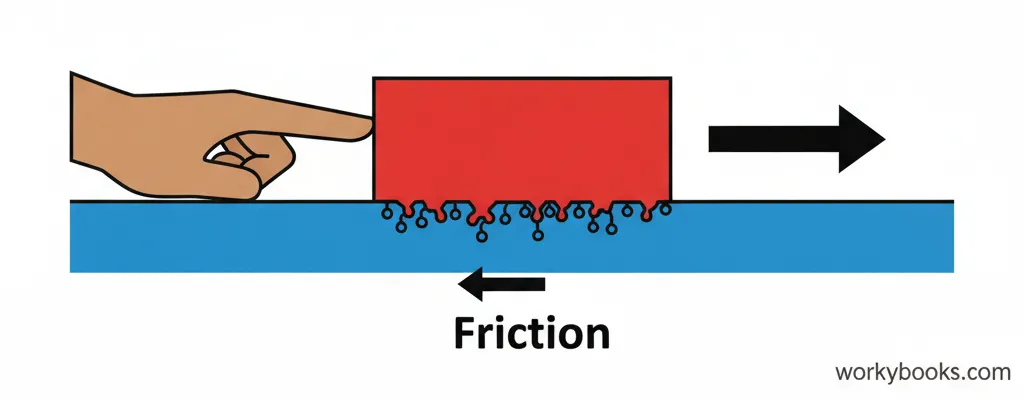
Friction is a fundamental force that resists movement when two surfaces touch. Whether it is the brakes on a bicycle, your shoes gripping the sidewalk, or a soccer ball rolling to a stop, friction plays a critical role in our daily lives. Friction is not just an obstacle; it is an essential part of how systems work, balancing the forces that allow us to move, stop, or control objects. Scientists have studied friction for centuries to understand its causes, effects, and practical uses.
How Friction Works: Types and Mechanisms
Friction always acts in the direction opposite to motion or attempted motion. There are several types of friction, each with unique characteristics. Static friction prevents an object from starting to move. For example, when you try to push a heavy box, static friction keeps it in place until you apply enough force. Once the box starts moving, sliding friction takes over, resisting the motion as the box slides. When objects roll, such as a skateboard or a car tire, rolling friction is at work, usually less than sliding friction. Finally, fluid friction, also called drag or air resistance, happens when objects move through liquids or gases, like a swimmer moving through water or a plane flying through the air.
Factors Affecting Friction: Surfaces and Forces
The amount of friction depends on two main factors: surface roughness and the force pressing the surfaces together. Rough surfaces have more microscopic bumps, which increases friction by catching and resisting movement. Smoother surfaces create less friction, but even polished materials have tiny irregularities that interact. The harder two surfaces are pushed together, the more their microscopic high points interlock, increasing friction. For example, racing bicycles use smooth tires to reduce friction, while car tires have treads to increase friction for safety. Scientists can measure friction by comparing how much force is needed to move objects on different surfaces.
Friction in Everyday Life: Helpful and Problematic
Friction is both beneficial and problematic. It allows us to walk without slipping, cars to brake, and pencils to write on paper. Sports like curling or bowling depend on controlling friction for better performance. However, friction can also cause problems. It wears down machine parts, wastes energy as heat, and makes it harder to move heavy objects. Engineers design lubricants and smooth materials to reduce unwanted friction, while increasing friction where it is needed for safety or efficiency. This balance is essential in technology, transportation, and even environmental protection.
Understanding friction has led to innovations in material science, engineering, and safety. The principles of friction are connected to Newton’s laws of motion, which explain how forces interact to produce movement and stability. As technology advances, scientists continue to investigate new ways to control friction, benefiting society in countless ways.
Interesting Fact:
About 20% of the fuel energy in a typical car is lost as heat due to friction in the engine and moving parts.
Comprehension quiz (10 questions)
1. What is friction?
2. Which of the following is an example of static friction?
3. What type of friction is usually less than sliding friction?
4. Which factor increases friction between two surfaces?
5. What is another name for fluid friction?
6. Why do racing bicycles use smooth tires?
7. What is one problem caused by friction according to the passage?
8. True or False: Friction is always bad and should be reduced as much as possible.
9. True or False: Fluid friction only happens in water, not in air.
10. What law connects the principles of friction to movement and stability?
Perfect for the way you teach
- Build comprehension skills
- Auto-graded quiz
- Differentiated reading
- Read together at home
- Improve fluency
- Quiet reading time
- Reading curriculum support
- Independent practice
- Track Lexile growth