Newton's Laws in Everyday Life — Reading Comprehension
Rate this
Premium Resource
Present
Present in classroom. No work saved
Assign
Classroom with student accounts, Track progress
Quick Play
No student accounts, assign with a link
Grades
5
6
7
8
Standards
MS-PS2-1
MS-PS2-2
PRINT+DIGITAL RESOURCE
This learning resource is available in interactive and printable formats. The interactive worksheet can be played online and assigned to students. The Printable PDF version can be downloaded and printed for completion by hand.
This comprehensive reading passage introduces middle school students to Newton's three laws of motion using relatable, everyday situations. Aligned with NGSS standards MS-PS2-1 and MS-PS2-2, it provides in-depth, mechanistic explanations of inertia, acceleration, and action-reaction forces, connecting them to real-world experiences like riding in cars, carrying groceries, and walking. The passage includes a differentiated version for struggling readers, a full Spanish translation, a glossary of key terms, multiple-choice comprehension questions, writing prompts, and graphic organizers designed for grades 6-8. Audio integration supports diverse learners. This resource helps students understand the causes and effects of motion and prepares them to analyze scientific phenomena in daily life.
CONTENT PREVIEW
Expand content preview
Newton's Laws in Everyday Life
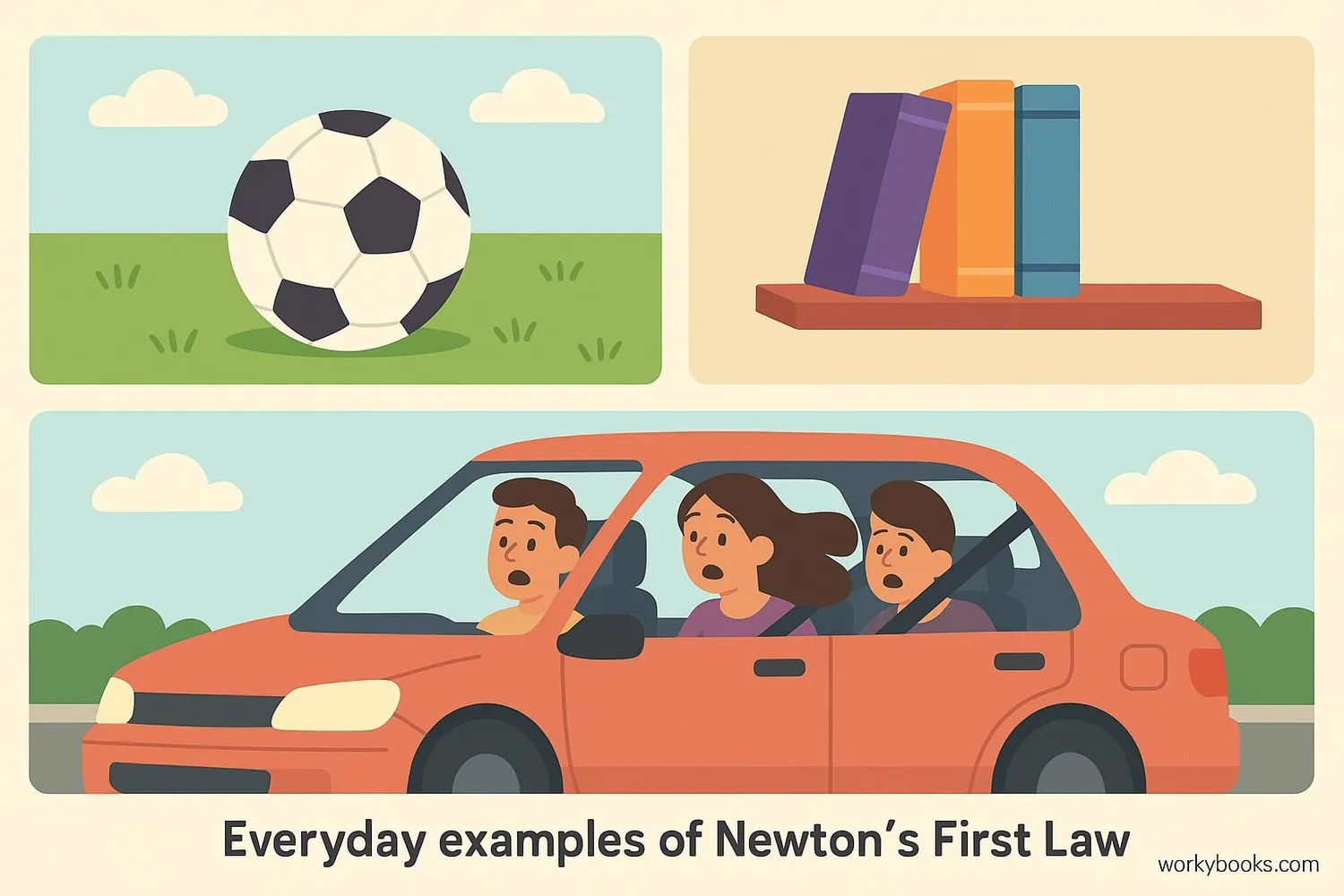
Newton's Laws of Motion are the foundation of classical physics, describing how forces influence the movement of objects. These laws explain everyday actions, from why we move forward in a braking car to how we walk or row a boat. Understanding Newton's laws helps us predict, analyze, and explain the physical world around us.
How Newton's First Law Explains Everyday Motion
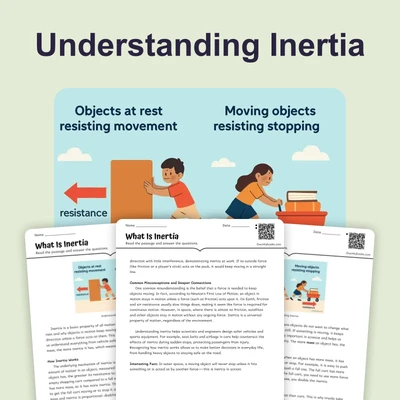
The first law, also called the law of inertia, states that an object will remain at rest or move at a constant speed in a straight line unless acted on by an unbalanced force. When a car suddenly stops, passengers feel like they’re thrown forward. This happens because your body wants to keep moving at the same speed as the car—demonstrating inertia. Similarly, when a bus stops quickly, people often stumble forward. The motion doesn’t stop instantly for their bodies, but the bus does, so an outside force (like friction with the floor or grabbing a pole) is needed to stop them.
Newton's Second Law: Force, Mass, and Acceleration in Daily Life
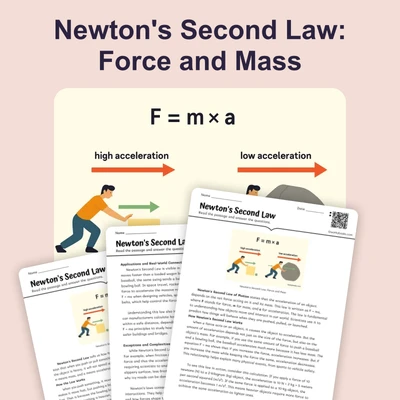
The second law states that the acceleration of an object depends on its mass and the net force applied. This is expressed mathematically as F = m × a (force equals mass times acceleration). For example, carrying heavy grocery bags is harder than carrying light ones because heavier objects require more force to accelerate. When biking uphill, you pedal harder to increase the force, since gravity slows you down. The more massive the object or the greater the acceleration needed, the more force must be applied.
Newton's Third Law: Actions and Reactions Everywhere
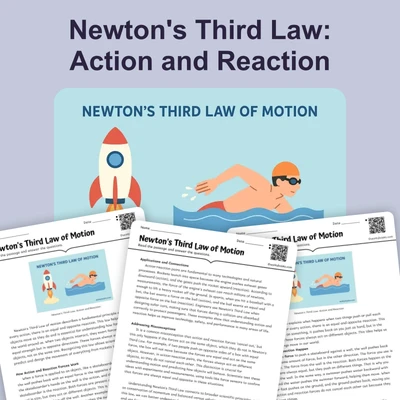
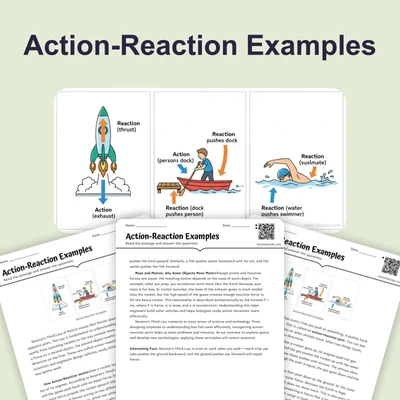
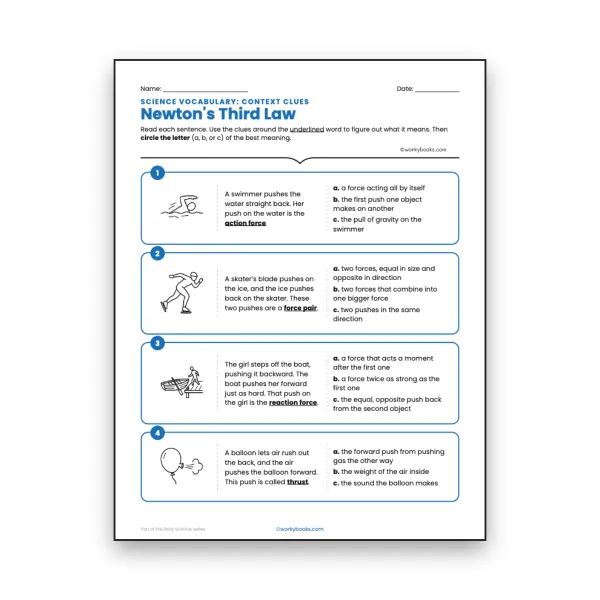
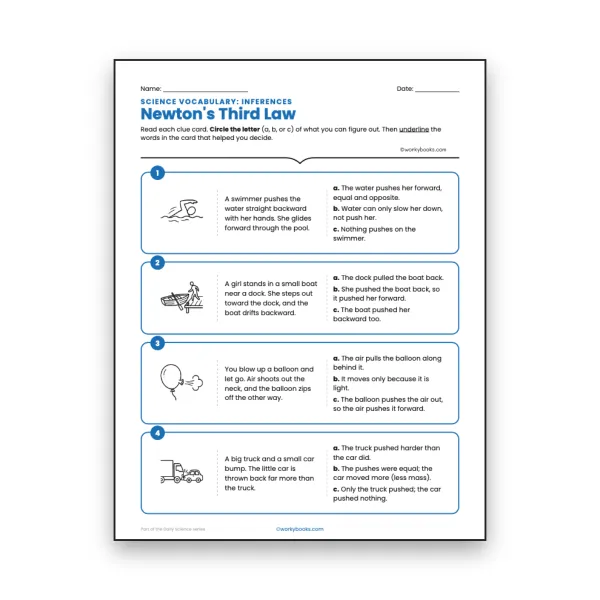
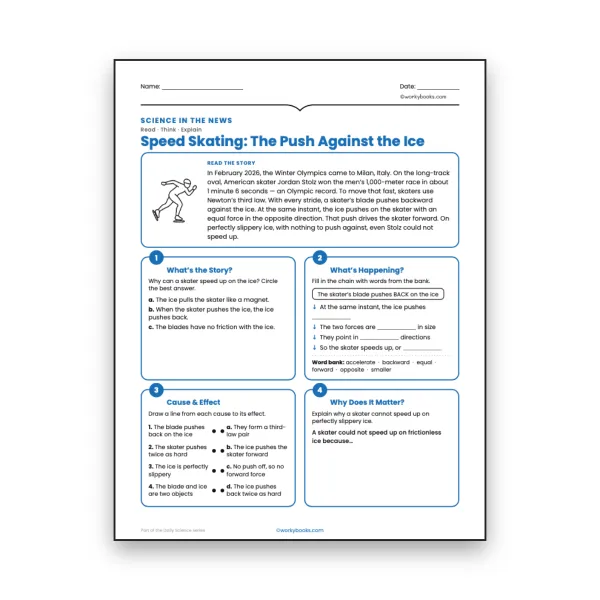
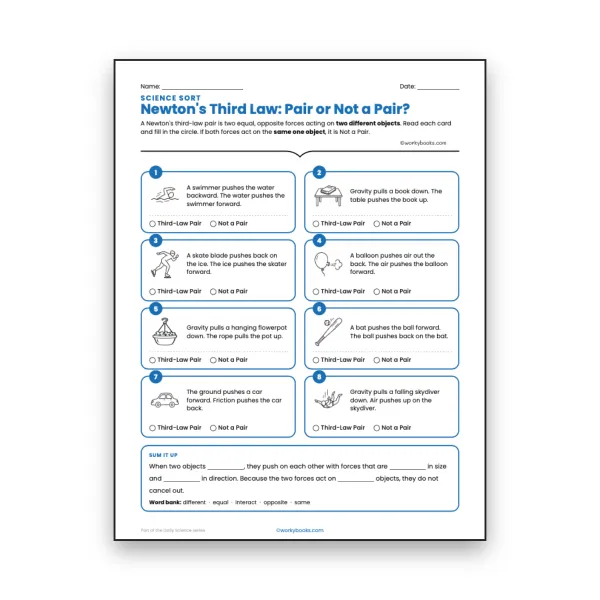
The third law states that for every action, there is an equal and opposite reaction. When you walk, your foot pushes back on the ground, and the ground pushes you forward with equal force. Opening a heavy door involves you pushing on the door, and the door pushes back. Rowing a boat works the same way: as you push water backward with the oar, the boat moves forward. Without these reaction forces, movement would not be possible.
Connecting the Laws to the Bigger Picture
Newton’s laws do not just explain simple movements—they are the basis for engineering, sports, transportation, and safety technology. Airbags in cars, for example, are designed to reduce the force on passengers during a crash, applying Newton’s second law. Understanding these laws helps scientists and engineers solve problems, create safer vehicles, and even design athletic equipment for optimal performance. These laws are universal, applying to everything from rockets to falling apples.
Interesting Fact: Isaac Newton published his three laws of motion in 1687, and they still explain the motion of most objects we encounter every day!
What is Newton's First Law also called?
The law of inertiaThe law of gravityThe law of action-reactionThe law of energy
According to Newton's Second Law, what does force equal?
Mass divided by accelerationMass plus accelerationMass times accelerationAcceleration minus mass
What happens to your body when a bus stops quickly?
Your body moves backwardYour body moves forwardYou remain stillYou jump up
Why is it harder to carry heavy grocery bags compared to light ones?
Heavy bags are largerHeavy bags need more force to moveLight bags have more frictionHeavy bags are slippery
In the context of the passage, what does 'inertia' mean?
The tendency to change direction quicklyThe tendency to resist a change in motionThe force that pushes objectsThe speed of an object
What is meant by 'action and reaction' as explained in the passage?
All actions are the sameEvery force has an equal and opposite forceReactions are always weaker than actionsAction and reaction only apply to walking
Which of Newton's laws explains why we push harder when biking uphill?
First lawSecond lawThird lawLaw of gravity
What real-world technology uses Newton’s Second Law to protect people?
Airbags in carsStreetlightsTelevisionsRefrigerators
True or False: Newton’s Laws only apply to scientists, not to everyday life.
TrueFalse
True or False: Without reaction forces, movement would be impossible.
TrueFalse
Perfect For:
👩🏫 Teachers
• Reading comprehension practice
• Auto-graded assessments
• Literacy skill development
👨👩👧👦 Parents
• Reading practice at home
• Comprehension improvement
• Educational reading time
🏠 Homeschoolers
• Reading curriculum support
• Independent reading practice
• Progress monitoring
Reading Features:
📖
Reading Passage
Engaging fiction or nonfiction text
❓
Comprehension Quiz
Auto-graded questions
📊
Instant Feedback
Immediate results and scoring
📄
Printable Version
Download for offline reading
🔊
Read Aloud
Voice-over with word highlighting
Reviews & Ratings
No reviews yet. Be the first to share your experience!
Related Content
Friction
This NGSS-aligned passage for grades 6-8 covers the science of friction, the force that opposes motion between surfaces ...
MS-PS2-1
What Is Force?
This passage, aligned to NGSS standards MS-PS2-1 and MS-PS2-2, provides a clear and age-appropriate explanation of force...
MS-PS2-1MS-PS2-2
Newton's First Law
This middle school science passage introduces students to Newton's First Law of Motion, also called the Law of Inertia. ...
MS-PS2-1MS-PS2-2
Newton's Laws in Sports
This engaging science passage is designed for grades 6-8 and aligns with NGSS standards MS-PS2-1 and MS-PS2-2. It explor...
MS-PS2-1MS-PS2-2
Balanced and Unbalanced Forces
This informational science passage explores the core concepts of balanced and unbalanced forces as aligned with NGSS sta...
MS-PS2-1MS-PS2-2
Air Resistance
This engaging, NGSS-aligned informational passage explores the science of air resistance—also known as fluid friction th...
MS-PS2-1
Types of Forces
This comprehensive passage introduces middle school students to the types of forces that govern the motion of objects, a...
MS-PS2-1
Net Force
This comprehensive science reading passage for grades 6-8 explores the concept of net force, aligned with NGSS standard ...
MS-PS2-1
Understanding Inertia
This comprehensive science passage introduces middle school students to the concept of inertia, a key property of matter...
MS-PS2-1MS-PS2-2
Newton's Second Law
This comprehensive passage introduces middle school students to Newton's Second Law of Motion, focusing on the core rela...
MS-PS2-1MS-PS2-2
Newton's Third Law of Motion
This comprehensive science reading passage introduces middle school students to Newton's Third Law: for every action, th...
MS-PS2-1
Action-Reaction Examples
This comprehensive science passage, designed for grades 6-8 and aligned with NGSS MS-PS2-1, delves into Newton’s Third L...
MS-PS2-1
Isaac Newton
This middle school science reading passage introduces students to Isaac Newton, one of the most influential scientists i...
MS-PS2-2
Reference Points
This passage for grades 6-8 explores the critical role of reference points in measuring and describing motion, aligning ...
MS-PS2-2
Distance vs. Displacement
This informational science passage for grades 6-8 explores the key differences between distance and displacement, aligni...
MS-PS2-2
Speed
This comprehensive science passage for grades 6-8 introduces students to the concept of speed, aligned with NGSS standar...
MS-PS2-2
Velocity
This middle school science passage explores the concept of velocity as a vector quantity, meaning it includes both speed...
MS-PS2-2
Acceleration
This comprehensive passage introduces middle school students to the concept of acceleration, aligned with NGSS standard ...
MS-PS2-2
Graphing Motion
This passage introduces middle school students to the fundamental concepts of graphing motion, focusing on distance-time...