This learning resource is available in interactive and printable formats. The interactive worksheet can be played online and assigned to students. The Printable PDF version can be downloaded and printed for completion by hand.
This comprehensive science passage introduces middle school students to the concept of inertia, a key property of matter that determines how objects resist changes in their motion. Aligned with NGSS standards MS-PS2-1 and MS-PS2-2, the passage explains the relationship between mass and inertia, providing clear examples such as pushing empty and full shopping carts, stopping large trucks, and the movement of hockey pucks on ice. The text addresses common misconceptions, such as the belief that force is needed to keep objects moving, and offers real-world applications, including vehicle safety and sports. Glossary terms, a Spanish translation, a differentiated version for struggling readers, a multiple-choice quiz, writing prompts, and graphic organizers support diverse learners. The passage features academic vocabulary, accessible explanations, and is integrated with audio for enhanced learning. Ideal for grades 6-8 science classrooms.
CONTENT PREVIEW
Expand content preview
Understanding Inertia
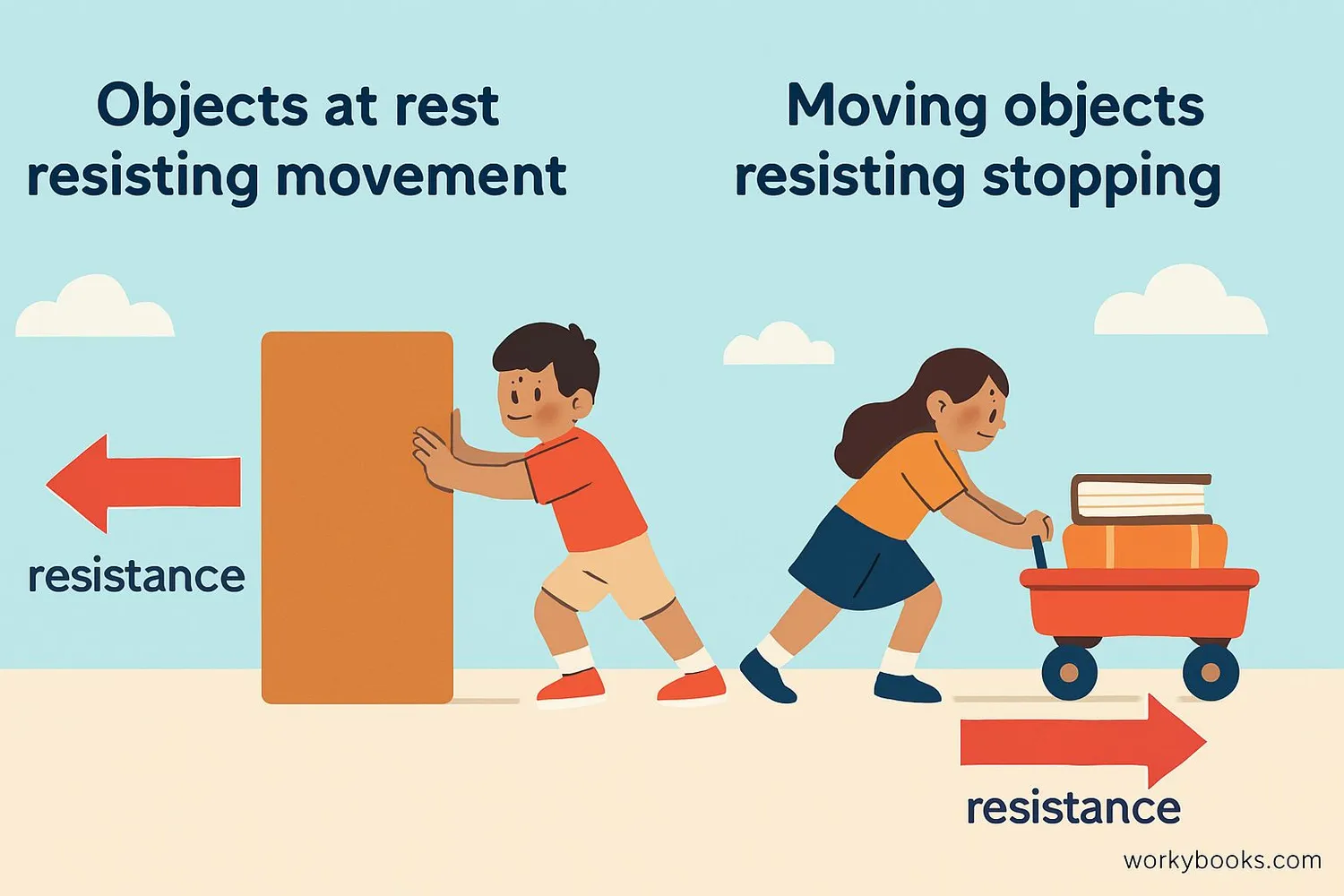
Inertia is a basic property of all matter. It explains why objects at rest stay at rest and why objects in motion keep moving at the same speed and in the same direction unless a force acts on them. This concept is essential in physics and helps us understand everything from vehicle safety to sports. The greater an object's mass, the more inertia it has, which means it is harder to start or stop its motion.
How Inertia Works
The underlying mechanism of inertia is connected directly to mass. Mass is the amount of matter in an object, measured in kilograms or grams. The more mass an object has, the greater its resistance to changes in motion. For example, pushing an empty shopping cart compared to a full one involves much less effort. The full cart has more mass, so it has more inertia. This means you need to apply a greater force to get the full cart moving or to stop it once it is rolling. The relationship between mass and inertia is proportional: doubling the mass of an object doubles its inertia.
Real-World Applications and Examples
Inertia is not just a classroom concept; it affects us every day. Large vehicles, like trucks, have much more mass than small cars. When a truck is moving, its inertia makes it much harder to stop, which is why trucks need longer distances to come to a complete stop compared to cars. This is a key reason for speed limits and safe stopping distances on highways. Another example is a hockey puck sliding across the ice. The smooth, low-friction surface allows the puck to maintain its speed and direction with little interference, demonstrating inertia at work. If no outside force (like friction or a player’s stick) acts on the puck, it would keep moving in a straight line.
Common Misconceptions and Deeper Connections
One common misunderstanding is the belief that a force is needed to keep objects moving. In fact, according to Newton's First Law of Motion, an object in motion stays in motion unless a force (such as friction) acts upon it. On Earth, friction and air resistance usually slow things down, making it seem like force is required for continuous motion. However, in space, where there is almost no friction, satellites and other objects stay in motion without any ongoing force. Inertia is a universal property of matter, regardless of the environment.
Understanding inertia helps scientists and engineers design safer vehicles and sports equipment. For example, seat belts and airbags in cars help counteract the effects of inertia during sudden stops, protecting passengers from injury. Recognizing how inertia works allows us to make better decisions in everyday life, from handling heavy objects to staying safe on the road.
Interesting Fact: In outer space, a moving object will never stop unless it hits something or is acted on by another force—this is inertia in action!
What is inertia?
The property of matter that resists changes in motion.A type of force that speeds up objects.The amount of energy in an object.A special material used in sports equipment.
How does mass affect inertia?
More mass means more inertia.Less mass means more inertia.Mass does not affect inertia.Inertia only depends on speed.
What is an example of inertia from the passage?
A truck needing more distance to stop than a car.A balloon floating upward.A light bulb turning on.Water freezing into ice.
Why does a hockey puck slide so easily on ice?
Because ice has little friction, so inertia keeps the puck moving.Because ice pushes the puck forward.Because the puck has no mass.Because air resistance is very strong.
What does the passage say about force and moving objects?
Objects can keep moving without a force if nothing stops them.A force must always keep objects moving.Friction is not important in motion.Objects stop moving because they run out of energy.
What does 'proportional' mean in the passage?
When one thing increases, the other increases at the same rate.Something that never changes.A type of force.A measure of energy.
According to Newton's First Law, what happens if no force acts on a moving object?
It will keep moving in the same direction and speed.It will stop immediately.It will change direction randomly.It will double its speed.
Why are seat belts and airbags important, according to the passage?
They help protect passengers from the effects of inertia during sudden stops.They make cars go faster.They reduce the mass of a car.They increase the friction in the car.
True or False: Inertia only happens on Earth.
TrueFalse
True or False: A full shopping cart has more inertia than an empty one.
TrueFalse
Perfect For:
👩🏫 Teachers
• Reading comprehension practice
• Auto-graded assessments
• Literacy skill development
👨👩👧👦 Parents
• Reading practice at home
• Comprehension improvement
• Educational reading time
🏠 Homeschoolers
• Reading curriculum support
• Independent reading practice
• Progress monitoring
Reading Features:
📖
Reading Passage
Engaging fiction or nonfiction text
❓
Comprehension Quiz
Auto-graded questions
📊
Instant Feedback
Immediate results and scoring
📄
Printable Version
Download for offline reading
🔊
Read Aloud
Voice-over with word highlighting
Reviews & Ratings
No reviews yet. Be the first to share your experience!
Related Content
Friction
This NGSS-aligned passage for grades 6-8 covers the science of friction, the force that opposes motion between surfaces ...
MS-PS2-1
What Is Force?
This passage, aligned to NGSS standards MS-PS2-1 and MS-PS2-2, provides a clear and age-appropriate explanation of force...
MS-PS2-1MS-PS2-2
Newton's First Law
This middle school science passage introduces students to Newton's First Law of Motion, also called the Law of Inertia. ...
MS-PS2-1MS-PS2-2
Newton's Laws in Sports
This engaging science passage is designed for grades 6-8 and aligns with NGSS standards MS-PS2-1 and MS-PS2-2. It explor...
MS-PS2-1MS-PS2-2
Balanced and Unbalanced Forces
This informational science passage explores the core concepts of balanced and unbalanced forces as aligned with NGSS sta...
MS-PS2-1MS-PS2-2
Air Resistance
This engaging, NGSS-aligned informational passage explores the science of air resistance—also known as fluid friction th...
MS-PS2-1
Types of Forces
This comprehensive passage introduces middle school students to the types of forces that govern the motion of objects, a...
MS-PS2-1
Net Force
This comprehensive science reading passage for grades 6-8 explores the concept of net force, aligned with NGSS standard ...
MS-PS2-1
Newton's Second Law
This comprehensive passage introduces middle school students to Newton's Second Law of Motion, focusing on the core rela...
MS-PS2-1MS-PS2-2
Newton's Third Law of Motion
This comprehensive science reading passage introduces middle school students to Newton's Third Law: for every action, th...
MS-PS2-1
Action-Reaction Examples
This comprehensive science passage, designed for grades 6-8 and aligned with NGSS MS-PS2-1, delves into Newton’s Third L...
MS-PS2-1
Newton's Laws in Everyday Life
This comprehensive reading passage introduces middle school students to Newton's three laws of motion using relatable, e...
MS-PS2-1MS-PS2-2
Isaac Newton
This middle school science reading passage introduces students to Isaac Newton, one of the most influential scientists i...
MS-PS2-2
Reference Points
This passage for grades 6-8 explores the critical role of reference points in measuring and describing motion, aligning ...
MS-PS2-2
Distance vs. Displacement
This informational science passage for grades 6-8 explores the key differences between distance and displacement, aligni...
MS-PS2-2
Speed
This comprehensive science passage for grades 6-8 introduces students to the concept of speed, aligned with NGSS standar...
MS-PS2-2
Velocity
This middle school science passage explores the concept of velocity as a vector quantity, meaning it includes both speed...
MS-PS2-2
Acceleration
This comprehensive passage introduces middle school students to the concept of acceleration, aligned with NGSS standard ...
MS-PS2-2
Graphing Motion
This passage introduces middle school students to the fundamental concepts of graphing motion, focusing on distance-time...