Balanced and Unbalanced Forces — Reading Comprehension
Rate this|
4
Premium Resource
Present
Present in classroom. No work saved
Assign
Classroom with student accounts, Track progress
Quick Play
No student accounts, assign with a link
Grades
5
6
7
8
Standards
MS-PS2-1
MS-PS2-2
PRINT+DIGITAL RESOURCE
This learning resource is available in interactive and printable formats. The interactive worksheet can be played online and assigned to students. The Printable PDF version can be downloaded and printed for completion by hand.
This informational science passage explores the core concepts of balanced and unbalanced forces as aligned with NGSS standards MS-PS2-1 and MS-PS2-2. Students learn how to calculate net force, interpret force diagrams, and understand the cause-and-effect relationships that determine whether an object moves or stays still. Real-world examples, such as a book resting on a table, a tug of war match, and a falling object, help students visualize and apply these ideas. The passage integrates vocabulary, multiple-choice and writing activities, and includes both standard and simplified versions (with Spanish translations), making it accessible for all learners. Force diagrams are described to build scientific thinking and problem-solving skills. Audio integration supports diverse learning needs. This resource is ideal for grades 6-8 and covers key disciplinary core ideas in physical science.
CONTENT PREVIEW
Expand content preview
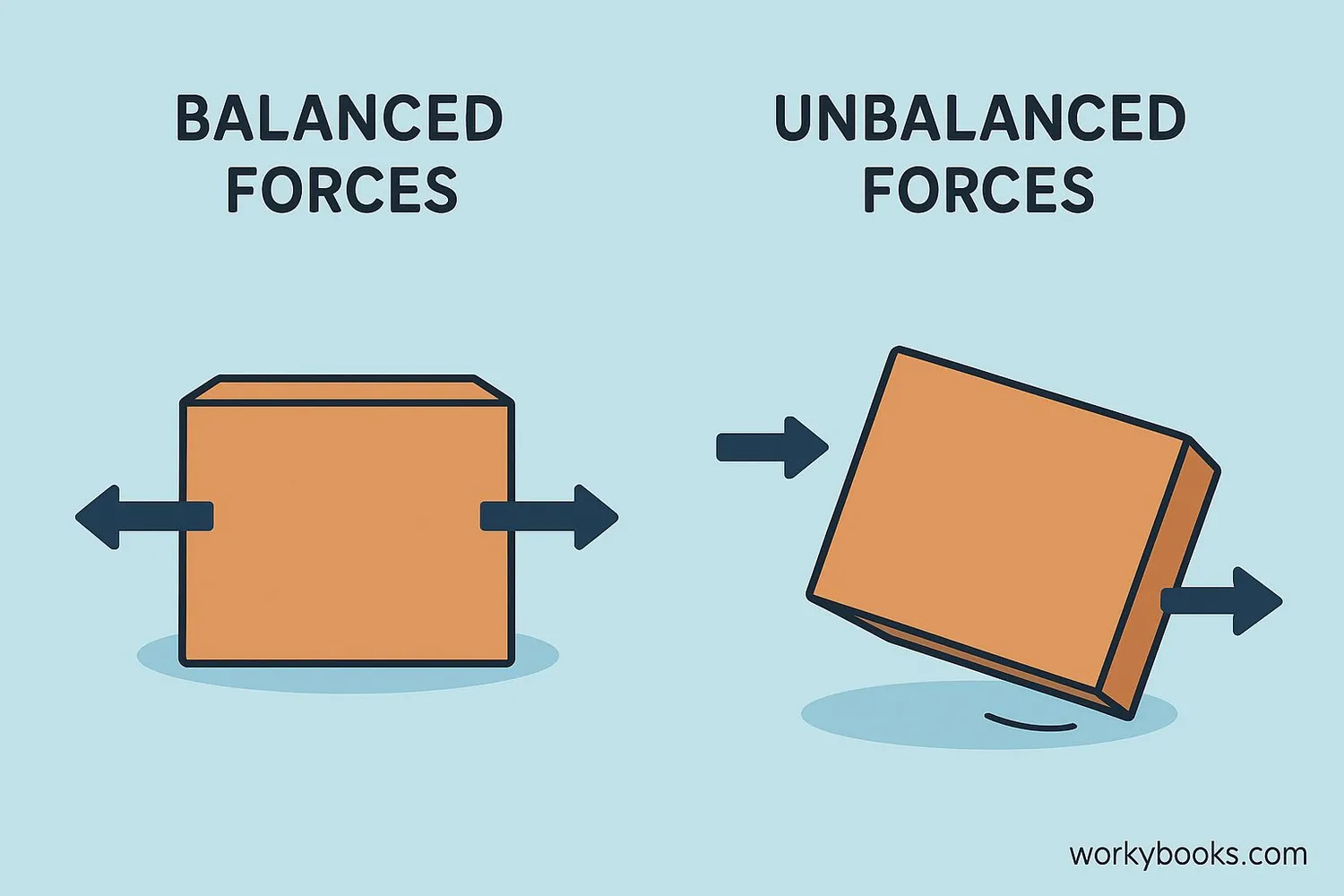
Illustration comparing balanced and unbalanced forces
Forces are pushes or pulls that act on objects, causing them to move, stop, or change direction. The study of balanced and unbalanced forces helps scientists explain why objects behave the way they do in the physical world. Understanding these forces is essential for predicting motion in everything from sports to engineering. The main idea is that the way forces combine determines whether an object stays at rest or moves in a new way.
Net Force: The Sum of All Forces Every object can have many forces acting on it at once. The net force is the sum of all these forces, including their directions. If two people pull on a rope in opposite directions with equal strength, the net force is zero. Forces are often shown in force diagrams, where arrows represent the size and direction of each force. For example, a book sitting on a table has the downward force of gravity balanced by the upward support force of the table. Since the two forces are equal and opposite, the net force is zero and the book does not move.
Balanced vs. Unbalanced Forces: What Changes? Balanced forces occur when all the forces on an object cancel each other out, so the net force is zero. In this case, the object stays at rest or continues moving at a constant speed. In contrast, unbalanced forces happen when one force is stronger than the others, so the net force is not zero. This causes the object's motion to change—speeding up, slowing down, or changing direction. In tug of war, if both teams pull equally, the rope stays still (balanced forces). But if one team suddenly pulls harder, unbalanced forces make the rope move in their direction. When an object falls, gravity is an unbalanced force that pulls it toward the ground, causing it to accelerate.
Applications and Broader Implications Understanding balanced and unbalanced forces is crucial in many areas of science and engineering. Engineers use these principles to design bridges, vehicles, and buildings that remain stable under different loads. Athletes rely on their knowledge of forces to improve their performance, adjusting their movements to create unbalanced forces that help them run faster or jump higher. In the environment, wind and water act as forces that shape landscapes over time. Recognizing how forces interact allows us to solve problems, design safer products, and understand natural events like landslides or storms. These concepts connect to larger scientific ideas about energy, motion, and stability in systems.
In summary, the motion of any object depends on the net force acting upon it. Balanced forces mean no change in motion, while unbalanced forces result in acceleration or deceleration. By analyzing force diagrams and calculating net force, scientists and engineers can predict and control how objects move in our world.
Interesting Fact: Sir Isaac Newton's laws of motion are the foundation for understanding forces and continue to guide scientific discoveries today.
What is net force?
The sum of all forces acting on an object, including their directionsThe amount of gravity onlyThe force that always moves objects upwardThe difference between mass and weight
What happens when the forces on an object are balanced?
The object changes directionThe object stays at rest or keeps moving at the same speedThe object accelerates quicklyThe object always falls downward
In a tug of war, what causes the rope to move?
Balanced forcesUnbalanced forcesNo forcesGravity only
Which of these is the best definition of 'force diagram' as used in the passage?
A chart for measuring speedA drawing that uses arrows to show forces on an objectA tool for finding massA graph comparing weights
What does 'acceleration' mean in the context of forces?
A change in the speed or direction of motionBeing balancedRemaining stillA measure of weight
Engineers use the concept of balanced and unbalanced forces to:
Design stable bridges and buildingsRun faster in racesDraw picturesGrow plants
If a book is sitting still on a table, what are the two main forces acting on it?
Gravity and the table's upward supportWind and frictionGravity and accelerationMagnetism and electricity
True or False: Unbalanced forces always cause an object to change its motion.
TrueFalse
True or False: Balanced forces can cause an object to accelerate.
TrueFalse
Which of the following is a real-world example of unbalanced forces?
A soccer ball sitting still on the grassA car speeding up after the driver presses the gas pedalA paper resting on a deskA book remaining at rest
Perfect For:
👩🏫 Teachers
• Reading comprehension practice
• Auto-graded assessments
• Literacy skill development
👨👩👧👦 Parents
• Reading practice at home
• Comprehension improvement
• Educational reading time
🏠 Homeschoolers
• Reading curriculum support
• Independent reading practice
• Progress monitoring
Reading Features:
📖
Reading Passage
Engaging fiction or nonfiction text
❓
Comprehension Quiz
Auto-graded questions
📊
Instant Feedback
Immediate results and scoring
📄
Printable Version
Download for offline reading
🔊
Read Aloud
Voice-over with word highlighting
Reviews & Ratings
No reviews yet. Be the first to share your experience!
Related Content
Friction
This NGSS-aligned passage for grades 6-8 covers the science of friction, the force that opposes motion between surfaces ...
MS-PS2-1
What Is Force?
This passage, aligned to NGSS standards MS-PS2-1 and MS-PS2-2, provides a clear and age-appropriate explanation of force...
MS-PS2-1MS-PS2-2
Newton's First Law
This middle school science passage introduces students to Newton's First Law of Motion, also called the Law of Inertia. ...
MS-PS2-1MS-PS2-2
Newton's Laws in Sports
This engaging science passage is designed for grades 6-8 and aligns with NGSS standards MS-PS2-1 and MS-PS2-2. It explor...
MS-PS2-1MS-PS2-2
Air Resistance
This engaging, NGSS-aligned informational passage explores the science of air resistance—also known as fluid friction th...
MS-PS2-1
Types of Forces
This comprehensive passage introduces middle school students to the types of forces that govern the motion of objects, a...
MS-PS2-1
Net Force
This comprehensive science reading passage for grades 6-8 explores the concept of net force, aligned with NGSS standard ...
MS-PS2-1
Understanding Inertia
This comprehensive science passage introduces middle school students to the concept of inertia, a key property of matter...
MS-PS2-1MS-PS2-2
Newton's Second Law
This comprehensive passage introduces middle school students to Newton's Second Law of Motion, focusing on the core rela...
MS-PS2-1MS-PS2-2
Newton's Third Law of Motion
This comprehensive science reading passage introduces middle school students to Newton's Third Law: for every action, th...
MS-PS2-1
Action-Reaction Examples
This comprehensive science passage, designed for grades 6-8 and aligned with NGSS MS-PS2-1, delves into Newton’s Third L...
MS-PS2-1
Newton's Laws in Everyday Life
This comprehensive reading passage introduces middle school students to Newton's three laws of motion using relatable, e...
MS-PS2-1MS-PS2-2
Isaac Newton
This middle school science reading passage introduces students to Isaac Newton, one of the most influential scientists i...
MS-PS2-2
Reference Points
This passage for grades 6-8 explores the critical role of reference points in measuring and describing motion, aligning ...
MS-PS2-2
Distance vs. Displacement
This informational science passage for grades 6-8 explores the key differences between distance and displacement, aligni...
MS-PS2-2
Speed
This comprehensive science passage for grades 6-8 introduces students to the concept of speed, aligned with NGSS standar...
MS-PS2-2
Velocity
This middle school science passage explores the concept of velocity as a vector quantity, meaning it includes both speed...
MS-PS2-2
Acceleration
This comprehensive passage introduces middle school students to the concept of acceleration, aligned with NGSS standard ...
MS-PS2-2
Graphing Motion
This passage introduces middle school students to the fundamental concepts of graphing motion, focusing on distance-time...