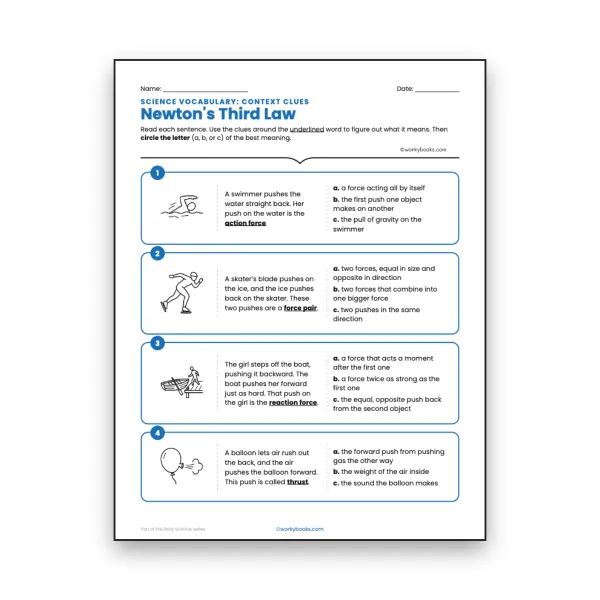
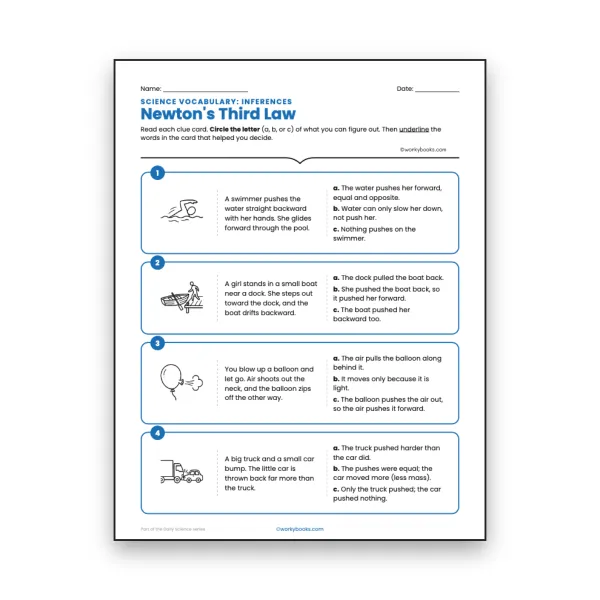
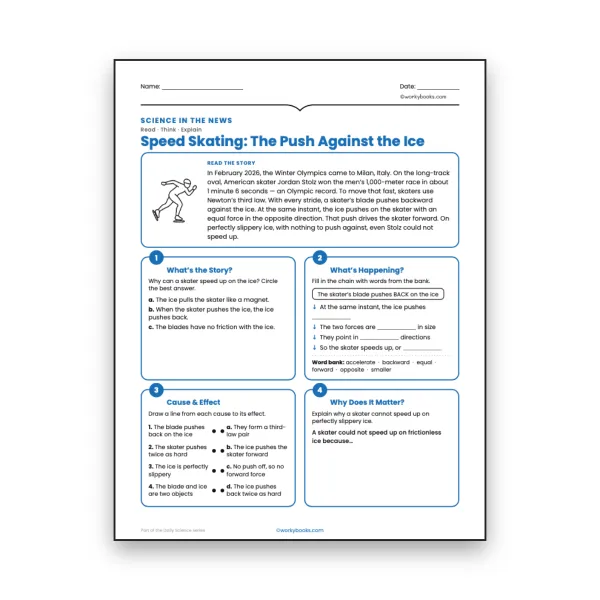
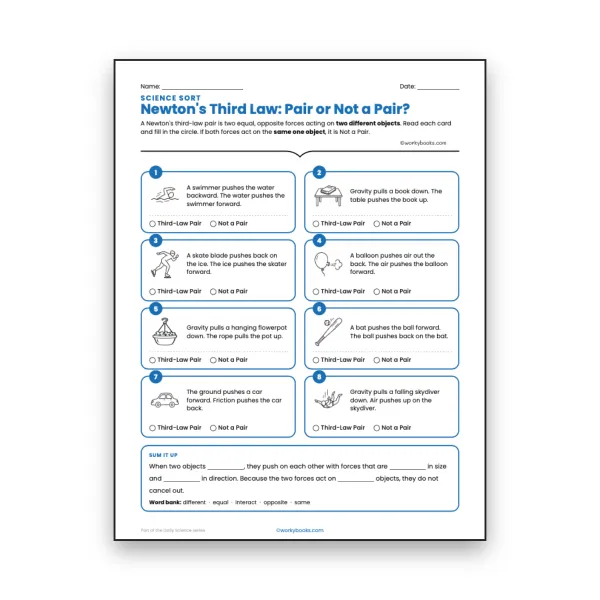
This learning resource is available in interactive and printable formats. The interactive worksheet can be played online and assigned to students. The Printable PDF version can be downloaded and printed for completion by hand.
This passage, aligned to NGSS standards MS-PS2-1 and MS-PS2-2, provides a clear and age-appropriate explanation of force for middle school students. It defines force as a push or pull that can change an object's motion and introduces force as a vector, which means it has both magnitude and direction. The passage discusses common units of force (Newtons), explains the difference between contact and non-contact forces, and provides familiar examples such as kicking a ball or pulling a wagon. Students will learn how forces interact and the scientific thinking behind how we measure and observe them. The passage includes a glossary, a differentiated version for struggling readers, Spanish translations, comprehension and writing activities, and engaging graphic organizers. Audio integration supports diverse learners. This resource is ideal for reinforcing core concepts in physical science and helping students build a strong foundation for further study.
CONTENT PREVIEW
Expand content preview
Force is a push or pull that can make objects move, stop, or change direction
Force is a fundamental concept in science that explains how objects move and interact. Every time an object starts to move, stops, or changes direction, a force is involved. For example, when a soccer ball sails across a field after being kicked, it is responding to the force applied by a player's foot. Scientists study force to understand and predict the motion of everything from tiny atoms to giant planets. Understanding force is essential for explaining many events in our daily lives and in the universe.
How Force Works: Magnitude and Direction Force is defined as a push or pull that can change the motion of an object. Force is described as a vector, which means it has both a size (called magnitude) and a direction. The magnitude tells us how strong the force is, and the direction tells us which way the force is applied. The standard unit for measuring force is the Newton (N). If you kick a soccer ball with a force of 10 Newtons to the east, it will move in that direction with a speed and distance determined by the force and the mass of the ball. Scientists use special tools, such as spring scales, to measure force in Newtons, allowing them to compare and analyze different situations.
Types of Forces: Contact and Non-Contact There are two main types of force: contact forces and non-contact forces. Contact forces require two objects to touch, like the force of your hand pulling a wagon or friction slowing down a sliding book. Non-contact forces act at a distance, such as gravity pulling an apple toward the ground or wind pushing a sailboat across a lake. Both types of forces can cause objects to start moving, stop, or change direction. The way forces combine can sometimes result in no movement if they are balanced, or in acceleration if they are unbalanced.
Forces in Action and Scientific Understanding Scientists use experiments and mathematical models to study how forces affect motion. For example, Isaac Newton observed that objects accelerate when a force acts on them, leading to his laws of motion. Engineers design vehicles, buildings, and machines by calculating how forces will affect them in real-world conditions. On a windy day, the force of the wind (a non-contact force) pushes against trees and buildings, sometimes causing branches to bend or even break. In sports, understanding how to apply just the right amount and direction of force can mean the difference between winning and losing.
By studying force, scientists can predict and control how objects move, leading to safer structures, better technology, and a deeper understanding of the world. Force is a key concept that connects many areas of science, from physics to engineering to biology.
Interesting Fact: The unit "Newton" is named after Sir Isaac Newton, who discovered the laws that explain how force and motion are related.
What is the standard unit for measuring force?
NewtonMeterJouleKilogram
Which of the following is an example of a non-contact force?
Pulling a wagonWind pushing a sailboatFriction slowing a bookKicking a soccer ball
What does it mean when force is described as a vector?
It can only push objects.It has both magnitude and direction.It is measured in meters.It always acts at a distance.
What can happen when two forces on an object are balanced?
The object will speed up.The object will change direction.The object will not move.The object will explode.
Which scientist is the unit for force named after?
Albert EinsteinIsaac NewtonMarie CurieGalileo Galilei
What is the meaning of 'magnitude' in the context of force?
The direction of the force.The speed of the object.The size or strength of the force.The type of force involved.
Why do engineers need to know about forces?
To predict and control the motion of objects.To create new elements.To study animal behavior.To observe stars.
If you push a box and it does not move, what does this mean about the forces?
The forces are balanced.There is no force acting.The box is weightless.The force is too strong.
True or False: Gravity is a contact force.
TrueFalse
True or False: Force can only act when objects touch.
TrueFalse
Perfect For:
👩🏫 Teachers
• Reading comprehension practice
• Auto-graded assessments
• Literacy skill development
👨👩👧👦 Parents
• Reading practice at home
• Comprehension improvement
• Educational reading time
🏠 Homeschoolers
• Reading curriculum support
• Independent reading practice
• Progress monitoring
Reading Features:
📖
Reading Passage
Engaging fiction or nonfiction text
❓
Comprehension Quiz
Auto-graded questions
📊
Instant Feedback
Immediate results and scoring
📄
Printable Version
Download for offline reading
🔊
Read Aloud
Voice-over with word highlighting
Reviews & Ratings
No reviews yet. Be the first to share your experience!
Related Content
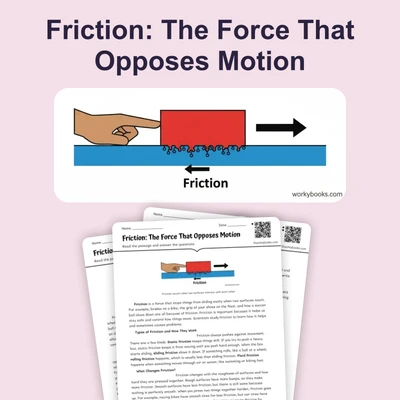
Friction
This NGSS-aligned passage for grades 6-8 covers the science of friction, the force that opposes motion between surfaces ...
MS-PS2-1
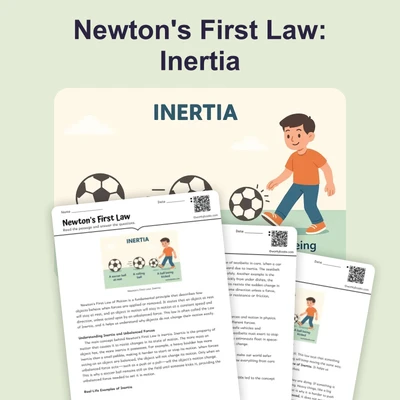
Newton's First Law
This middle school science passage introduces students to Newton's First Law of Motion, also called the Law of Inertia. ...
MS-PS2-1MS-PS2-2
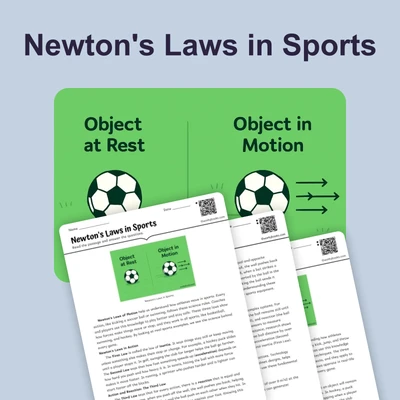
Newton's Laws in Sports
This engaging science passage is designed for grades 6-8 and aligns with NGSS standards MS-PS2-1 and MS-PS2-2. It explor...
MS-PS2-1MS-PS2-2
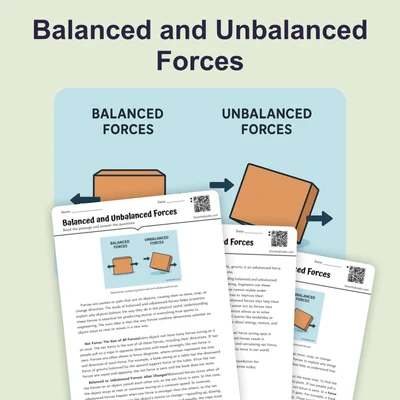
Balanced and Unbalanced Forces
This informational science passage explores the core concepts of balanced and unbalanced forces as aligned with NGSS sta...
MS-PS2-1MS-PS2-2
Air Resistance
This engaging, NGSS-aligned informational passage explores the science of air resistance—also known as fluid friction th...
MS-PS2-1
Types of Forces
This comprehensive passage introduces middle school students to the types of forces that govern the motion of objects, a...
MS-PS2-1
Net Force
This comprehensive science reading passage for grades 6-8 explores the concept of net force, aligned with NGSS standard ...
MS-PS2-1
Understanding Inertia
This comprehensive science passage introduces middle school students to the concept of inertia, a key property of matter...
MS-PS2-1MS-PS2-2
Newton's Second Law
This comprehensive passage introduces middle school students to Newton's Second Law of Motion, focusing on the core rela...
MS-PS2-1MS-PS2-2
Newton's Third Law of Motion
This comprehensive science reading passage introduces middle school students to Newton's Third Law: for every action, th...
MS-PS2-1
Action-Reaction Examples
This comprehensive science passage, designed for grades 6-8 and aligned with NGSS MS-PS2-1, delves into Newton’s Third L...
MS-PS2-1
Newton's Laws in Everyday Life
This comprehensive reading passage introduces middle school students to Newton's three laws of motion using relatable, e...
MS-PS2-1MS-PS2-2
Isaac Newton
This middle school science reading passage introduces students to Isaac Newton, one of the most influential scientists i...
MS-PS2-2
Reference Points
This passage for grades 6-8 explores the critical role of reference points in measuring and describing motion, aligning ...
MS-PS2-2
Distance vs. Displacement
This informational science passage for grades 6-8 explores the key differences between distance and displacement, aligni...
MS-PS2-2
Speed
This comprehensive science passage for grades 6-8 introduces students to the concept of speed, aligned with NGSS standar...
MS-PS2-2
Velocity
This middle school science passage explores the concept of velocity as a vector quantity, meaning it includes both speed...
MS-PS2-2
Acceleration
This comprehensive passage introduces middle school students to the concept of acceleration, aligned with NGSS standard ...
MS-PS2-2
Graphing Motion
This passage introduces middle school students to the fundamental concepts of graphing motion, focusing on distance-time...