Newton's Third Law of Motion
Interactive passage with audio narration, comprehension questions, and printable PDF.
By completing this purchase you agree to our Terms of Use and Privacy Policy. Your subscription renews automatically until you cancel. You can cancel anytime from your account settings. All sales are final and non-refundable. Digital content is available for download in your account immediately upon purchase.
What's included
Newton's Third Law of Motion preview and details
About this printable Newton's Third Law of Motion science reading passage, NGSS-aligned (Grades 5-8)
Sample passage and quiz from Newton's Third Law of Motion
Reading passage and comprehension quiz preview
Newton's Third Law of Motion
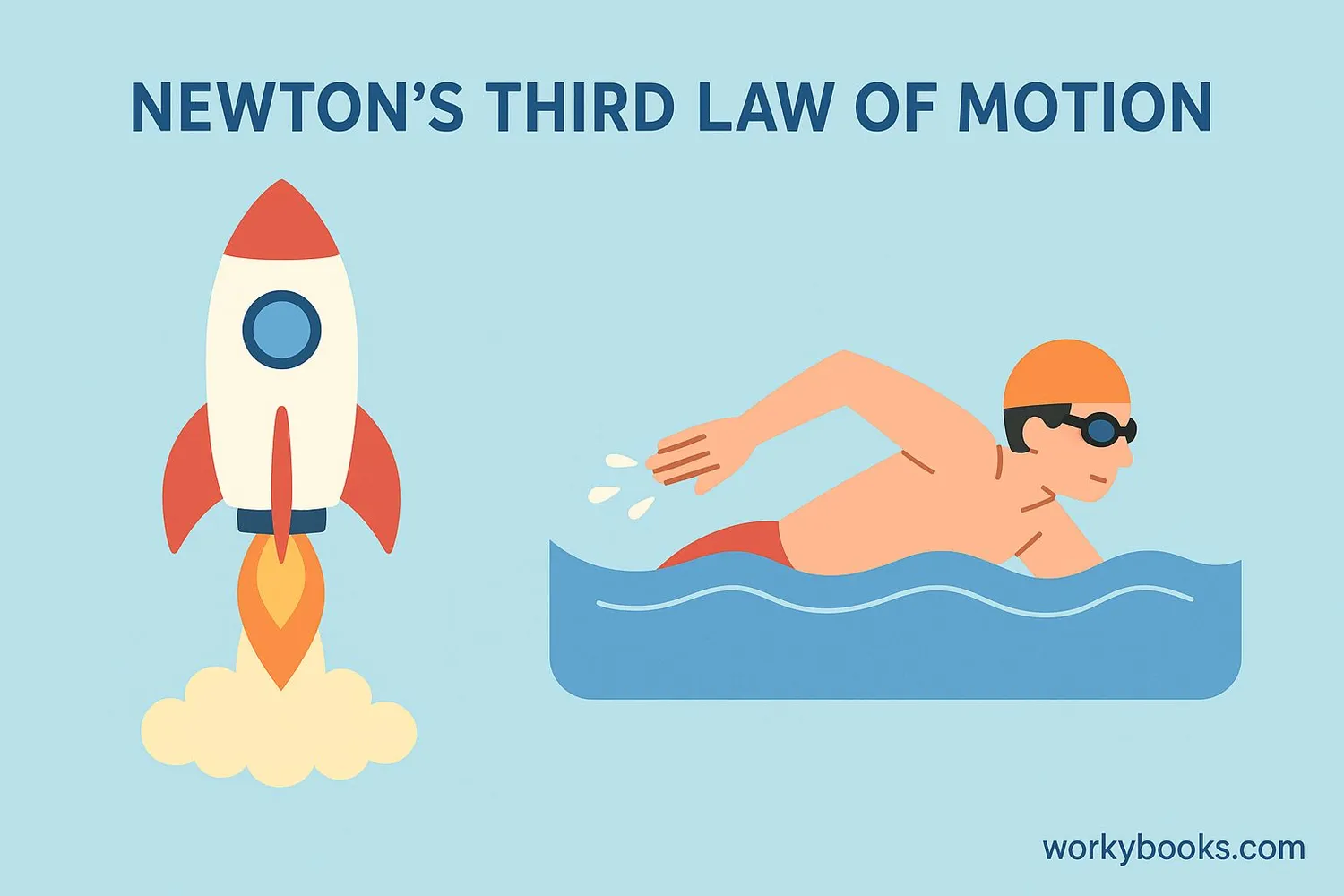
Newton's Third Law of motion describes a fundamental principle of physics: for every action, there is an equal and opposite reaction. This law helps explain why objects move as they do and is essential for understanding how forces interact in the world around us. When two objects interact, they exert forces on each other of equal strength but in opposite directions. These forces always act on different objects, not on the same one. Recognizing this law allows scientists and engineers to predict and design the movement of everything from rockets to skateboards.
How Action and Reaction Forces Work
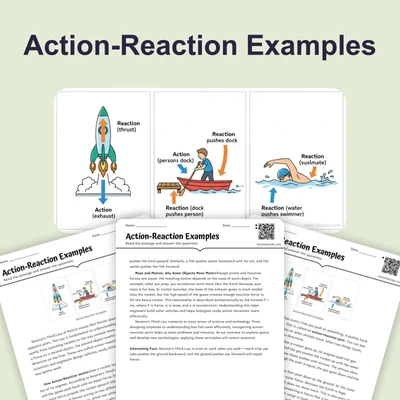
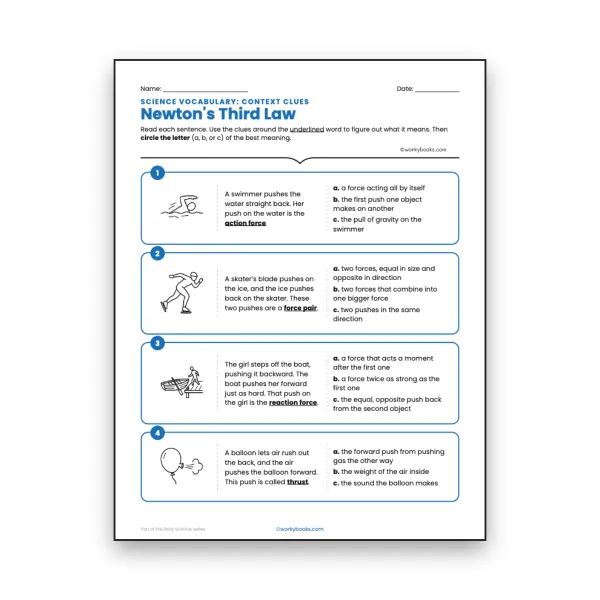
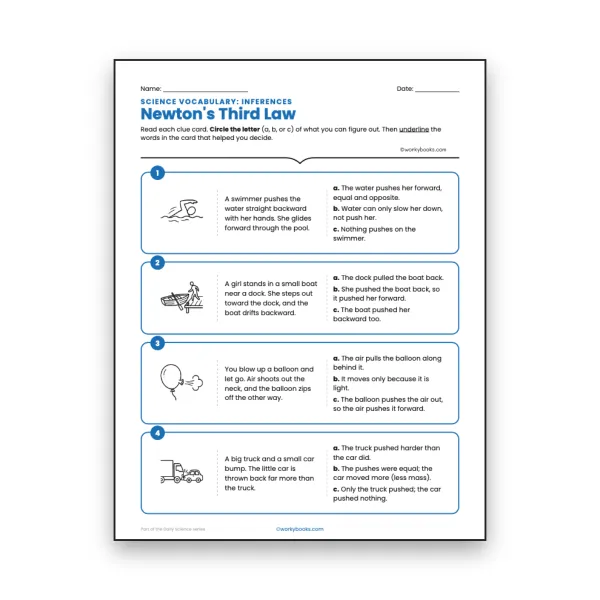
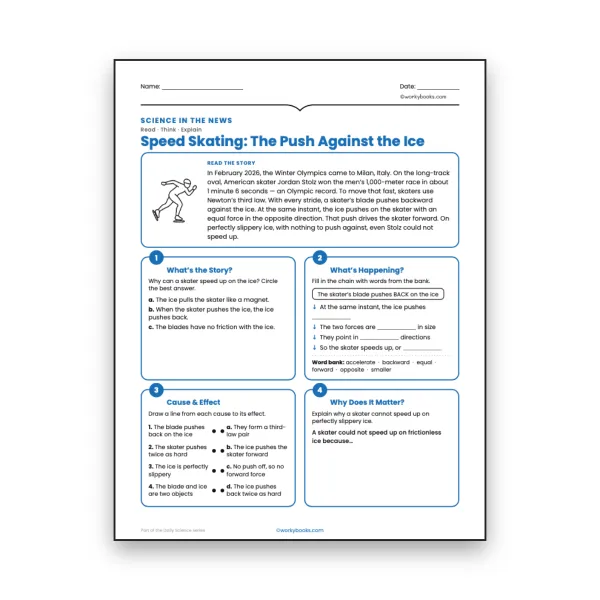
When a force is applied to an object, like a skateboarder pushing against a wall, the wall pushes back with an equal force in the opposite direction. The force from the skateboarder's hands on the wall is the action, and the force from the wall on the skateboarder is the reaction. Both forces are present at the same time and are equal in size, but they act on different objects. This is why the skateboarder moves backward when pushing off the wall. Another example is a swimmer pushing water backward with their hands. The water pushes the swimmer forward with an equal force in the opposite direction, propelling the swimmer ahead. In walking, your foot pushes backward against the ground, and the ground pushes your foot forward, allowing you to move. In each case, the action and reaction forces do not cancel because they act on different objects.
Applications and Connections
Action-reaction pairs are fundamental to many technologies and natural processes. Rockets launch into space because the engine pushes exhaust gases downward (action), and the gases push the rocket upward (reaction). According to measurements, the force of the engine’s exhaust can reach millions of newtons, enough to lift a heavy rocket off the ground. In sports, when you hit a baseball with a bat, the bat exerts a force on the ball (action), and the ball exerts an equal and opposite force on the bat (reaction). Engineers use Newton's Third Law when designing safer cars, making sure that forces during a collision are absorbed correctly to protect passengers. These examples show that understanding action and reaction helps us improve technology, safety, and performance in many areas of life.
Addressing Misconceptions
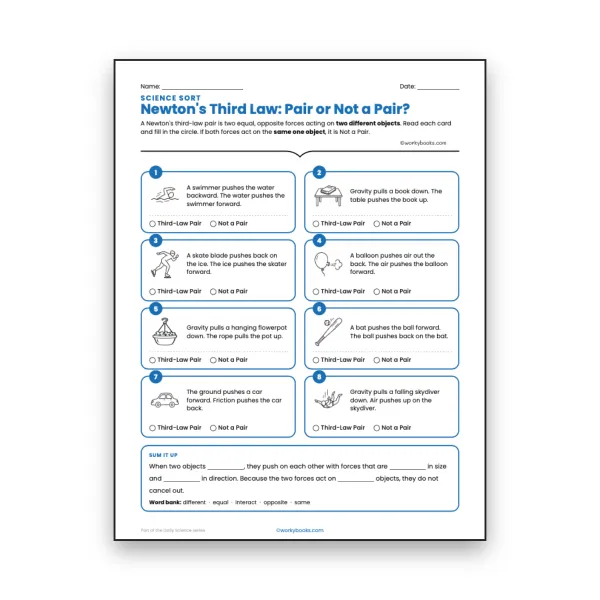
It is a common misconception that action and reaction forces 'cancel out,' but this only happens if the forces act on the same object, which they do not in Newton's Third Law. For example, if two people push on opposite sides of a box with equal force, the box will not move because the forces are equal and act on the same object. However, in action-reaction pairs, the forces always act on different objects, so they do not cancel each other. This distinction is crucial for understanding motion and predicting how objects will behave. Scientists test these ideas with experiments and measurements, using tools like force sensors to confirm that forces are always equal and opposite in these situations.
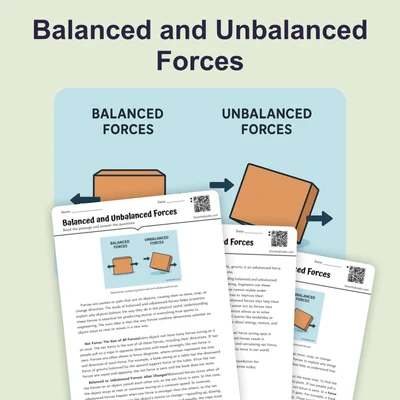
Understanding Newton's Third Law connects to broader scientific principles, such as conservation of momentum and balanced versus unbalanced forces. By applying this law, we can better understand not just how things move, but also how to control and use forces in engineering and daily life.
Interesting Fact:
Sir Isaac Newton published his Third Law of Motion in 1687. It still forms the foundation for much of modern engineering and space exploration today!
Comprehension quiz (10 questions)
1. What does Newton's Third Law state?
2. Which example best shows Newton’s Third Law in action?
3. Why don’t action and reaction forces cancel each other out?
4. Which of the following is a real-world application of Newton’s Third Law?
5. What does the word 'force' mean in the passage?
6. What is meant by 'action-reaction pairs'?
7. Based on the passage, what happens when a swimmer pushes water backward?
8. If two people push a box from opposite sides with equal force, what happens?
9. True or False: Newton’s Third Law explains why rockets can launch into space.
10. True or False: Action and reaction forces always act on the same object.
Perfect for the way you teach
- Build comprehension skills
- Auto-graded quiz
- Differentiated reading
- Read together at home
- Improve fluency
- Quiet reading time
- Reading curriculum support
- Independent practice
- Track Lexile growth