This learning resource is available in interactive and printable formats. The interactive worksheet can be played online and assigned to students. The Printable PDF version can be downloaded and printed for completion by hand.
This middle school science passage introduces students to Newton's First Law of Motion, also called the Law of Inertia. Students learn how inertia explains the tendency of objects to remain at rest or keep moving unless acted upon by an unbalanced force, with real-world examples like seatbelts in cars, the classic tablecloth trick, and the motion of spacecraft in space. The passage explores the underlying mechanisms and relationships between force, motion, and inertia, connecting these ideas to broader scientific principles and the NGSS standards MS-PS2-1 and MS-PS2-2. Activities include a comprehension quiz, writing prompts, and graphic organizers to support understanding. Key vocabulary is defined in a glossary. All content is accessible and includes audio integration for diverse learners. Perfect for grades 6-8 science classrooms seeking engaging, standards-aligned resources.
CONTENT PREVIEW
Expand content preview
Newton's First Law: Inertia
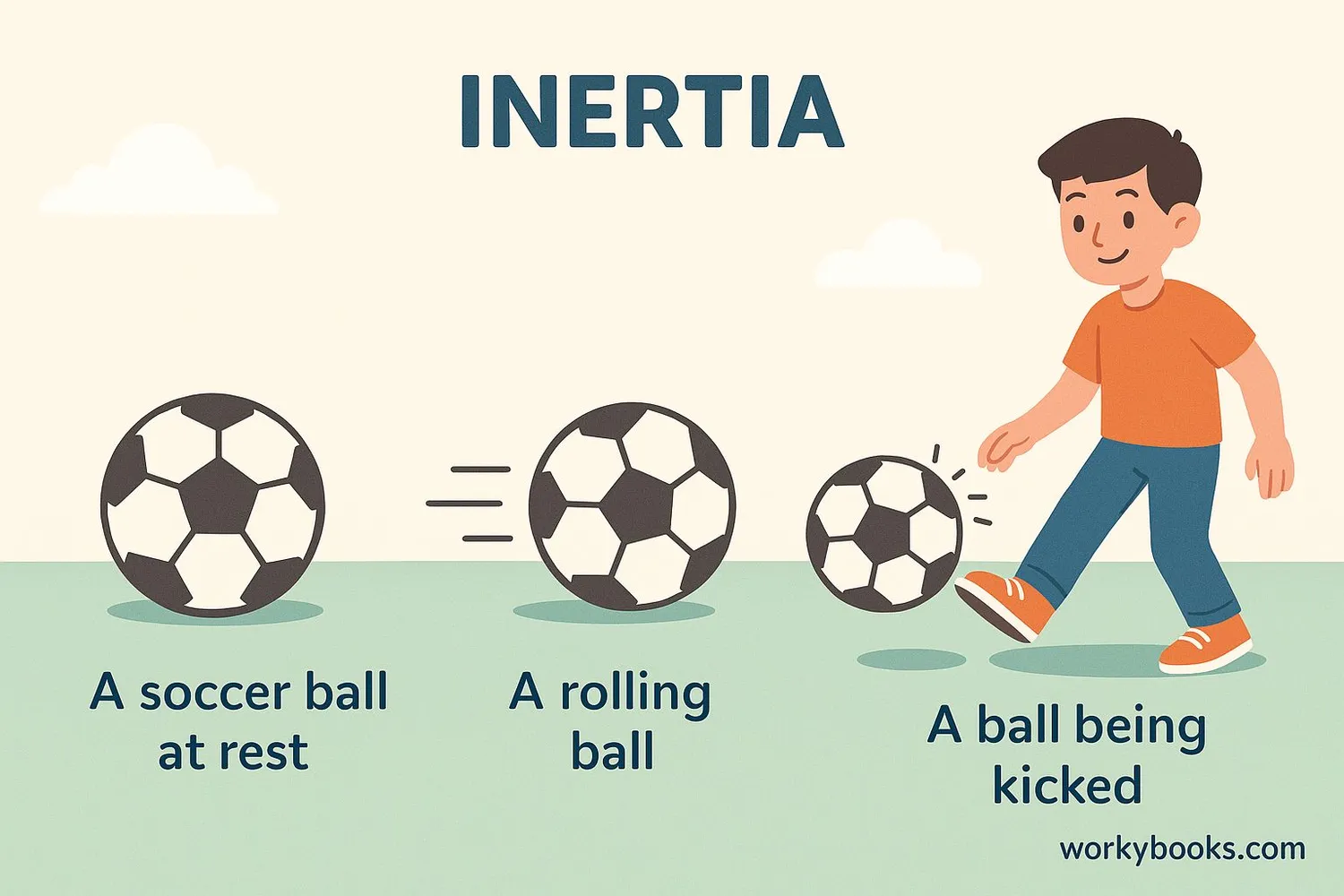
Newton's First Law of Motion is a fundamental principle that describes how objects behave when forces are applied or removed. It states that an object at rest will stay at rest, and an object in motion will stay in motion at a constant speed and direction, unless acted upon by an unbalanced force. This law is often called the Law of Inertia, and it helps us understand why objects do not change their motion easily.
Understanding Inertia and Unbalanced Forces
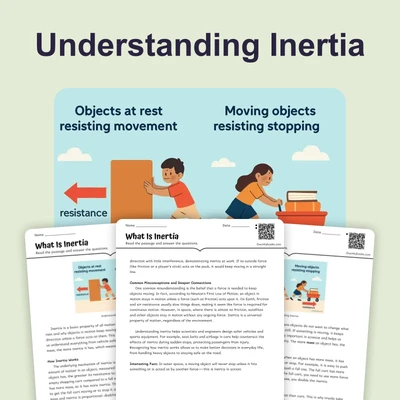
The main concept behind Newton's First Law is inertia. Inertia is the property of matter that causes it to resist changes in its state of motion. The more mass an object has, the more inertia it possesses. For example, a heavy boulder has more inertia than a small pebble, making it harder to start or stop its motion. When forces acting on an object are balanced, the object will not change its motion. Only when an unbalanced force acts—such as a push or a pull—will the object's motion change. This is why a soccer ball remains still on the field until someone kicks it, providing the unbalanced force needed to set it in motion.
Real-Life Examples of Inertia
One common example of inertia is the importance of seatbelts in cars. When a car suddenly stops, your body wants to keep moving forward due to inertia. The seatbelt provides the unbalanced force to stop your motion safely. Another example is the classic tablecloth trick: if you pull a tablecloth out quickly from under dishes, the dishes stay nearly in place. This is because their inertia resists the sudden change in motion. In space, spacecraft continue moving in the same direction unless a force, like a rocket thruster, changes their motion. Without air resistance or friction, inertia keeps them traveling at a steady speed.
Connecting to Larger Scientific Principles
Newton's First Law is closely related to the idea of forces and motion in physics. It helps scientists predict how objects will respond to different forces. Understanding inertia also guides engineers in designing safe vehicles and spacecraft. For example, they calculate how much force seatbelts must exert to stop passengers during sudden stops. This law also explains why astronauts float in space: without significant unbalanced forces, their motion doesn't change.
By studying Newton's First Law, scientists and engineers make our world safer and improve technology. It is a key part of understanding how everything from cars to planets moves through space.
Interesting Fact: Galileo Galilei's observations in the early 1600s led to the concept of inertia, even before Newton described the law in 1687.
What does Newton's First Law of Motion state?
An object at rest will stay at rest and an object in motion will stay in motion unless acted upon by an unbalanced force.All objects fall at the same rate regardless of mass.For every action, there is an equal and opposite reaction.Objects with more mass always move faster than lighter objects.
Which term describes an object's resistance to changes in motion?
VelocityInertiaAccelerationFriction
What happens when the forces acting on an object are balanced?
The object will accelerate.The object will not change its motion.The object will move in a circle.The object will always speed up.
Why is a seatbelt important when a car stops suddenly, according to Newton's First Law?
It provides an unbalanced force to stop your body from continuing to move forward.It makes the car go faster.It reduces the weight of your body.It changes the direction of the car.
What is the main reason a spacecraft keeps moving at the same speed in space?
There is almost no friction or air resistance in space.Gravity pushes it forward.It is being pulled by the sun.It has no inertia.
In the passage, what does the word 'unbalanced force' mean?
A force that is not canceled out by other forces, causing a change in an object's motion.A force that is equal on all sides.A gentle push.A force that acts only in space.
Based on the passage, what would happen if you pull a tablecloth slowly from under dishes?
The dishes would likely move with the tablecloth.The dishes would stay perfectly still.The dishes would fly off the table.Nothing would happen.
How does mass affect an object's inertia?
Objects with more mass have more inertia.Objects with less mass have more inertia.Mass doesn't affect inertia.Only living things have inertia.
Newton's First Law is sometimes called the Law of Inertia. (True/False)
TrueFalse
Balanced forces cause a change in an object's motion. (True/False)
TrueFalse
Perfect For:
👩🏫 Teachers
• Reading comprehension practice
• Auto-graded assessments
• Literacy skill development
👨👩👧👦 Parents
• Reading practice at home
• Comprehension improvement
• Educational reading time
🏠 Homeschoolers
• Reading curriculum support
• Independent reading practice
• Progress monitoring
Reading Features:
📖
Reading Passage
Engaging fiction or nonfiction text
❓
Comprehension Quiz
Auto-graded questions
📊
Instant Feedback
Immediate results and scoring
📄
Printable Version
Download for offline reading
🔊
Read Aloud
Voice-over with word highlighting
Reviews & Ratings
No reviews yet. Be the first to share your experience!
Related Content
Friction
This NGSS-aligned passage for grades 6-8 covers the science of friction, the force that opposes motion between surfaces ...
MS-PS2-1
What Is Force?
This passage, aligned to NGSS standards MS-PS2-1 and MS-PS2-2, provides a clear and age-appropriate explanation of force...
MS-PS2-1MS-PS2-2
Newton's Laws in Sports
This engaging science passage is designed for grades 6-8 and aligns with NGSS standards MS-PS2-1 and MS-PS2-2. It explor...
MS-PS2-1MS-PS2-2
Balanced and Unbalanced Forces
This informational science passage explores the core concepts of balanced and unbalanced forces as aligned with NGSS sta...
MS-PS2-1MS-PS2-2
Air Resistance
This engaging, NGSS-aligned informational passage explores the science of air resistance—also known as fluid friction th...
MS-PS2-1
Types of Forces
This comprehensive passage introduces middle school students to the types of forces that govern the motion of objects, a...
MS-PS2-1
Net Force
This comprehensive science reading passage for grades 6-8 explores the concept of net force, aligned with NGSS standard ...
MS-PS2-1
Understanding Inertia
This comprehensive science passage introduces middle school students to the concept of inertia, a key property of matter...
MS-PS2-1MS-PS2-2
Newton's Second Law
This comprehensive passage introduces middle school students to Newton's Second Law of Motion, focusing on the core rela...
MS-PS2-1MS-PS2-2
Newton's Third Law of Motion
This comprehensive science reading passage introduces middle school students to Newton's Third Law: for every action, th...
MS-PS2-1
Action-Reaction Examples
This comprehensive science passage, designed for grades 6-8 and aligned with NGSS MS-PS2-1, delves into Newton’s Third L...
MS-PS2-1
Newton's Laws in Everyday Life
This comprehensive reading passage introduces middle school students to Newton's three laws of motion using relatable, e...
MS-PS2-1MS-PS2-2
Isaac Newton
This middle school science reading passage introduces students to Isaac Newton, one of the most influential scientists i...
MS-PS2-2
Reference Points
This passage for grades 6-8 explores the critical role of reference points in measuring and describing motion, aligning ...
MS-PS2-2
Distance vs. Displacement
This informational science passage for grades 6-8 explores the key differences between distance and displacement, aligni...
MS-PS2-2
Speed
This comprehensive science passage for grades 6-8 introduces students to the concept of speed, aligned with NGSS standar...
MS-PS2-2
Velocity
This middle school science passage explores the concept of velocity as a vector quantity, meaning it includes both speed...
MS-PS2-2
Acceleration
This comprehensive passage introduces middle school students to the concept of acceleration, aligned with NGSS standard ...
MS-PS2-2
Graphing Motion
This passage introduces middle school students to the fundamental concepts of graphing motion, focusing on distance-time...