Air Resistance
Interactive passage with audio narration, comprehension questions, and printable PDF.
By completing this purchase you agree to our Terms of Use and Privacy Policy. Your subscription renews automatically until you cancel. You can cancel anytime from your account settings. All sales are final and non-refundable. Digital content is available for download in your account immediately upon purchase.
What's included
Air Resistance preview and details
About this printable Air Resistance science reading passage, NGSS-aligned (Grades 5-8)
Sample passage and quiz from Air Resistance
Reading passage and comprehension quiz preview
Air Resistance
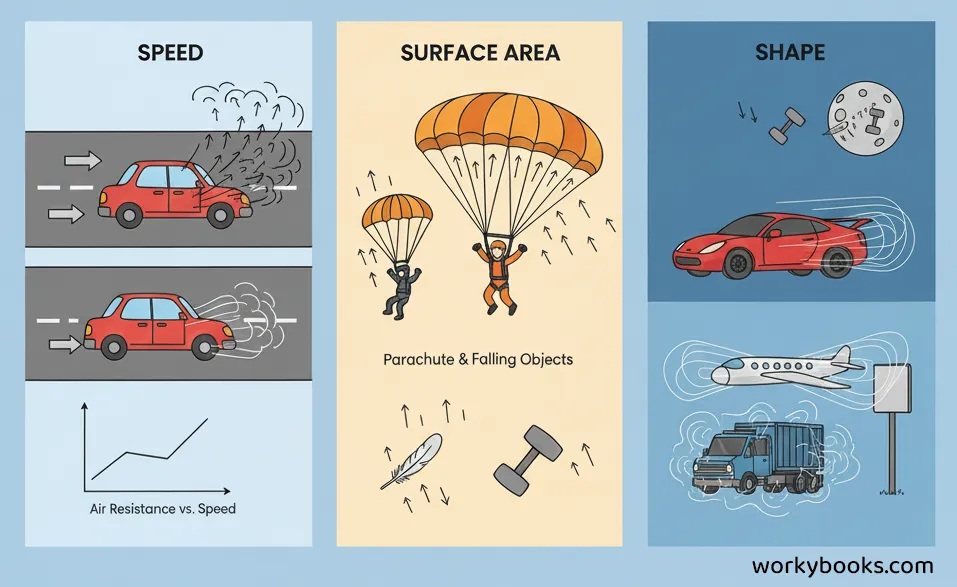
Air resistance is a force that acts against objects as they move through the air. It plays a crucial role in how fast or slow things fall or travel. When an object moves, it must push air molecules out of its way, and this interaction creates a type of friction called fluid friction. Scientists have discovered that air resistance can change the motion of objects in surprising ways, from slowing down skydivers to shaping the design of cars and airplanes. Understanding air resistance helps engineers and inventors create safer and more efficient technology.
How Air Resistance Works
Air resistance happens because air is made of tiny particles that push back against anything moving through it. The faster an object moves, the more air particles it meets per second, and the greater the resistance. Three main factors affect air resistance: speed, surface area, and shape. As speed increases, air resistance also increases. If an object has a large surface area, like a parachute, it meets more air and slows down more quickly. The shape of an object matters too. Streamlined, or aerodynamic, shapes allow air to flow smoothly around them, reducing resistance. For example, race cars and airplanes are designed with rounded, sloped bodies to cut through air efficiently.
Terminal Velocity and Real-World Examples
When an object falls, gravity pulls it downward, but air resistance pushes upward. As it speeds up, air resistance increases until it equals the force of gravity. At this point, the object stops accelerating and falls at a constant speed known as terminal velocity. Skydivers experience this when they jump from planes. Without a parachute, their terminal velocity is around 53 meters per second (about 120 mph), but when they open a parachute, the large surface area increases air resistance, lowering terminal velocity to a much safer speed. In contrast, a feather and a hammer dropped together in air fall at different rates because the feather encounters more air resistance for its weight. However, on the Moon—where there is no air—they fall at the same rate, showing that air resistance is the key difference.
Broader Implications and Applications
Understanding air resistance has led to important advancements in transportation and safety. Engineers design vehicles to be aerodynamic to save fuel and reduce emissions, while athletes wear tight-fitting suits to minimize drag during races. Even in sports, balls and equipment are shaped to control air resistance and improve performance. Scientists continue to study how air resistance interacts with other forces, such as gravity, to better predict motion in different environments. These principles are part of the larger science of forces and motion, which help explain everything from falling leaves to spacecraft re-entering Earth's atmosphere.
Understanding air resistance not only helps us make better technology but also deepens our knowledge of the natural world and the laws that govern it. As we develop new materials and explore different planets, the way we think about air resistance will continue to evolve.
Interesting Fact: The world record for the highest skydive was set from over 39 kilometers above Earth, where the air is so thin that there is almost no air resistance at first!
Comprehension quiz (10 questions)
1. What is air resistance?
2. Which of the following is NOT a factor that affects air resistance?
3. What happens to air resistance as an object moves faster?
4. What is terminal velocity?
5. In the passage, why do cars and planes have aerodynamic shapes?
6. Based on the passage, what would happen if you dropped a feather and a hammer on the Moon?
7. What is the main purpose of a parachute?
8. True or False: Air resistance is a type of friction.
9. True or False: Terminal velocity occurs when gravity and air resistance are balanced.
10. Which best describes the relationship between air resistance and surface area?
Perfect for the way you teach
- Build comprehension skills
- Auto-graded quiz
- Differentiated reading
- Read together at home
- Improve fluency
- Quiet reading time
- Reading curriculum support
- Independent practice
- Track Lexile growth