Chandragupta and the Mauryan Empire
Interactive passage with audio narration, comprehension questions, and printable PDF.
What's included
Part of this bundle

Chandragupta and the Mauryan Empire preview and details
About this printable Chandragupta and the Mauryan Empire reading passage (Grades 6-8)
Sample passage and quiz from Chandragupta and the Mauryan Empire
Reading passage and comprehension quiz preview
Chandragupta and the Mauryan Empire
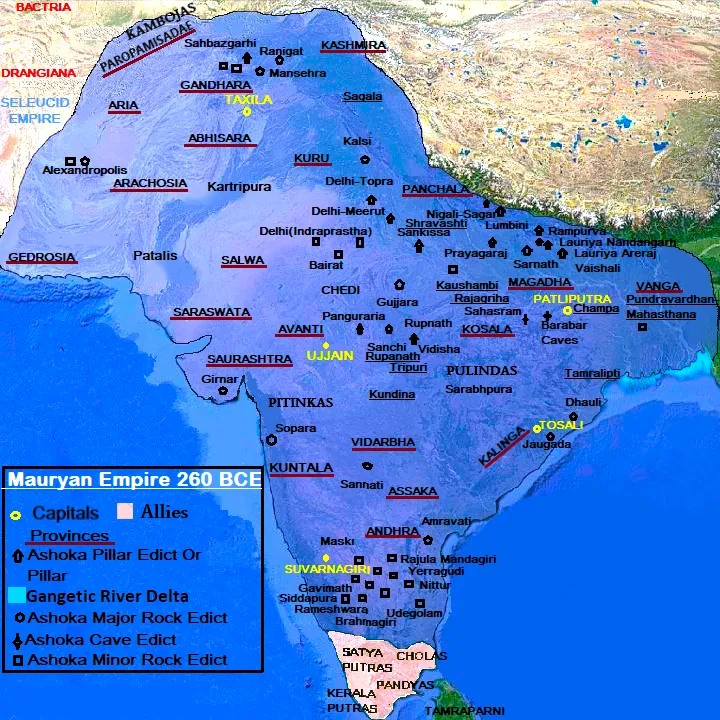
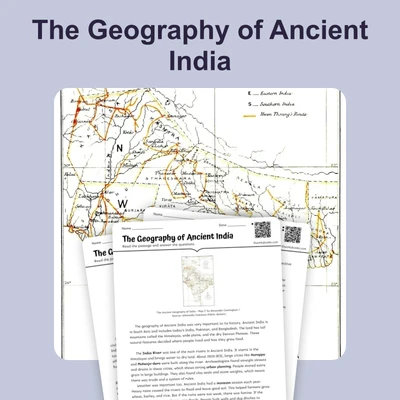
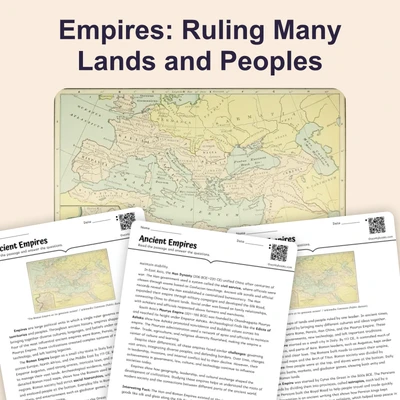
"Maurya Empire c.260 BCE" by Deztar / Wikimedia Commons (CC0).
Chandragupta Maurya was the founder of the Mauryan Empire, recognized as the first empire to unite much of ancient India. Around 321 BCE, Chandragupta rose to power in the region of Magadha, located in present-day Bihar. He overthrew the unpopular king Dhana Nanda and began a remarkable journey to unite the Indian subcontinent. Chandragupta's rise was aided by his advisor Chanakya, a skilled strategist and author of the famous text, the Arthashastra, which described methods of statecraft, administration, and military tactics.
The Mauryan Empire expanded rapidly under Chandragupta’s rule. After securing Magadha, he turned his attention to the northwest, where the remnants of Alexander the Great’s Greek forces still controlled parts of modern-day Punjab and Afghanistan. In a series of military campaigns, Chandragupta defeated Seleucus I Nicator, a Greek general who had inherited Alexander’s eastern territories. By 305 BCE, a peace treaty was established, and Seleucus ceded large territories to Chandragupta in exchange for 500 war elephants. Archaeological evidence, including coins and ancient texts, confirm these exchanges and demonstrate the interactions between Indian and Hellenistic cultures.
Chandragupta’s empire stretched from the Himalayas in the north to the Deccan Plateau in the south, and from the Arabian Sea in the west to the Bay of Bengal in the east. He established a strong bureaucracy to govern the vast territory. The capital city, Pataliputra (modern Patna), became a center of art, learning, and trade. The Arthashastra describes a hierarchical society, with the king at the top, followed by officials, soldiers, artisans, and farmers. Daily life in the empire was influenced by both Indian traditions and new ideas from Greek and Persian contacts. The use of standardized weights, measures, and coinage helped grow the economy and connect distant regions.
Chandragupta’s rule brought major changes, but also continuity in Indian society. Traditional beliefs and local customs remained important, even as centralized government spread. According to Jain texts, Chandragupta eventually became interested in Jainism, a religion that teaches non-violence and asceticism. He abdicated the throne in favor of his son Bindusara and spent his final years as a Jain monk in Karnataka, in southern India. The Mauryan Empire continued to grow under his descendants, especially his grandson Ashoka, who became one of India’s greatest rulers.
Chandragupta Maurya’s legacy is significant because he created the first large, unified Indian state and laid the foundations for later empires. His achievements show how geography, military skill, and wise governance can shape history. Chandragupta’s story connects to bigger themes of empire-building and cultural exchange in the ancient world.
Interesting Fact: Chandragupta Maurya is sometimes said to have met Alexander the Great, but there is no clear historical evidence for this meeting.
Comprehension quiz (8 questions)
1. Who helped Chandragupta with strategy?
2. What was the capital city of the Mauryan Empire?
3. What did Seleucus receive in the peace treaty?
4. Why did Chandragupta’s empire expand?
5. How did administration help the empire?
6. What is a bureaucracy?
7. Chandragupta became a Jain monk. True or false?
8. What does 'hierarchical' mean?
Perfect for the way you teach
- Build comprehension skills
- Auto-graded quiz
- Differentiated reading
- Read together at home
- Improve fluency
- Quiet reading time
- Reading curriculum support
- Independent practice
- Track Lexile growth