Reading PassagePremium

India Invents Zero

Interactive passage with audio narration, comprehension questions, and printable PDF.

No ratings yet|
2
Grades 5–8ReadingElaSocial-studiesHistoryEnglish · SpanishInteractive · Printable
Aligned toCA HSS 6.5RH.6-8.1RH.6-8.2RH.6-8.4
Just this resource
$1.50
One-time purchase
Best value
Unlock everything
$49.99$29.99/yr
40% off until Aug 1 — 10,000+ resources
Renews at $49.99/year.
Unlock above to use these actions

What's included

Reading passage
Audio narration
Comprehension quiz
Writing activity
Glossary & flashcards
Differentiated version
Spanish translation

India Invents Zero preview and details

About this printable India Invents Zero reading passage (Grades 5-8)

This engaging history reading passage explores the invention of zero by ancient Indian mathematicians, focusing on the contributions of scholars such as Brahmagupta and the significance of the concept in mathematics and civilization. Students will learn about the origins of zero in South Asia, archaeological and textual evidence, and the impact of this discovery on trade, science, and global knowledge. The resource includes a main passage, a simplified version, Spanish translations, glossary terms, multiple-choice quiz, writing prompts, graphic organizers, and a timeline of key developments. This passage and activities align with CA HSS 6.5, CCSS RH.6-8.1, and are designed to build historical thinking and literacy skills. Read aloud audio and Spanish translation are provided for accessibility.
Written by Workybooks TeamPublished by Workybooks
Preview

Sample passage and quiz from India Invents Zero

Reading passage and comprehension quiz preview

India Invents Zero
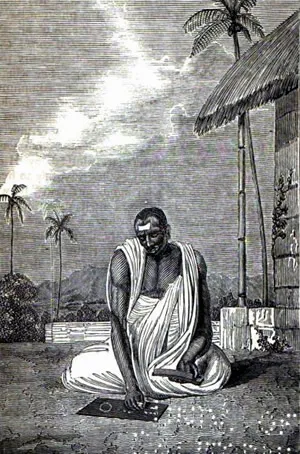
Hindu astronomer, 19th-century illustration

"BrahmaGupta, Ancient Mathematician"/ Wikimedia Commons 

Ancient Indian mathematicians developed the concept of zero, one of the most important ideas in mathematics, between the 5th and 7th centuries CE. The invention of zero transformed mathematics, science, and daily life, both in India and around the world. This achievement was rooted in the rich intellectual traditions of South Asia, where scholars valued learning and innovation.

Before the invention of zero, ancient societies like the Egyptians, Babylonians, and Romans used number systems that made calculations difficult. For example, Roman numerals had no symbol for zero, which made advanced mathematics almost impossible. In contrast, Indian mathematicians created a place-value system, where the position of a digit determined its value. The symbol for zero, usually a small dot or circle, was first recorded in ancient Indian texts and inscriptions. One of the earliest known examples is an inscription found at the Chaturbhuj Temple in Gwalior, India, dated to the 9th century CE. Earlier references to zero appear in the mathematical work "Brahmasphutasiddhanta" written by the mathematician Brahmagupta in 628 CE. Brahmagupta described zero as both a placeholder and a number that could be used in calculations, making it possible to perform addition, subtraction, and even negative numbers more easily.

This innovation did not happen overnight. Indian mathematicians, working in urban centers and temples, developed mathematical systems over centuries. They built on ideas from earlier Indian texts, such as the "Sulba Sutras," which included early forms of geometry. Archaeological evidence, including manuscripts and stone inscriptions, shows how the use of zero gradually became accepted and spread. The decimal system, using zero as a placeholder, allowed for much simpler multiplication and division. This was especially important for merchants and traders in South Asia, whose economic activities required accurate recordkeeping and calculations.

The impact of zero spread beyond India through trade routes and cultural exchange. By the 8th century, the concept had reached the Islamic world, where scholars translated Indian texts into Arabic. Later, zero entered Europe, helping to spark advances in science, engineering, and finance during the Middle Ages and Renaissance. The invention of zero is an example of how one culture's innovation can shape the world. The work of Indian mathematicians remains a key part of global mathematical heritage and demonstrates the power of ideas to cross borders.

Studying the invention of zero helps us understand the connections between different civilizations and the importance of intellectual exchange. The story of zero is a powerful reminder that human progress depends on curiosity, collaboration, and the willingness to question old ideas.

Interesting Fact: Archaeologists found an early use of zero in a stone inscription at the Chaturbhuj Temple in Gwalior, India—a symbol that changed math forever!

Comprehension quiz (8 questions)

1. Who wrote about zero in 628 CE?

Brahmagupta
Aryabhata
Euclid
Archimedes

2. Where is the earliest known stone zero?

Chaturbhuj Temple
Nalanda University
Great Wall
Parthenon

3. In which century did zero reach the Islamic world?

8th century
2nd century
12th century
15th century

4. Why was zero important for merchants?

For easy calculations
For building temples
For farming
For writing stories

5. What made the Indian number system unique?

Place-value and zero
Roman numerals
Hieroglyphics
Greek letters

6. How did zero spread to Europe?

Through trade and translations
Through war
Through farming
Through music

7. Zero was invented in ancient India. True or false?

True
False

8. What does the word 'heritage' mean?

Traditions passed down
A kind of number
A famous city
A food dish
Who it's for

Perfect for the way you teach

Teachers
  • Build comprehension skills
  • Auto-graded quiz
  • Differentiated reading
Parents
  • Read together at home
  • Improve fluency
  • Quiet reading time
Homeschoolers
  • Reading curriculum support
  • Independent practice
  • Track Lexile growth
Topics

Reviews & Ratings

No reviews yet. Be the first to share your experience!

More reading you might love

19 more
Passage
Ashoka and the Mauryan Empire - reading educational content
Grades 5–8

Ashoka and the Mauryan Empire

ancient history · CA HSS 6.5

$1.50
Passage
Caste System in Ancient India - reading educational content
Grades 5–8

Caste System in Ancient India

ancient history · CA HSS 6.5

$1.50
Passage
Core Beliefs of Hinduism - reading educational content
Grades 5–8

Core Beliefs of Hinduism

ancient history · CA HSS 6.5

$1.50
Passage
Geography of Ancient India - reading educational content
Grades 5–8

Geography of Ancient India

ancient history · CA HSS 6.5

$1.50
Passage
Vedas Sacred Hindu Texts - reading educational content
Grades 5–8

Vedas Sacred Hindu Texts

ancient history · CA HSS 6.5

$1.50
Passage
Achievements of Ancient India - reading educational content
Grades 5–8

Achievements of Ancient India

ancient history · CA HSS 6.5

$1.50
Passage
Trade in Ancient India - reading educational content
Grades 5–8

Trade in Ancient India

ancient history · CA HSS 6.5

$1.50
Passage
Chandragupta and the Mauryan Empire - reading educational content
Grades 6–8

Chandragupta and the Mauryan Empire

ancient history · CA HSS 6.5

Free
Passage
Afro-Eurasian Trade Networks - reading educational content
Grades 6–8

Afro-Eurasian Trade Networks

ancient history · CA HSS 6.5

$1.50
Passage
Gupta Empire - reading educational content
Grades 5–8

Gupta Empire

ancient history · CA HSS 6.5

$1.50
Passage
Africans and Filipinos in Early California - reading educational content
Grades 3–5

Africans and Filipinos in Early California

us history · HSS 4.2.1

$1.50
Passage
Bear Flag Revolt - reading educational content
Grades 3–5

Bear Flag Revolt

us history · HSS 4.3.5

$1.50
Passage
First California Constitution - reading educational content
Grades 3–5

First California Constitution

us history · HSS 4.3.5

$1.50
Passage
California Forty-Niners - reading educational content
Grades 3–5

California Forty-Niners

us history · HSS 4.4.2

$1.50
Passage
California Chinese Miners - reading educational content
Grades 3–5

California Chinese Miners

us history · HSS 4.4.3

$1.50
Passage
Effects of the Gold Rush - reading educational content
Grades 3–5

Effects of the Gold Rush

us history · HSS 4.4.4

$1.50
Passage
Golden Spike 1869 - reading educational content
Grades 3–5

Golden Spike 1869

us history · HSS 4.4.1

$1.50
Passage
Newcomers to California - reading educational content
Grades 3–5

Newcomers to California

us history · HSS 4.4.4

$1.50
Passage
1965 Immigration Act - reading educational content
Grades 3–5

1965 Immigration Act

us history · HSS 4.4.4

$1.50
Copyright © 2026 Workybooks. Made with ♥ in California.