Gupta Empire
Interactive passage with audio narration, comprehension questions, and printable PDF.
By completing this purchase you agree to our Terms of Use and Privacy Policy. Your subscription renews automatically until you cancel. You can cancel anytime from your account settings. All sales are final and non-refundable. Digital content is available for download in your account immediately upon purchase.
What's included
Gupta Empire preview and details
About this printable Gupta Empire reading passage (Grades 5-8)
Sample passage and quiz from Gupta Empire
Reading passage and comprehension quiz preview
India Under the Gupta Empire
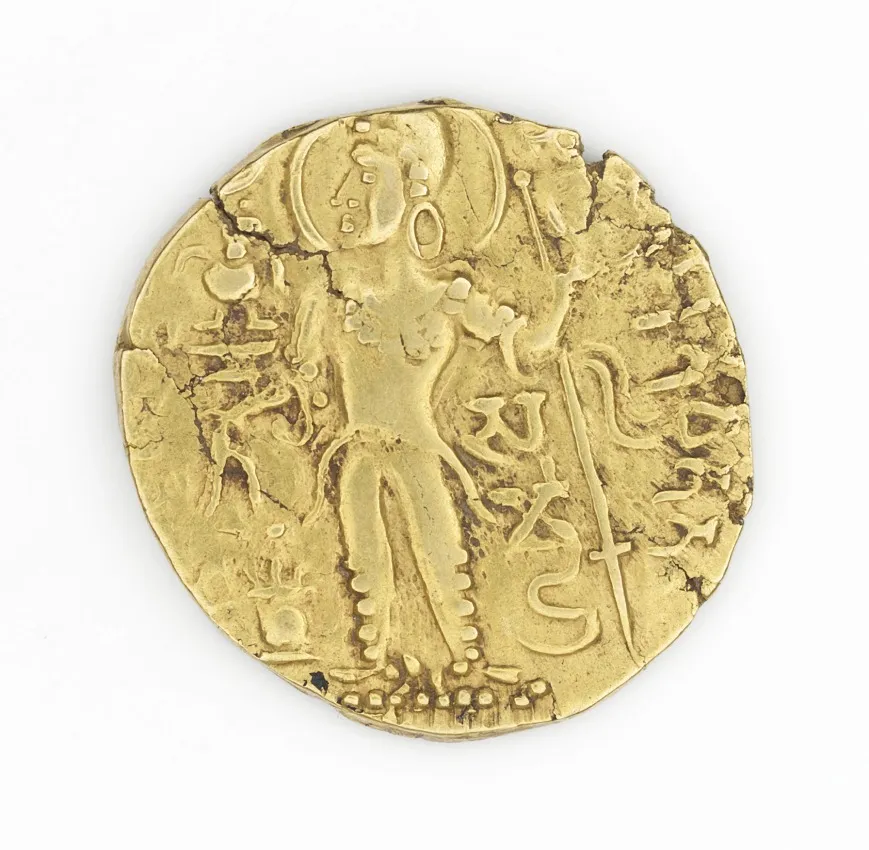
"Dinar of Samudragupta" / Wikimedia Commons (Public domain).
The Gupta Empire emerged as a powerful state in northern India around 320 CE. Historians consider it one of the most significant periods of ancient Indian history. The Gupta dynasty united many small kingdoms, creating a large and stable empire that lasted for over two centuries. Their rule is often called the "Golden Age" of India because of extraordinary achievements in science, mathematics, art, and literature.
The founder of the dynasty, Chandragupta I, began his reign in 320 CE. He expanded his territory through alliances and marriages with influential families. Chandragupta I's son, Samudragupta, continued this expansion by leading military campaigns across northern and central India. A famous stone pillar, the Allahabad Pillar Inscription, describes Samudragupta's conquests and lists the regions he brought under Gupta control. These primary sources help historians understand the extent and organization of the empire.
Under Gupta rule, the empire was divided into provinces governed by royal officials. The capital, Pataliputra, became a hub for trade, culture, and administration. The Guptas encouraged learning by supporting scholars and establishing centers of study such as Nalanda University. Indian mathematicians developed the concept of zero and the decimal system, which revolutionized mathematics. Astronomers like Aryabhata calculated the length of the solar year with remarkable accuracy. Gupta artists produced beautiful sculptures, coins, and temples, including the intricate carvings at the Dashavatara Temple in Deogarh.
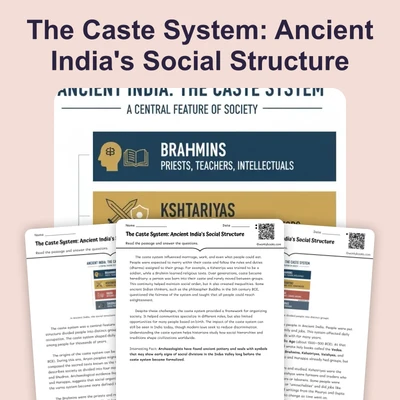
Religion played a crucial role in Gupta society. Hinduism was the most prominent faith, but the Guptas also tolerated Buddhism and Jainism. Temples and monasteries flourished, and religious texts such as the Mahabharata and Ramayana were recorded and spread throughout the empire. Social life in the Gupta Empire was organized by a rigid caste system. Most people lived in villages and worked as farmers, artisans, or merchants.
The Gupta Empire eventually weakened due to internal conflicts and invasions from the Huns around the late 400s CE. However, its achievements continued to influence Indian culture and world history. The Gupta period set a standard for later Indian kingdoms in art, science, and governance.
In world history, the rise and fall of the Gupta Empire shows how geography, leadership, and culture shape civilizations. Understanding the Guptas helps us connect the development of ancient societies across Asia and beyond.
Interesting Fact: The famous mathematician Aryabhata, who lived during the Gupta Empire, wrote that the Earth rotates on its axis—over 1,000 years before European scientists made the same discovery!
Comprehension quiz (8 questions)
1. Who founded the Gupta Empire?
2. When did the Gupta Empire begin?
3. What was the capital of the Gupta Empire?
4. Why is the Gupta period called the 'Golden Age'?
5. What is one achievement in mathematics?
6. What caused the Gupta Empire to decline?
7. The Guptas accepted only Hinduism. True or false?
8. What is a caste system?
Perfect for the way you teach
- Build comprehension skills
- Auto-graded quiz
- Differentiated reading
- Read together at home
- Improve fluency
- Quiet reading time
- Reading curriculum support
- Independent practice
- Track Lexile growth