Core Beliefs of Hinduism
Interactive passage with audio narration, comprehension questions, and printable PDF.
By completing this purchase you agree to our Terms of Use and Privacy Policy. Your subscription renews automatically until you cancel. You can cancel anytime from your account settings. All sales are final and non-refundable. Digital content is available for download in your account immediately upon purchase.
What's included
Part of this bundle

Core Beliefs of Hinduism preview and details
About this printable Core Beliefs of Hinduism reading passage (Grades 5-8)
Sample passage and quiz from Core Beliefs of Hinduism
Reading passage and comprehension quiz preview
Core Beliefs of Hinduism
![[Images of Hindu cosmogony and gods]](https://assets.workybooks.com/INTERACTIVE/media/pd--Images-of-Hindu-cosmogony-and-gods--1762586245435-604672790.webp)
Source: Library of Congress - Winkles, Henry, 1800-approximately 1860
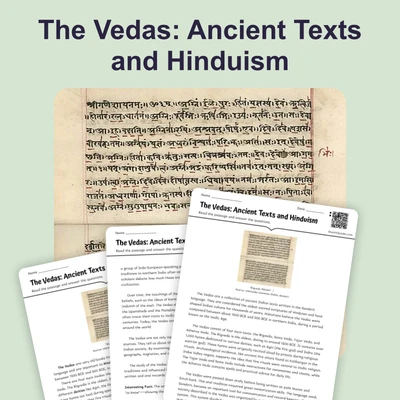
Hinduism, one of the world's oldest religions, developed in ancient India over 3,000 years ago. Its core beliefs, including dharma, karma, and reincarnation, have shaped Indian society and culture since the times of the early Vedic civilization (around 1500 BCE). The Vedas, Hinduism's oldest sacred texts, provide evidence of these ideas and their significance in ancient Indian life.
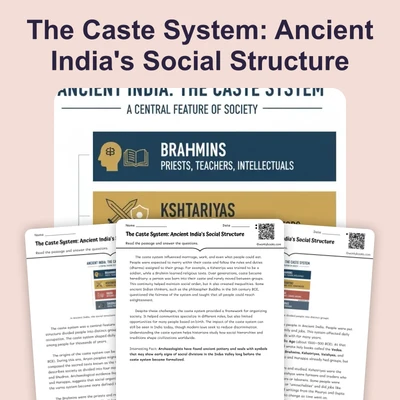
The concept of dharma refers to a person's duty or the moral code that guides actions. In ancient India, dharma was closely linked to a person's social class, or varna, and role in society. For example, the Rigveda, a primary Vedic text, describes the four main social classes: priests (Brahmins), warriors (Kshatriyas), merchants (Vaishyas), and laborers (Shudras). Each group had its own dharma, or responsibilities, to maintain harmony in society. Following one's dharma was believed to support the order of the universe, or cosmos.
The idea of karma is another central Hindu belief. Karma means that every action has consequences, shaping a person's future experiences. Good actions lead to positive outcomes, while negative actions bring suffering. This cause-and-effect principle is found in many ancient Hindu texts, including the Upanishads, which state, "As a person acts, so he becomes." Karma influenced daily life, encouraging people to act with kindness and honesty.
Reincarnation is the belief that the soul is reborn in a new body after death. According to Hindu teachings, a person's karma from past lives determines their next birth. Someone who fulfilled their dharma and built up good karma might be reborn into a higher social class or even reach moksha—liberation from the cycle of rebirth. This belief gave hope to people in lower social groups, since they could improve their position in the next life by living morally. Archaeological evidence, such as ancient burial practices and religious art, suggests that these beliefs were widespread across India by the time of the Mauryan Empire (c. 322–185 BCE).
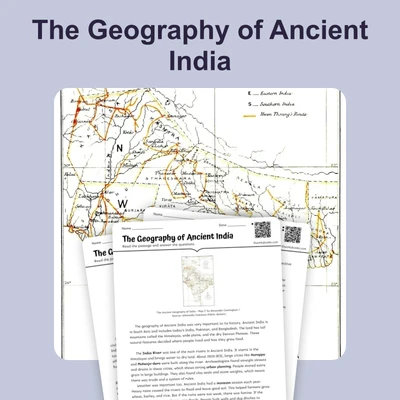
Over centuries, these beliefs have remained central to Hinduism and Indian culture. While the details of dharma, karma, and reincarnation evolved over time, their influence on laws, traditions, and social organization can still be seen today. Ancient Indian thinkers used these concepts to explain inequality, motivate good behavior, and guide rulers and citizens alike. These ideas also connected people to their geographic environment, as many Hindu rituals honor rivers, animals, and the land itself.
Understanding dharma, karma, and reincarnation helps us see how ancient Indians explained the world, structured society, and found meaning in daily life. These beliefs continue to influence millions of people and connect the ancient past with the present.
Interesting Fact: The word "karma" comes from the Sanskrit root "kri," which means "to do" or "to act."
Comprehension quiz (8 questions)
1. When did Vedic civilization begin?
2. Which text lists four main social classes?
3. What is moksha?
4. How did karma affect daily life?
5. Why was dharma important?
6. What does reincarnation mean?
7. Dharma is a person’s duty. True or false?
8. What is the meaning of 'varna'?
Perfect for the way you teach
- Build comprehension skills
- Auto-graded quiz
- Differentiated reading
- Read together at home
- Improve fluency
- Quiet reading time
- Reading curriculum support
- Independent practice
- Track Lexile growth