Caste System in Ancient India
Interactive passage with audio narration, comprehension questions, and printable PDF.
By completing this purchase you agree to our Terms of Use and Privacy Policy. Your subscription renews automatically until you cancel. You can cancel anytime from your account settings. All sales are final and non-refundable. Digital content is available for download in your account immediately upon purchase.
What's included
Part of this bundle

Caste System in Ancient India preview and details
About this printable Caste System in Ancient India reading passage (Grades 5-8)
Sample passage and quiz from Caste System in Ancient India
Reading passage and comprehension quiz preview
Caste System in Ancient India
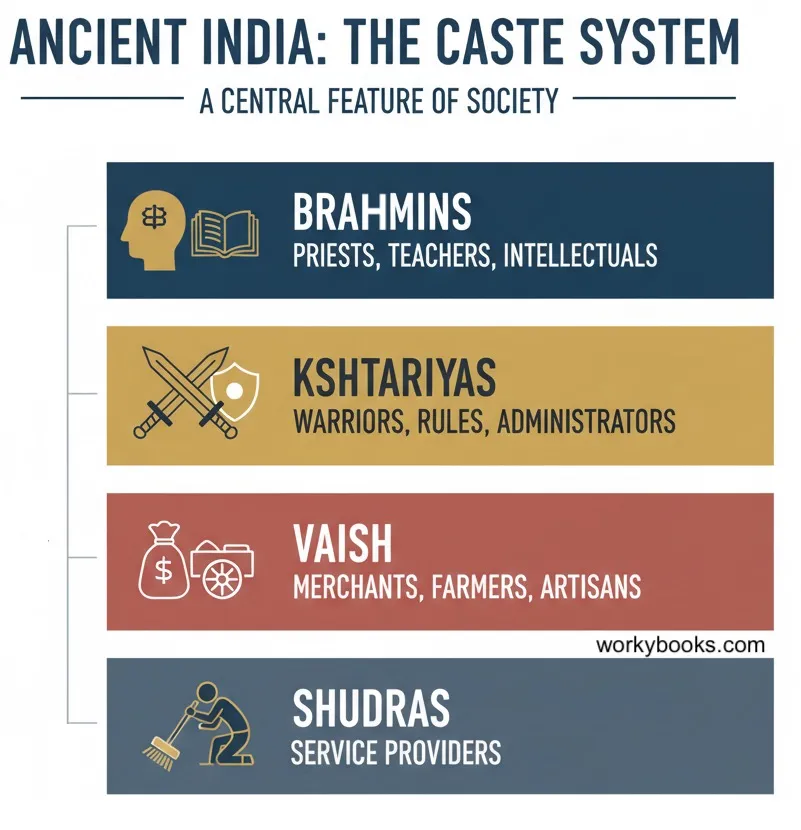
The caste system was a central feature of society in Ancient India. This social structure divided people into distinct groups, or varnas, based largely on birth and occupation. The caste system shaped daily life, religious practices, and relationships among people for thousands of years.
The origins of the caste system can be traced to the Vedic Age (c. 1500–500 BCE). During this era, Aryan peoples migrated into the Indian subcontinent and composed the sacred texts known as the Vedas. One of these texts, the Rig Veda, describes society as divided into four main classes: Brahmins, Kshatriyas, Vaishyas, and Shudras. Archaeological evidence from early Indian cities, such as Mohenjo Daro and Harappa, suggests that social organization existed before the caste system, but the varna system became more defined in later centuries.
The Brahmins were the priests and religious scholars. They performed rituals and maintained sacred knowledge. The Kshatriyas were warriors and rulers, responsible for protecting society and governing the land. The Vaishyas were merchants, farmers, and traders who supported the economy. The Shudras, often laborers and servants, provided essential services to the other classes. Outside these four varnas were groups sometimes called Dalits or "untouchables." Dalits performed jobs considered impure, such as handling waste or working with animal skins. Historical sources, including inscriptions and legal codes from the Maurya and Gupta periods, show that these divisions became stricter over time.
The caste system influenced marriage, work, and even what people could eat. People were expected to marry within their caste and follow the rules and duties (dharma) assigned to their group. For example, a Kshatriya was trained to be a soldier, while a Brahmin learned religious texts. Over generations, caste became hereditary: a person was born into their caste and rarely moved between groups. This continuity helped maintain social order, but it also created inequalities. Some ancient Indian thinkers, such as the philosopher Buddha in the 5th century BCE, questioned the fairness of the system and taught that all people could reach enlightenment.
Despite these challenges, the caste system provided a framework for organizing society. It helped communities specialize in different roles, but also limited opportunities for many people based on birth. The impact of the caste system can still be seen in India today, though modern laws seek to reduce discrimination. Understanding the caste system helps historians study how social hierarchies and traditions shape civilizations worldwide.
Interesting Fact: Archaeologists have found ancient pottery and seals with symbols that may show early signs of social divisions in the Indus Valley long before the caste system became formalized.
Comprehension quiz (8 questions)
1. What are the four main varnas?
2. Which ancient text describes the varnas?
3. Who performed religious rituals?
4. What was a main effect of the caste system?
5. Why did Dalits face discrimination?
6. How did caste affect marriage?
7. The caste system is no longer seen today. True or false?
8. What does 'duties' mean in this passage?
Perfect for the way you teach
- Build comprehension skills
- Auto-graded quiz
- Differentiated reading
- Read together at home
- Improve fluency
- Quiet reading time
- Reading curriculum support
- Independent practice
- Track Lexile growth