Ancient Forms of Government
Interactive passage with audio narration, comprehension questions, and printable PDF.
What's included
Ancient Forms of Government preview and details
About this printable Ancient Forms of Government reading passage (Grades 5-8)
Sample passage and quiz from Ancient Forms of Government
Reading passage and comprehension quiz preview
Ancient Forms of Government
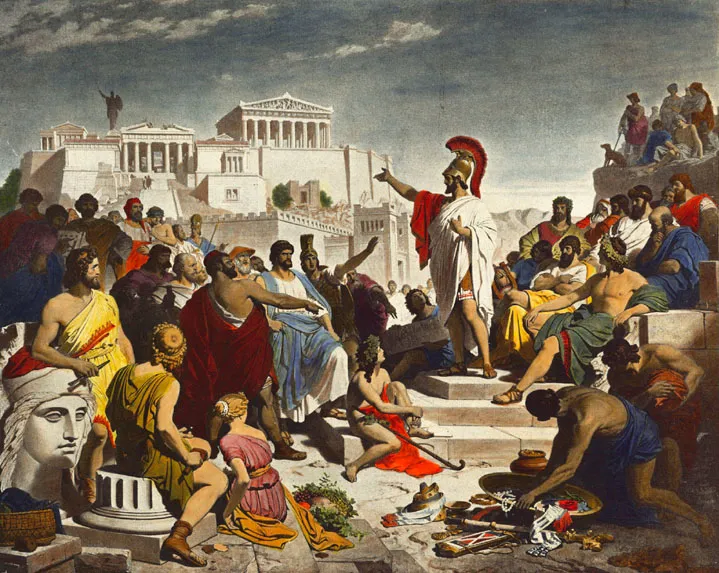
"Pericles’ Funeral Oration" by Philipp Foltz /
Source: Wikimedia Commons (Public domain).
Governments in the ancient world took many forms, shaping how people lived, worked, and made decisions together. While each civilization was unique, the systems they created—such as monarchy, oligarchy, and democracy—help us understand the development of political power and social structure throughout history.
The earliest civilizations, like those in Mesopotamia and Egypt around 3000 BCE, were mostly monarchies. A monarch—usually a king or queen—held supreme authority, often claiming power from the gods. In ancient Egypt, pharaohs were not only rulers but were also considered divine. The famous Narmer Palette (c. 3100 BCE) is an archaeological artifact depicting King Narmer, who united Upper and Lower Egypt and became the first pharaoh. Monarchs relied on strict laws and loyal officials to maintain control. The Code of Hammurabi (c. 1754 BCE), carved on a stone pillar in ancient Babylon, is one of the earliest examples of a written legal system, showing how rulers used laws to organize society and solve disputes.
Ancient Greece introduced new ideas about government, especially in the city-state of Athens. By the 5th century BCE, Athens developed a direct democracy, where adult male citizens voted on laws and decisions. This was different from a tyranny or an oligarchy, where a small group or a single ruler held power. The Athenian democracy involved public debates, the use of a council called the Boule, and courts with citizen juries. However, not everyone could participate—women, slaves, and foreigners were excluded. In contrast, the city-state of Sparta had an oligarchic system, where a few elders and kings made most decisions, showing how geography and social needs shaped government forms.
Geography played a crucial role in shaping ancient governments. In river valley civilizations like Egypt and Mesopotamia, centralized authority helped organize irrigation and defend against invaders. In mountainous Greece, separate city-states developed their own governments because travel and communication were difficult. Over time, some societies, like Rome, shifted from monarchy to a republic, introducing new checks on power and balancing the interests of different social groups. Archaeological evidence, such as inscriptions and buildings like the Parthenon, helps historians understand these changes and continuities.
The structure of government affected daily life, social hierarchy, and the rights of individuals. Ancient systems created the foundation for many modern concepts of law and citizenship. By comparing these early forms, we see how humans have long debated who should rule and how power should be shared.
From the divine pharaohs of Egypt to the assemblies of Athens, the study of ancient governments connects directly to themes of power, law, and citizenship that continue to shape societies today.
Interesting Fact: The word "democracy" comes from the Greek words "demos" (people) and "kratos" (power), literally meaning "rule by the people."
Comprehension quiz (8 questions)
1. What artifact shows King Narmer?
2. When was the Code of Hammurabi created?
3. Who could vote in Athenian democracy?
4. What was the main role of the Boule?
5. How did geography affect Greek governments?
6. Why did monarchs make laws?
7. Rome always had a monarchy. True or false?
8. What is an oligarchy?
Perfect for the way you teach
- Build comprehension skills
- Auto-graded quiz
- Differentiated reading
- Read together at home
- Improve fluency
- Quiet reading time
- Reading curriculum support
- Independent practice
- Track Lexile growth