This learning resource is available in interactive and printable formats. The interactive worksheet can be played online and assigned to students. The Printable PDF version can be downloaded and printed for completion by hand.
This NGSS-aligned science reading passage for grades 6-8 provides a comprehensive survey of Earth’s major terrestrial biomes, including tropical rainforests, temperate and boreal forests, grasslands, deserts, and tundra. The passage introduces students to the mechanisms that define each biome, such as climate and dominant vegetation, and explains how environmental factors drive the adaptation of characteristic organisms. Through examples and scientific reasoning, students discover cause-and-effect relationships within biomes and the underlying principles that connect them as part of the biosphere. Activities include vocabulary, comprehension quiz, writing analysis, and graphic organizers to deepen understanding. Audio integration supports diverse learners. This resource is ideal for supporting instruction on ecosystems, biodiversity, and environmental science, and is aligned with NGSS standard MS-LS2-1.
CONTENT PREVIEW
Expand content preview
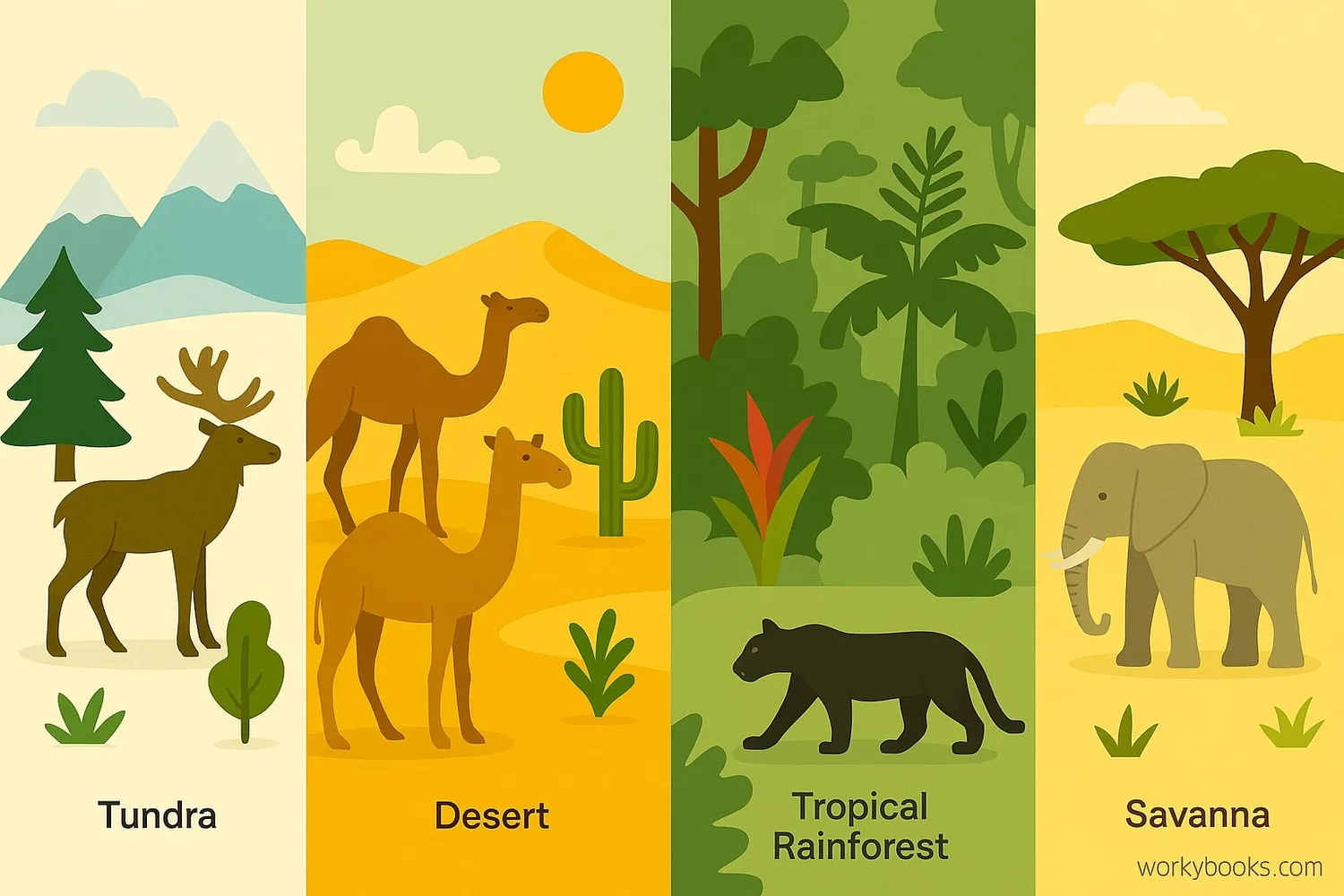
Illustration showing different biomes
Biomes are large regions on Earth defined by their climate, vegetation, and the unique communities of organisms they support. Scientists study biomes to understand the complex relationships between living things and their environments. The distribution of biomes across the planet is determined by patterns of temperature, precipitation, and sunlight. Each terrestrial biome serves as a system where energy flows and matter cycles, shaping the diversity of life found there.
Climate and Vegetation: The Foundations of Biomes Climate is the main force that shapes terrestrial biomes. For example, tropical rainforests are found near the equator, where temperatures average above 25°C (77°F) year-round, and annual rainfall can exceed 200 centimeters (79 inches). This warm, wet climate supports dense forests with the highest biodiversity on Earth. Temperate forests have moderate climates and distinct seasons; their trees are often deciduous (shedding leaves) or coniferous (evergreen). The taiga, or boreal forest, exists in colder regions with long winters and short summers. Its coniferous trees are adapted to snow and freezing temperatures.
Adaptations and Organism Interactions Plants and animals in each biome have unique adaptations that help them survive. In grasslands, such as prairies and savannas, moderate rainfall favors grasses over trees. Large herbivores like bison and antelope graze on tough grasses, while predators like lions and wolves depend on these herbivores for food. Deserts receive less than 25 centimeters (10 inches) of rain annually, leading to extreme temperature changes between day and night. Cacti and succulents store water, and many desert animals are nocturnal to avoid daytime heat. In the tundra, permafrost keeps the soil frozen most of the year, limiting plant growth to mosses and low shrubs. Animals like caribou and arctic foxes have thick fur and fat layers for insulation.
Biomes as Interconnected Systems Biomes interact with each other and influence the global climate. For instance, forests absorb carbon dioxide and release oxygen through photosynthesis, helping regulate Earth's atmosphere. Grasslands can support large migrations of animals, which spread seeds and nutrients. Destruction of one biome through deforestation or climate change can disrupt food webs and affect other biomes. Scientists use satellite data, field studies, and climate models to monitor and predict changes in biome distribution and health.
Understanding biomes helps us recognize the importance of biodiversity and the need to protect ecosystems. Each biome plays a vital role in maintaining Earth's balance and supporting life.
Interesting Fact: The Amazon rainforest, the largest tropical rainforest, contains about 10% of all known species on Earth!
Which two environmental factors are most important in determining a terrestrial biome?
Climate and vegetationSoil and altitudeOcean currents and wind speedAnimal population and rainfall
What is one main difference between temperate forests and taiga forests?
Taiga forests are warmer and wetter.Temperate forests have more coniferous trees.Taiga forests are colder with more evergreen trees.Temperate forests have no animals.
Which biome is known for having the highest biodiversity?
TundraTropical rainforestGrasslandDesert
What does the word 'adaptation' mean as used in the passage?
A type of weather patternA feature or behavior that helps living things surviveA kind of ecosystemA food chain process
What does 'permafrost' refer to in the context of the tundra biome?
Frozen ground all yearMelted ice in summerA type of grassTall trees
Why are many desert animals active at night?
To avoid daytime heatBecause there is more foodBecause it rains at nightTo find water easily
How can the destruction of one biome affect other biomes?
It only changes the local weather.It disrupts food webs and impacts other ecosystems.It causes more rainfall everywhere.It has no effect on other biomes.
If a forest biome is cut down, what is one likely result?
Increase in oxygen productionLoss of biodiversity and climate changesGrowth of new desertsMore animal migrations
True or False: Grasslands support large migrations of animals that help spread seeds and nutrients.
TrueFalse
True or False: The Amazon rainforest contains about 1% of all known species on Earth.
TrueFalse
Perfect For:
👩🏫 Teachers
• Reading comprehension practice
• Auto-graded assessments
• Literacy skill development
👨👩👧👦 Parents
• Reading practice at home
• Comprehension improvement
• Educational reading time
🏠 Homeschoolers
• Reading curriculum support
• Independent reading practice
• Progress monitoring
Reading Features:
📖
Reading Passage
Engaging fiction or nonfiction text
❓
Comprehension Quiz
Auto-graded questions
📊
Instant Feedback
Immediate results and scoring
📄
Printable Version
Download for offline reading
🔊
Read Aloud
Voice-over with word highlighting
Reviews & Ratings
No reviews yet. Be the first to share your experience!
Related Content
The Leafy Sea Dragon: Nature's Living Seaweed
This NGSS-aligned passage explores how leafy sea dragons (Phycodurus eques) demonstrate key life science concepts for mi...
MS-LS2-1RI.6.3RI.7.3RI.8.8
The Narwhal: Arctic’s Unicorn of the Sea
This NGSS-aligned passage (MS-LS2-1) explores how narwhals survive in Arctic ecosystems. Students learn about specialize...
MS-LS2-1RI.6.3RI.7.3RI.8.8
The Blue-Ringed Octopus
This NGSS aligned passage explores how the tiny blue-ringed octopus impacts its ecosystem through predator-prey relation...
MS-LS2-1RI.6.3RI.7.3RI.8.8
Tardigrades: Microscopic Superheroes
Aligned to MS-LS1-1, this passage examines how tardigrade cell structures (TDP proteins, DNA-repair enzymes) allow survi...
MS-LS2-1RI.6.3RI.7.3RI.8.8
What Do Axolotls Eat?
This science reading passage, titled "What Do Axolotls Eat?", offers an engaging exploration into the feeding habits of ...
MS-LS2-1
Where Do Axolotls Live?
This science reading passage, titled "The Axolotl's Home," delves into the specific natural environment of the fascinati...
MS-LS4-DMS-LS2-1
The Blobfish
This science reading passage, titled "The Blobfish: A Deep-Sea Mystery," introduces students to one of Earth's most pecu...
MS-LS4-DMS-LS2-1
What Do Blobfish Eat?
This science reading passage, titled "What Do Blobfish Eat?", offers an engaging exploration into the feeding habits of ...
MS-LS2-1
Where Do Penguins Live?
This engaging science reading passage, titled "Where Do Penguins Live? A Cold and Coastal World," clarifies the diverse ...
MS-LS2-1
The Emperor Penguin
This science reading passage, titled "The Emperor Penguin: Antarctica's Royal Survivor," introduces students to one of t...
MS-LS2-1
The Adélie Penguin
This engaging science reading passage, titled "The Adélie Penguin: Antarctica's Little Explorer," introduces students to...
MS-LS2-1
How Does Global Warming Affect Adélie Penguins?
This comprehensive science passage, titled "How Does Global Warming Affect Adélie Penguins?", details the significant im...
MS-LS2-1
Desert Birds
This informational passage for grades 6-8 examines how desert birds survive and thrive in some of the harshest environme...
MS-LS2-1MS-LS2-2MS-LS1-4
Abiotic Factors in Ecosystems
This comprehensive informational reading passage is designed for middle school science students and aligns with NGSS sta...
MS-LS2-1
Biomes: Aquatic Ecosystems
This middle school science passage, aligned with NGSS standard MS-LS2-1, introduces students to the key features and mec...
MS-LS2-1
Galápagos Islands
This engaging science passage explores the Galápagos Islands, a volcanic archipelago located off the coast of Ecuador in...
MS-LS2-1MS-LS4-4MS-ESS3-4
Florida Everglades
This comprehensive passage introduces middle school students to the Florida Everglades, a distinctive wetland ecosystem ...
MS-LS2-1MS-LS2-4MS-ESS3-3MS-ESS3-4
Great Barrier Reef
This passage introduces middle school students to the Great Barrier Reef, the world's largest coral reef system, located...
MS-LS2-1MS-LS2-4MS-ESS3-5
Wetland Biomes
This comprehensive science passage introduces middle school students to the concept of wetland biomes. Aligned with NGSS...