Abiotic Factors in Ecosystems — Reading Comprehension
Rate this
Premium Resource
Present
Present in classroom. No work saved
Assign
Classroom with student accounts, Track progress
Quick Play
No student accounts, assign with a link
Grades
5
6
7
8
Standards
MS-LS2-1
PRINT+DIGITAL RESOURCE
This learning resource is available in interactive and printable formats. The interactive worksheet can be played online and assigned to students. The Printable PDF version can be downloaded and printed for completion by hand.
This comprehensive informational reading passage is designed for middle school science students and aligns with NGSS standard MS-LS2-1. It explores the vital role of abiotic factors—such as temperature, water availability, sunlight, soil composition, oxygen levels, salinity, and altitude—in shaping ecosystems. Students will learn how these nonliving components interact with biotic elements, determine organism survival, and drive adaptations like desert heat resistance and deep ocean pressure tolerance. The passage also introduces the concepts of tolerance ranges, limiting factors, and microclimates, providing real-world examples and scientific reasoning. Differentiated and Spanish-translated versions, glossary, multiple-choice quiz, writing prompts, and graphic organizers support diverse learners. Audio integration is available for accessibility. This resource is ideal for grades 6-8 and covers core ideas in ecology, environmental science, and life science.
CONTENT PREVIEW
Expand content preview
Abiotic factors are the nonliving components of an ecosystem that have a profound impact on which organisms can survive and thrive. For example, the high temperatures and low rainfall in deserts make these environments challenging for most life forms. Scientists observe that certain plants and animals have special adaptations to live under these extreme conditions. Understanding how abiotic factors shape ecosystems is essential for predicting how changes in the environment might affect living things.
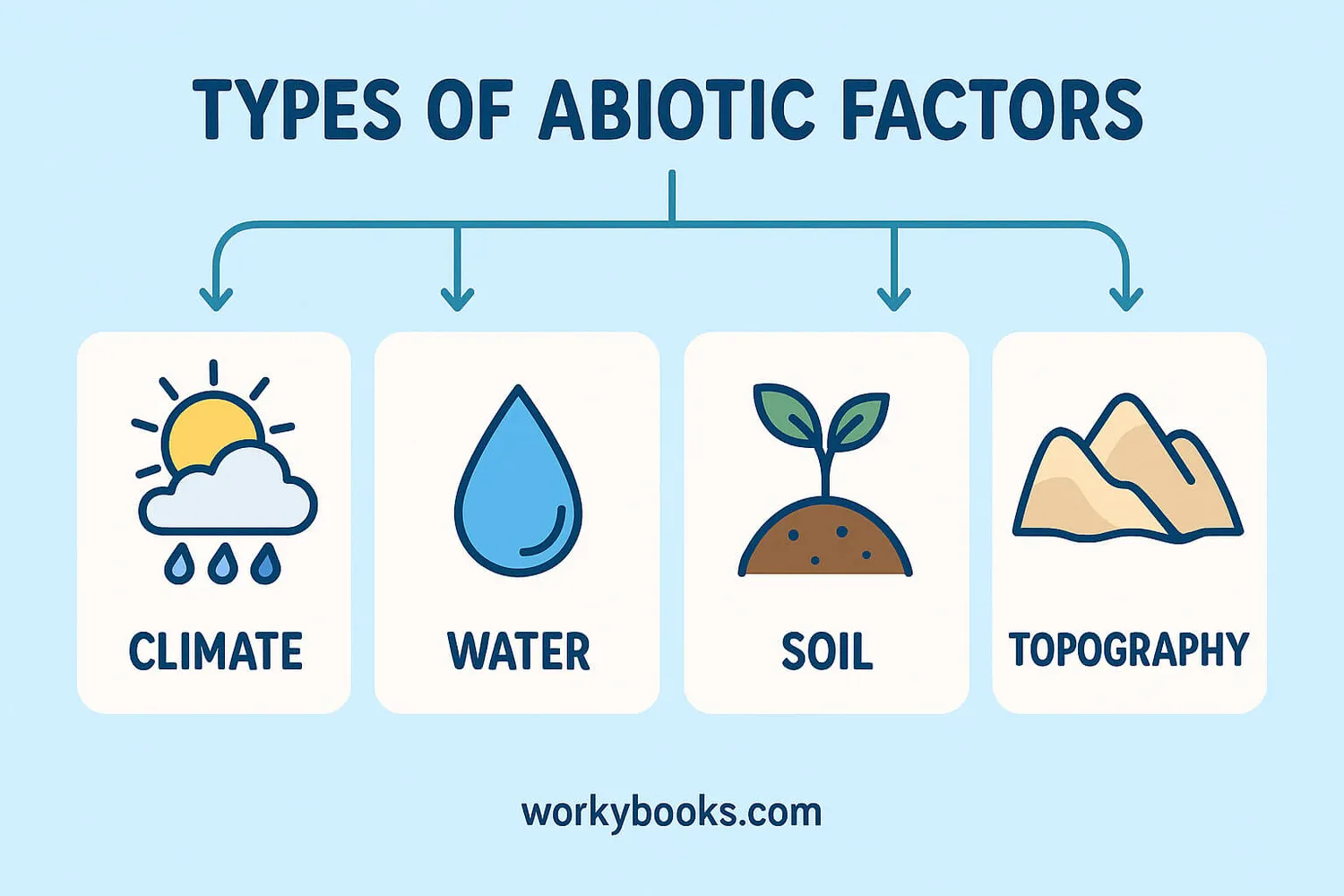
How Abiotic Factors Influence Ecosystems Abiotic factors such as temperature, water availability, sunlight, soil composition, oxygen levels, salinity, and altitude interact to create unique environments. Each species has a tolerance range—the set of conditions it can survive within. For instance, cacti thrive in deserts with minimal water, while fish in freshwater lakes cannot tolerate high salinity. The concept of limiting factors explains how the scarcest abiotic resource controls the growth of populations. If oxygen becomes limited in a pond, fish may die, even if there is plenty of food. These interactions form the basis for understanding ecosystem dynamics.
Adaptations and Microclimates Organisms develop adaptations that help them survive specific abiotic conditions. For example, desert animals like the fennec fox have large ears to release heat, and succulents store water in their tissues. In the deep ocean, high pressure and low temperatures require creatures like the anglerfish to have flexible bodies and special biochemistry. Even within a single ecosystem, there can be microclimates—small areas with different abiotic conditions. The shade under a large tree may be cooler and more humid than the surrounding grassland, allowing different organisms to live there.
Broader Implications and Scientific Principles Understanding abiotic factors is crucial for studying the effects of climate change, habitat destruction, and pollution. Human activities can alter abiotic conditions, leading to shifts in which species can survive. For example, increased salinity in soils due to irrigation can make land unsuitable for crops. Scientists use quantitative data, such as temperature ranges or oxygen concentrations, to model and predict ecosystem changes. This knowledge is essential for conservation efforts and for developing sustainable technologies that work in harmony with natural systems.
Abiotic factors are a core concept in ecology, demonstrating the interconnectedness of living and nonliving components in the natural world. They remind us that even the smallest changes in temperature, water, or light can ripple through entire ecosystems, affecting all forms of life.
Interesting Fact: Some bacteria called extremophiles can survive in boiling hot springs above 100°C or in salt flats ten times saltier than ocean water!
Which of the following is NOT an abiotic factor discussed in the passage?
PredatorsSalinityTemperatureSunlight
What is a tolerance range?
The variety of foods an animal eatsThe range of abiotic conditions an organism can surviveThe number of predators in an ecosystemThe amount of sunlight reaching the ground
What adaptation helps the fennec fox survive in the desert?
Large ears to release heatThick fur for insulationWebbed feet for swimmingSharp teeth for eating prey
Why might fish in a pond die even if there is plenty of food?
If oxygen becomes limitedIf there are too many plantsIf the temperature is stableIf there is too much sunlight
What does the term 'microclimate' refer to?
A large region with one climateA small area with different abiotic conditionsA new organism in an ecosystemA sudden weather event
Which word in the passage means 'the abiotic resource in shortest supply'?
AdaptationLimiting factorSalinityTolerance range
What might happen if irrigation increases the salinity of soil?
The land may become unsuitable for cropsMore animals will move thereRainfall will increaseThe temperature will decrease
Which of the following is an example of an adaptation to high pressure?
Flexible bodies in deep ocean creaturesLarge leaves on treesBright feathers on birdsWebbed feet on ducks
Abiotic factors only affect plants, not animals. (True/False)
TrueFalse
Human activities can change abiotic factors in ecosystems. (True/False)
TrueFalse
Perfect For:
👩🏫 Teachers
• Reading comprehension practice
• Auto-graded assessments
• Literacy skill development
👨👩👧👦 Parents
• Reading practice at home
• Comprehension improvement
• Educational reading time
🏠 Homeschoolers
• Reading curriculum support
• Independent reading practice
• Progress monitoring
Reading Features:
📖
Reading Passage
Engaging fiction or nonfiction text
❓
Comprehension Quiz
Auto-graded questions
📊
Instant Feedback
Immediate results and scoring
📄
Printable Version
Download for offline reading
🔊
Read Aloud
Voice-over with word highlighting
Reviews & Ratings
No reviews yet. Be the first to share your experience!
Related Content
The Leafy Sea Dragon: Nature's Living Seaweed
This NGSS-aligned passage explores how leafy sea dragons (Phycodurus eques) demonstrate key life science concepts for mi...
MS-LS2-1RI.6.3RI.7.3RI.8.8
The Narwhal: Arctic’s Unicorn of the Sea
This NGSS-aligned passage (MS-LS2-1) explores how narwhals survive in Arctic ecosystems. Students learn about specialize...
MS-LS2-1RI.6.3RI.7.3RI.8.8
The Blue-Ringed Octopus
This NGSS aligned passage explores how the tiny blue-ringed octopus impacts its ecosystem through predator-prey relation...
MS-LS2-1RI.6.3RI.7.3RI.8.8
Tardigrades: Microscopic Superheroes
Aligned to MS-LS1-1, this passage examines how tardigrade cell structures (TDP proteins, DNA-repair enzymes) allow survi...
MS-LS2-1RI.6.3RI.7.3RI.8.8
What Do Axolotls Eat?
This science reading passage, titled "What Do Axolotls Eat?", offers an engaging exploration into the feeding habits of ...
MS-LS2-1
Where Do Axolotls Live?
This science reading passage, titled "The Axolotl's Home," delves into the specific natural environment of the fascinati...
MS-LS4-DMS-LS2-1
The Blobfish
This science reading passage, titled "The Blobfish: A Deep-Sea Mystery," introduces students to one of Earth's most pecu...
MS-LS4-DMS-LS2-1
What Do Blobfish Eat?
This science reading passage, titled "What Do Blobfish Eat?", offers an engaging exploration into the feeding habits of ...
MS-LS2-1
Where Do Penguins Live?
This engaging science reading passage, titled "Where Do Penguins Live? A Cold and Coastal World," clarifies the diverse ...
MS-LS2-1
The Emperor Penguin
This science reading passage, titled "The Emperor Penguin: Antarctica's Royal Survivor," introduces students to one of t...
MS-LS2-1
The Adélie Penguin
This engaging science reading passage, titled "The Adélie Penguin: Antarctica's Little Explorer," introduces students to...
MS-LS2-1
How Does Global Warming Affect Adélie Penguins?
This comprehensive science passage, titled "How Does Global Warming Affect Adélie Penguins?", details the significant im...
MS-LS2-1
Desert Birds
This informational passage for grades 6-8 examines how desert birds survive and thrive in some of the harshest environme...
MS-LS2-1MS-LS2-2MS-LS1-4
Biomes: Terrestrial Ecosystems
This NGSS-aligned science reading passage for grades 6-8 provides a comprehensive survey of Earth’s major terrestrial bi...
MS-LS2-1
Biomes: Aquatic Ecosystems
This middle school science passage, aligned with NGSS standard MS-LS2-1, introduces students to the key features and mec...
MS-LS2-1
Galápagos Islands
This engaging science passage explores the Galápagos Islands, a volcanic archipelago located off the coast of Ecuador in...
MS-LS2-1MS-LS4-4MS-ESS3-4
Florida Everglades
This comprehensive passage introduces middle school students to the Florida Everglades, a distinctive wetland ecosystem ...
MS-LS2-1MS-LS2-4MS-ESS3-3MS-ESS3-4
Great Barrier Reef
This passage introduces middle school students to the Great Barrier Reef, the world's largest coral reef system, located...
MS-LS2-1MS-LS2-4MS-ESS3-5
Wetland Biomes
This comprehensive science passage introduces middle school students to the concept of wetland biomes. Aligned with NGSS...