Are Directions Capitalized? — Reading Comprehension
Rate this
Premium Resource
Present
Present in classroom. No work saved
Assign
Classroom with student accounts, Track progress
Quick Play
No student accounts, assign with a link
Grades
3
4
5
6
7
Standards
FL.SS.2.G.1.1
SS.2.G.1.1
PRINT+DIGITAL RESOURCE
This learning resource is available in interactive and printable formats. The interactive worksheet can be played online and assigned to students. The Printable PDF version can be downloaded and printed for completion by hand.
This passage teaches students about capitalization rules for direction words such as north, south, east, and west. It explains the difference between using direction words as general movement versus as part of proper nouns or specific regions. With clear examples and fun comparisons, students learn how to use grammar properly when writing about directions in geography or everyday contexts. This NGSS-aligned passage supports language standards such as L.3.2 and is ideal for integrating writing skills into science and social studies. Students improve reading comprehension while building vocabulary around grammar and geography.
CONTENT PREVIEW
Expand content preview
Understanding When to Capitalize Directions
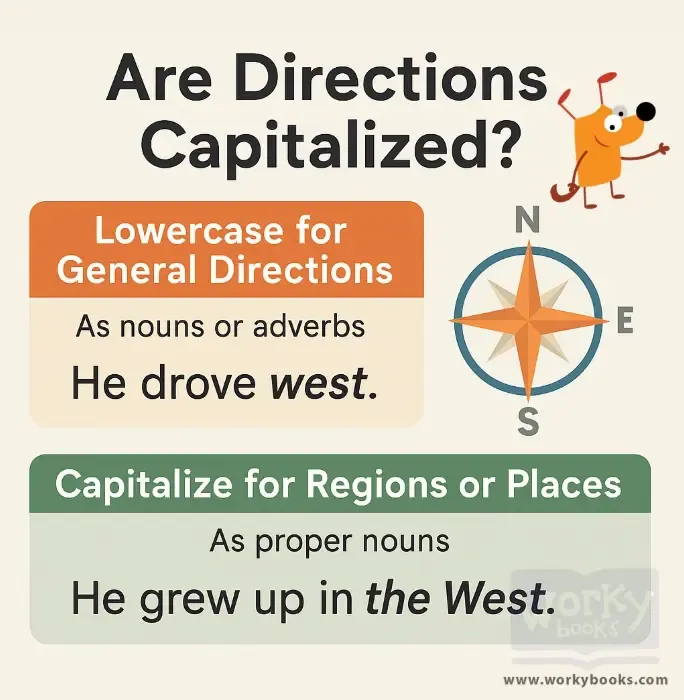
In writing, the words we use for directions—like north, south, east, and west—follow special rules for capitalization. Sometimes, these words get a capital letter, but other times they do not. Learning the difference helps us write correctly about places and regions.
When Do We Use Capital Letters?
Capitalize directions when they are part of a proper noun or the name of a region. Here are some examples:
When the direction names a region: I live in the Southwest.
When talking about people from a region: Northerners experience cold winters.
When it is part of a proper name: North Dakota, South America, East River.
When describing a cultural region: Western culture, Eastern philosophy.
When Do We Use Lowercase?
Do not capitalize directions when talking about which way to go or location:
When giving directions: Turn north on Main Street.
When describing a location: The park is south of the school.
When describing movement: Birds fly south for winter.
When talking about sides: The east side of the building.
Memory Trick
Ask yourself: "Can I replace this with a specific place name?" If yes, use a capital. Another trick is: if it’s a place name, use a capital letter. If it’s just telling you which way to go, use lowercase.
Comparison
Capitalizing directions is like knowing when to use someone’s name versus their job. "Doctor Smith" uses capitals, but "the doctor" does not. In the same way, "the West" (a place name) uses a capital, but "go west" (a direction) does not.
Examples
Capitalize: The West has beautiful mountains.
Don’t capitalize: Go west for three miles.
Capitalize: She moved to Southern California.
Don’t capitalize: The southern part of the state is warmer.
Interesting Fact: Did you know that compasses use the same directions—north, south, east, and west—no matter where you are in the world?
When do you capitalize 'north'?
When it names a regionWhen giving directionsAlwaysNever
Which is a proper noun?
North Dakotanorth of the parkgo northnorth side
What is a region?
A large areaA single streetA direction arrowA small room
Which sentence uses lowercase?
Turn east at the storeEast River is longHe visited the EastShe lives in the West
Why do we capitalize 'West Coast'?
It is a place nameIt is a directionAll words are capitalizedIt's a side
Which is NOT capitalized?
Turn south hereThe South has warm weatherNorthern lightsWestern states
Directions are always capitalized. True or false?
TrueFalse
What does 'proper noun' mean?
A special nameA type of animalA kind of mapA common word
Perfect For:
👩🏫 Teachers
• Reading comprehension practice
• Auto-graded assessments
• Literacy skill development
👨👩👧👦 Parents
• Reading practice at home
• Comprehension improvement
• Educational reading time
🏠 Homeschoolers
• Reading curriculum support
• Independent reading practice
• Progress monitoring
Reading Features:
📖
Reading Passage
Engaging fiction or nonfiction text
❓
Comprehension Quiz
Auto-graded questions
📊
Instant Feedback
Immediate results and scoring
📄
Printable Version
Download for offline reading
🔊
Read Aloud
Voice-over with word highlighting
Reviews & Ratings
No reviews yet. Be the first to share your experience!
Related Content
What Is a Hemisphere?
This passage introduces elementary students to the concept of a *hemisphere*, explaining how Earth can be divided into h...
FL.SS.2.G.1.1SS.2.G.1.1
What Is a Topographic Map?
This passage introduces elementary students to the *topographic map*, a special kind of map that shows *elevation* and *...
FL.SS.2.G.1.1SS.2.G.1.2
Finding Our Way with Cardinal Directions
This engaging passage introduces elementary students to the concept of cardinal directions—north, south, east, and west....
FL.SS.2.G.1.1SS.2.G.1.3
In Between the Main Directions
This short passage teaches students about intermediate directions—northeast, southeast, southwest, and northwest—which f...
FL.SS.2.G.1.1SS.2.G.1.3
What Is a Population Map?
This passage teaches students about population maps, a kind of thematic map that shows how many people live in different...
FL.SS.2.G.1.1SS.2.G.1.3
What Is a Political Map?
This passage introduces elementary students to political maps, which show how land is divided into countries, states, an...
FL.SS.2.G.1.1SS.2.G.1.3
The Western Hemisphere
This reading passage introduces students to the *Western Hemisphere*, the half of the Earth located west of the *Prime M...
FL.SS.2.G.1.1SS.2.G.1.2
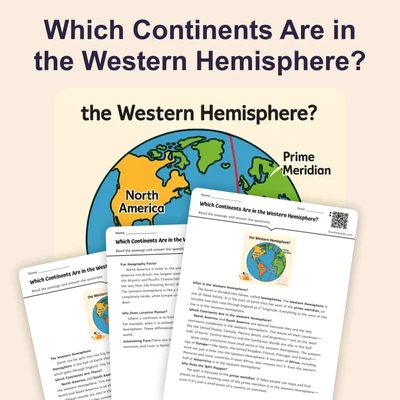
Which Continents Are in the Western Hemisphere?
This passage teaches elementary students which continents are found in the *Western Hemisphere*, including North America...
FL.SS.2.G.1.1SS.2.G.1.3
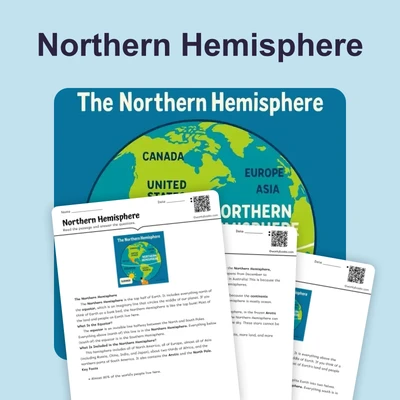
The Northern Hemisphere
This passage introduces elementary students to the *Northern Hemisphere*, the half of Earth that lies above the *Equator...
FL.SS.2.G.1.1SS.2.G.1.2
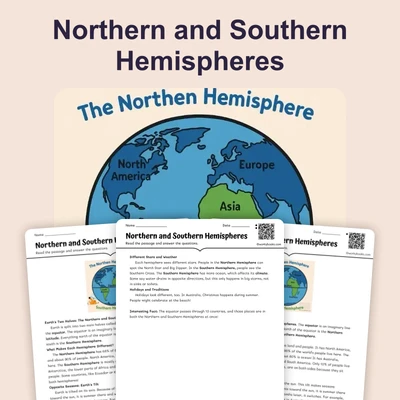
Northern and Southern Hemispheres
This passage explains the difference between the *Northern Hemisphere* and the *Southern Hemisphere*, the two halves of ...
FL.SS.2.G.1.1SS.2.G.1.3
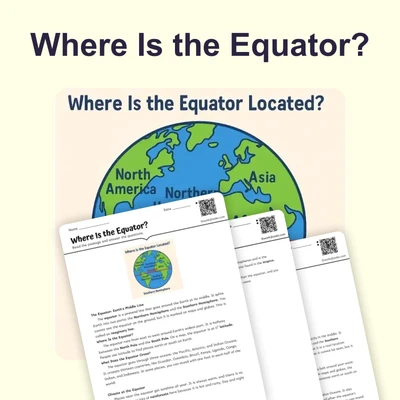
Where Is the Equator?
This passage teaches students about the *Equator*, the imaginary line that divides Earth into the *Northern* and *Southe...
FL.SS.2.G.1.1SS.2.G.1.2
Countries on the Equator
This passage introduces students to countries located on the *Equator*, including Ecuador, Brazil, Kenya, and Indonesia....
FL.SS.2.G.1.1SS.2.G.1.3
Understanding Cardinal Directions
This engaging passage explains the concept of cardinal directions—north, south, east, and west—and their importance in n...
FL.SS.2.G.1.1SS.2.G.1.1
What Is the Prime Meridian?
This passage explains the *Prime Meridian*, the imaginary line that runs from the *North Pole* to the *South Pole* and d...
FL.SS.2.G.1.1SS.2.G.1.3
What Is the Longitude of the Prime Meridian?
This passage explains that the *Prime Meridian* is the line of *0 degrees longitude* that divides the Earth into the *Ea...
FL.SS.2.G.1.1SS.2.G.1.3
My Room and My House
This passage introduces young learners to the idea of personal space by starting with the room and expanding to the hous...
FL.SS.2.G.1.1SS.2.G.1.3
My Street and My Neighborhood
This reading passage helps students understand the concepts of a street and a neighborhood. It highlights how neighborho...
FL.SS.2.G.1.1SS.2.G.1.3
My Town or City
In this passage, students learn how their towns and cities are structured. It explains the role of neighborhoods, commun...
FL.SS.2.G.1.1SS.2.G.1.2
My State or Province
This geography passage teaches students about states or provinces as larger political areas made up of many towns and ci...