This learning resource is available in interactive and printable formats. The interactive worksheet can be played online and assigned to students. The Printable PDF version can be downloaded and printed for completion by hand.
This passage introduces elementary students to political maps, which show how land is divided into countries, states, and cities. Students learn that political maps use bright colors and labels to help us see borders and find important places like capital cities. The passage aligns with Florida social studies standard SS.2.G.1.1 and builds map-reading skills by explaining the difference between political and physical maps. With helpful examples, fun facts, and easy-to-understand vocabulary, this reading helps students better understand how people organize and name places on Earth.
CONTENT PREVIEW
Expand content preview
What Is a Political Map?
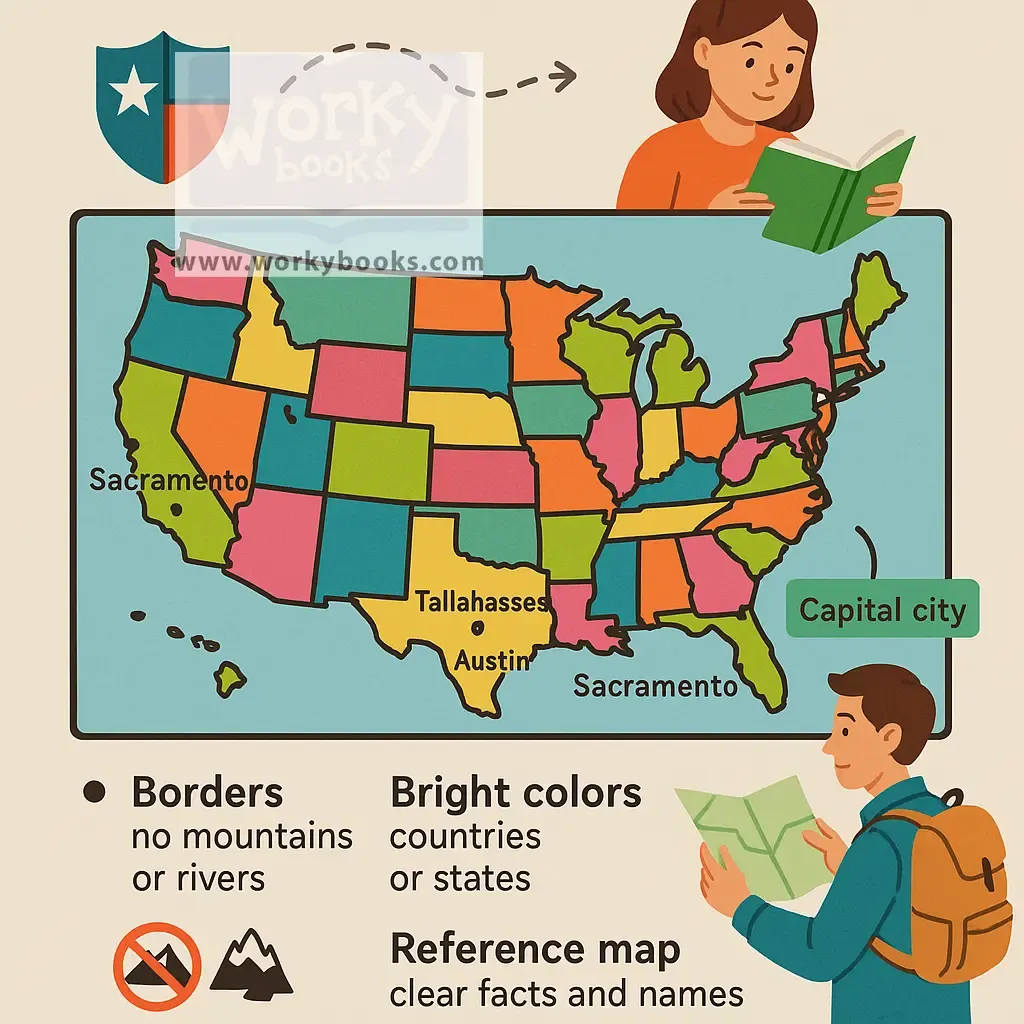
A political map is a special kind of map that shows how humans have divided up the land. Instead of showing mountains, rivers, or forests, a political map displays boundaries that people have agreed on. These boundaries mark where countries, states, and cities begin and end.
What Do Political Maps Show?
Political maps use different colors to show each country or state. This makes it easy to tell them apart. Borders are shown as lines, which show where one country or state ends and another begins. Capital cities are usually marked with a star, and major cities are shown with dots. Sometimes, a dashed line means a special or disputed border. The labels on the map tell you the names of countries, states, and cities.
Why Are They Called 'Political'?
The word political means that the map shows boundaries decided by governments, not nature. For example, a mountain or river exists naturally, but a country’s border is drawn by people. These decisions are made by leaders and governments, often through agreements or even wars.
How to Read a Political Map
On a political map, each country is usually a different color. Stars mark capitals. Big dots show large cities, and small dots show smaller cities. Dashed lines can mean a border that is not agreed on by everyone. Always look at the map key to know what the symbols mean.
Political Maps vs. Physical Maps
A political map is like a coloring book of Earth that humans filled in. For example, on a political map of Africa, you see 54 countries, each with its own borders. But on a physical map, you see the Sahara Desert spreading across many countries, with no lines drawn for borders.
Why Do Borders Change?
Borders can change because of wars, treaties, or independence movements. That’s why political maps from 100 years ago look different from today. For example, the Soviet Union used to be one big country, but now it is 15 separate countries.
Uses of Political Maps
Political maps help us understand news about different countries, learn geography, plan travel, and follow elections and governments.
Interesting Fact: Some borders are straight lines, especially in places like Africa and the Middle East, while others follow rivers or mountains.
What does a political map show?
Human-made borders and countriesMountains and riversWeather patternsTypes of plants
What marks a capital city on a political map?
A starA triangleA squareA wave
Why do borders change over time?
Wars and treatiesCloud movementOcean tidesAnimal migration
How do different colors help on a political map?
Show each country or stateShow rainfallShow tree typesShow temperatures
What is the main difference between political and physical maps?
Political maps show bordersPhysical maps show citiesPolitical maps show volcanoesPhysical maps show languages
If a border is a dashed line, what might it mean?
Special or disputed borderA roadA riverA mountain
Political maps never change. True or false?
TrueFalse
Which word means a line separating areas?
BorderDesertOceanForest
Perfect For:
👩🏫 Teachers
• Reading comprehension practice
• Auto-graded assessments
• Literacy skill development
👨👩👧👦 Parents
• Reading practice at home
• Comprehension improvement
• Educational reading time
🏠 Homeschoolers
• Reading curriculum support
• Independent reading practice
• Progress monitoring
Reading Features:
📖
Reading Passage
Engaging fiction or nonfiction text
❓
Comprehension Quiz
Auto-graded questions
📊
Instant Feedback
Immediate results and scoring
📄
Printable Version
Download for offline reading
🔊
Read Aloud
Voice-over with word highlighting
Reviews & Ratings
No reviews yet. Be the first to share your experience!
Related Content
What Is a Hemisphere?
This passage introduces elementary students to the concept of a *hemisphere*, explaining how Earth can be divided into h...
FL.SS.2.G.1.1SS.2.G.1.1
What Is a Topographic Map?
This passage introduces elementary students to the *topographic map*, a special kind of map that shows *elevation* and *...
FL.SS.2.G.1.1SS.2.G.1.2
Finding Our Way with Cardinal Directions
This engaging passage introduces elementary students to the concept of cardinal directions—north, south, east, and west....
FL.SS.2.G.1.1SS.2.G.1.3
In Between the Main Directions
This short passage teaches students about intermediate directions—northeast, southeast, southwest, and northwest—which f...
FL.SS.2.G.1.1SS.2.G.1.3
What Is a Physical Map?
This passage introduces young students to physical maps and explains how they show Earth's natural features such as moun...
FL.SS.2.G.1.1SS.2.G.1.2
What Is a Population Map?
This passage teaches students about population maps, a kind of thematic map that shows how many people live in different...
FL.SS.2.G.1.1SS.2.G.1.3
The Western Hemisphere
This reading passage introduces students to the *Western Hemisphere*, the half of the Earth located west of the *Prime M...
FL.SS.2.G.1.1SS.2.G.1.2
Which Continents Are in the Western Hemisphere?
This passage teaches elementary students which continents are found in the *Western Hemisphere*, including North America...
FL.SS.2.G.1.1SS.2.G.1.3
The Northern Hemisphere
This passage introduces elementary students to the *Northern Hemisphere*, the half of Earth that lies above the *Equator...
FL.SS.2.G.1.1SS.2.G.1.2
Northern and Southern Hemispheres
This passage explains the difference between the *Northern Hemisphere* and the *Southern Hemisphere*, the two halves of ...
FL.SS.2.G.1.1SS.2.G.1.3
Where Is the Equator?
This passage teaches students about the *Equator*, the imaginary line that divides Earth into the *Northern* and *Southe...
FL.SS.2.G.1.1SS.2.G.1.2
Countries on the Equator
This passage introduces students to countries located on the *Equator*, including Ecuador, Brazil, Kenya, and Indonesia....
FL.SS.2.G.1.1SS.2.G.1.3
Understanding Cardinal Directions
This engaging passage explains the concept of cardinal directions—north, south, east, and west—and their importance in n...
FL.SS.2.G.1.1SS.2.G.1.1
What Is the Prime Meridian?
This passage explains the *Prime Meridian*, the imaginary line that runs from the *North Pole* to the *South Pole* and d...
FL.SS.2.G.1.1SS.2.G.1.3
What Is the Longitude of the Prime Meridian?
This passage explains that the *Prime Meridian* is the line of *0 degrees longitude* that divides the Earth into the *Ea...
FL.SS.2.G.1.1SS.2.G.1.3
Are Directions Capitalized?
This passage teaches students about capitalization rules for direction words such as north, south, east, and west. It ex...
FL.SS.2.G.1.1SS.2.G.1.1
My Room and My House
This passage introduces young learners to the idea of personal space by starting with the room and expanding to the hous...
FL.SS.2.G.1.1SS.2.G.1.3
My Street and My Neighborhood
This reading passage helps students understand the concepts of a street and a neighborhood. It highlights how neighborho...
FL.SS.2.G.1.1SS.2.G.1.3
My Town or City
In this passage, students learn how their towns and cities are structured. It explains the role of neighborhoods, commun...