In Between the Main Directions — Reading Comprehension
Rate this
Premium Resource
Present
Present in classroom. No work saved
Assign
Classroom with student accounts, Track progress
Quick Play
No student accounts, assign with a link
Grades
3
4
5
6
7
Standards
FL.SS.2.G.1.1
SS.2.G.1.3
PRINT+DIGITAL RESOURCE
This learning resource is available in interactive and printable formats. The interactive worksheet can be played online and assigned to students. The Printable PDF version can be downloaded and printed for completion by hand.
This short passage teaches students about intermediate directions—northeast, southeast, southwest, and northwest—which fall between the main cardinal directions. It explains how these directions are shown on a compass rose and used in real life, such as on maps and GPS devices. The text helps students understand how to give and follow more exact directions, which aligns with Florida standard SS.2.G.1.1. With kid-friendly vocabulary, real-life examples, and a simple explanation, this passage supports map-reading and geography skills for students in grades 2–3.
CONTENT PREVIEW
Expand content preview
In Between the Main Directions
When we talk about where something is, we often use the four main directions: north, south, east, and west. But sometimes, these directions are not exact enough. What if the library is not directly north or east, but somewhere in between? That’s when we need the in-between directions.
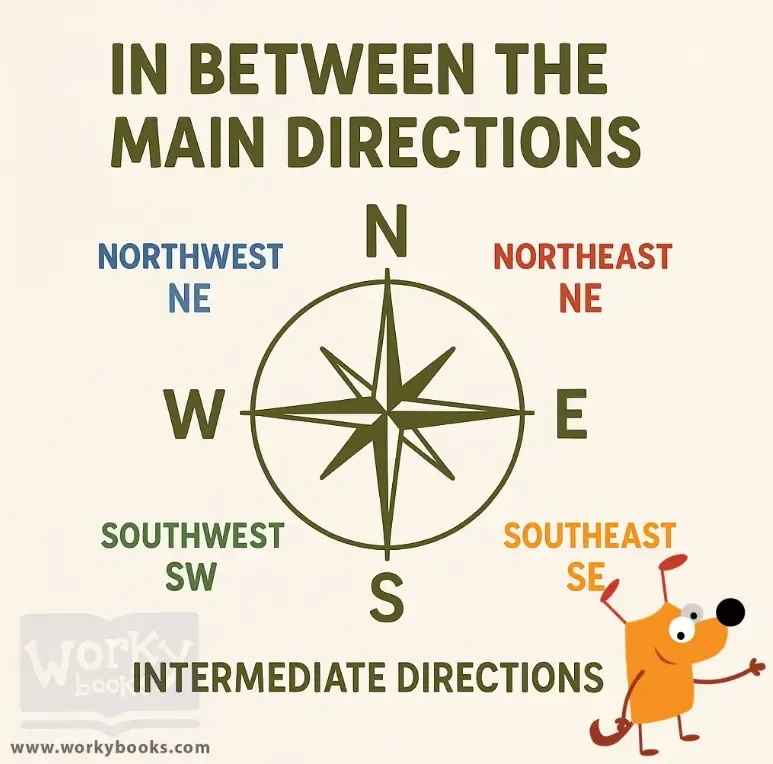
The four in-between directions are northeast, southeast, southwest, and northwest. These directions help us describe a location more precisely. For example, if your school is northeast of your house, it means it is between north and east—not exactly one or the other, but a mix of both. It’s like choosing not just chocolate or vanilla ice cream, but a chocolate-vanilla swirl!
The names of these directions always start with north or south, followed by east or west. So, we say "northeast," not "eastnorth." Here are some examples: northeast is between north and east (like where New England states are), southeast is between south and east (like Florida), southwest is between south and west (like Arizona), and northwest is between north and west (like Washington State).
To show all eight directions on a map, we often use a compass rose. This symbol looks like a star and points out north, south, east, west, and the in-between directions. The compass rose helps us read maps and give better directions.
We use these directions every day. For example, you might ask, “Which way to the playground from our classroom?” or “What direction do I go to grandma’s house?” Even the sun doesn’t always rise exactly in the east—it can be a little northeast in summer.
Pilots, sailors, and hikers sometimes use even more exact directions with numbers called degrees, like 45° for northeast. But knowing the eight main directions is usually enough for most of us to find our way.
Interesting Fact: The compass rose has been used on maps for hundreds of years to help people travel safely across land and sea!
Which is an in-between direction?
NortheastNorthEastSouth
What helps us read maps?
Compass roseThermometerClockRuler
Which direction is Florida from New England?
SoutheastSouthwestNorthwestNortheast
Why do we use in-between directions?
For more exact locationsFor funTo tell timeTo do math
If the playground is between north and west, what direction?
NorthwestSouthwestNortheastEast
What does a compass rose look like?
A starA squareA circleA triangle
Northeast is between north and east. True or false?
TrueFalse
What is a compass rose?
A symbol showing directionsA kind of flowerA type of birdA mountain
Perfect For:
👩🏫 Teachers
• Reading comprehension practice
• Auto-graded assessments
• Literacy skill development
👨👩👧👦 Parents
• Reading practice at home
• Comprehension improvement
• Educational reading time
🏠 Homeschoolers
• Reading curriculum support
• Independent reading practice
• Progress monitoring
Reading Features:
📖
Reading Passage
Engaging fiction or nonfiction text
❓
Comprehension Quiz
Auto-graded questions
📊
Instant Feedback
Immediate results and scoring
📄
Printable Version
Download for offline reading
🔊
Read Aloud
Voice-over with word highlighting
Reviews & Ratings
No reviews yet. Be the first to share your experience!
Related Content
What Is a Hemisphere?
This passage introduces elementary students to the concept of a *hemisphere*, explaining how Earth can be divided into h...
FL.SS.2.G.1.1SS.2.G.1.1
What Is a Topographic Map?
This passage introduces elementary students to the *topographic map*, a special kind of map that shows *elevation* and *...
FL.SS.2.G.1.1SS.2.G.1.2
Finding Our Way with Cardinal Directions
This engaging passage introduces elementary students to the concept of cardinal directions—north, south, east, and west....
FL.SS.2.G.1.1SS.2.G.1.3
What Is a Physical Map?
This passage introduces young students to physical maps and explains how they show Earth's natural features such as moun...
FL.SS.2.G.1.1SS.2.G.1.2
What Is a Population Map?
This passage teaches students about population maps, a kind of thematic map that shows how many people live in different...
FL.SS.2.G.1.1SS.2.G.1.3
What Is a Political Map?
This passage introduces elementary students to political maps, which show how land is divided into countries, states, an...
FL.SS.2.G.1.1SS.2.G.1.3
The Western Hemisphere
This reading passage introduces students to the *Western Hemisphere*, the half of the Earth located west of the *Prime M...
FL.SS.2.G.1.1SS.2.G.1.2
Which Continents Are in the Western Hemisphere?
This passage teaches elementary students which continents are found in the *Western Hemisphere*, including North America...
FL.SS.2.G.1.1SS.2.G.1.3
The Northern Hemisphere
This passage introduces elementary students to the *Northern Hemisphere*, the half of Earth that lies above the *Equator...
FL.SS.2.G.1.1SS.2.G.1.2
Northern and Southern Hemispheres
This passage explains the difference between the *Northern Hemisphere* and the *Southern Hemisphere*, the two halves of ...
FL.SS.2.G.1.1SS.2.G.1.3
Where Is the Equator?
This passage teaches students about the *Equator*, the imaginary line that divides Earth into the *Northern* and *Southe...
FL.SS.2.G.1.1SS.2.G.1.2
Countries on the Equator
This passage introduces students to countries located on the *Equator*, including Ecuador, Brazil, Kenya, and Indonesia....
FL.SS.2.G.1.1SS.2.G.1.3
Understanding Cardinal Directions
This engaging passage explains the concept of cardinal directions—north, south, east, and west—and their importance in n...
FL.SS.2.G.1.1SS.2.G.1.1
What Is the Prime Meridian?
This passage explains the *Prime Meridian*, the imaginary line that runs from the *North Pole* to the *South Pole* and d...
FL.SS.2.G.1.1SS.2.G.1.3
What Is the Longitude of the Prime Meridian?
This passage explains that the *Prime Meridian* is the line of *0 degrees longitude* that divides the Earth into the *Ea...
FL.SS.2.G.1.1SS.2.G.1.3
Are Directions Capitalized?
This passage teaches students about capitalization rules for direction words such as north, south, east, and west. It ex...
FL.SS.2.G.1.1SS.2.G.1.1
My Room and My House
This passage introduces young learners to the idea of personal space by starting with the room and expanding to the hous...
FL.SS.2.G.1.1SS.2.G.1.3
My Street and My Neighborhood
This reading passage helps students understand the concepts of a street and a neighborhood. It highlights how neighborho...
FL.SS.2.G.1.1SS.2.G.1.3
My Town or City
In this passage, students learn how their towns and cities are structured. It explains the role of neighborhoods, commun...