What Is a Topographic Map? — Reading Comprehension
Rate this|
1
Present
Present in classroom. No work saved
Assign
Classroom with student accounts, Track progress
Quick Play
No student accounts, assign with a link
Grades
3
4
5
6
7
Standards
FL.SS.2.G.1.1
SS.2.G.1.2
PRINT+DIGITAL RESOURCE
This learning resource is available in interactive and printable formats. The interactive worksheet can be played online and assigned to students. The Printable PDF version can be downloaded and printed for completion by hand.
This passage introduces elementary students to the *topographic map*, a special kind of map that shows *elevation* and *landforms* using *contour lines*. Students learn how to read these lines and understand what they tell us about the land’s shape—such as hills, valleys, and mountains. The passage explains how hikers, engineers, and scientists use these maps in real life. Aligned with Florida standard FL.SS.2.G.1.1, this passage builds geography skills and helps young learners read and understand land features on maps.
CONTENT PREVIEW
Expand content preview
What Is a Topographic Map?
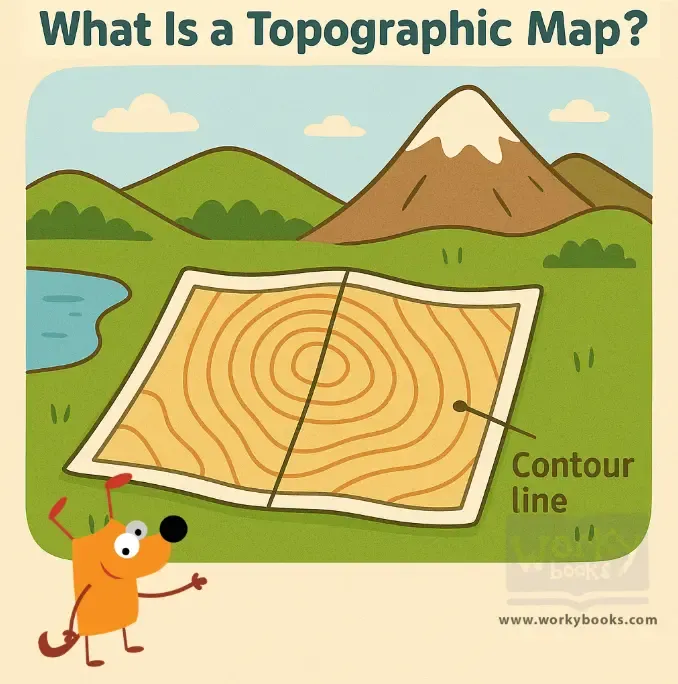
A topographic map is a special map that shows the shape of the land. It helps us see hills, mountains, valleys, and flat areas on a flat sheet of paper. The challenge is that Earth is three-dimensional with bumps and dips, but a map is flat. So, how do we show the land's height and depth?
Understanding Contour Lines
Topographic maps use contour lines to show elevation. A contour line is an imaginary line that connects places with the same height above sea level. Each line stands for a specific elevation. When contour lines are close together, they show a steep slope, like a cliff or a hill. When the lines are far apart, the land is more flat or gently sloped.
Reading Contour Lines
Reading a topographic map is like looking at a mountain sliced into layers, then looking down from above. Each layer is shown by a contour line. The space between the lines is called the contour interval. This tells you how much the elevation changes from one line to the next—often 10, 20, or 40 feet.
Other Map Features
Topographic maps use colors and symbols to show different features. Blue stands for water like rivers and lakes. Green shows forests or vegetation. Brown is used for contour lines. Black shows roads and buildings. Special marks called benchmarks give exact elevation numbers.
Why Are Topographic Maps Useful?
Many people use topographic maps: hikers plan safe and easy routes, builders choose the best places to build, and city planners, geologists, and farmers learn about the land. Rescue teams use them during emergencies. These maps help people find water, avoid steep climbs, and understand flood risks. The USGS (United States Geological Survey) makes topographic maps for the whole country.
A topographic map is like a fingerprint of the land—the curvy contour lines show every bump, slope, and valley just like ridges on your fingertip!
Interesting Fact: The highest mountain in the United States, Mount Denali, is shown on topographic maps with special contour lines that circle its peak many times!
What does a topographic map show?
Shape of the landWeather patternsAnimal habitatsOcean currents
What are contour lines?
Lines for equal elevationAnimal tracksWaterwaysTree lines
Which color shows water on the map?
BlueGreenBrownBlack
Lines close together mean what?
Steep slopeFlat landWater areaForest
Why do hikers use topographic maps?
To find safe routesTo watch birdsTo see weatherTo draw animals
What does a benchmark show?
Exact elevationRoad nameTree typeRiver length
Contour lines always show animal paths. True or false?
TrueFalse
What is elevation?
Height above sea levelDepth of waterAmount of rainfallNumber of trees
Perfect For:
👩🏫 Teachers
• Reading comprehension practice
• Auto-graded assessments
• Literacy skill development
👨👩👧👦 Parents
• Reading practice at home
• Comprehension improvement
• Educational reading time
🏠 Homeschoolers
• Reading curriculum support
• Independent reading practice
• Progress monitoring
Reading Features:
📖
Reading Passage
Engaging fiction or nonfiction text
❓
Comprehension Quiz
Auto-graded questions
📊
Instant Feedback
Immediate results and scoring
📄
Printable Version
Download for offline reading
🔊
Read Aloud
Voice-over with word highlighting
Reviews & Ratings
No reviews yet. Be the first to share your experience!
Related Content
What Is a Hemisphere?
This passage introduces elementary students to the concept of a *hemisphere*, explaining how Earth can be divided into h...
FL.SS.2.G.1.1SS.2.G.1.1
Finding Our Way with Cardinal Directions
This engaging passage introduces elementary students to the concept of cardinal directions—north, south, east, and west....
FL.SS.2.G.1.1SS.2.G.1.3
In Between the Main Directions
This short passage teaches students about intermediate directions—northeast, southeast, southwest, and northwest—which f...
FL.SS.2.G.1.1SS.2.G.1.3
What Is a Physical Map?
This passage introduces young students to physical maps and explains how they show Earth's natural features such as moun...
FL.SS.2.G.1.1SS.2.G.1.2
What Is a Population Map?
This passage teaches students about population maps, a kind of thematic map that shows how many people live in different...
FL.SS.2.G.1.1SS.2.G.1.3
What Is a Political Map?
This passage introduces elementary students to political maps, which show how land is divided into countries, states, an...
FL.SS.2.G.1.1SS.2.G.1.3
The Western Hemisphere
This reading passage introduces students to the *Western Hemisphere*, the half of the Earth located west of the *Prime M...
FL.SS.2.G.1.1SS.2.G.1.2
Which Continents Are in the Western Hemisphere?
This passage teaches elementary students which continents are found in the *Western Hemisphere*, including North America...
FL.SS.2.G.1.1SS.2.G.1.3
The Northern Hemisphere
This passage introduces elementary students to the *Northern Hemisphere*, the half of Earth that lies above the *Equator...
FL.SS.2.G.1.1SS.2.G.1.2
Northern and Southern Hemispheres
This passage explains the difference between the *Northern Hemisphere* and the *Southern Hemisphere*, the two halves of ...
FL.SS.2.G.1.1SS.2.G.1.3
Where Is the Equator?
This passage teaches students about the *Equator*, the imaginary line that divides Earth into the *Northern* and *Southe...
FL.SS.2.G.1.1SS.2.G.1.2
Countries on the Equator
This passage introduces students to countries located on the *Equator*, including Ecuador, Brazil, Kenya, and Indonesia....
FL.SS.2.G.1.1SS.2.G.1.3
Understanding Cardinal Directions
This engaging passage explains the concept of cardinal directions—north, south, east, and west—and their importance in n...
FL.SS.2.G.1.1SS.2.G.1.1
What Is the Prime Meridian?
This passage explains the *Prime Meridian*, the imaginary line that runs from the *North Pole* to the *South Pole* and d...
FL.SS.2.G.1.1SS.2.G.1.3
What Is the Longitude of the Prime Meridian?
This passage explains that the *Prime Meridian* is the line of *0 degrees longitude* that divides the Earth into the *Ea...
FL.SS.2.G.1.1SS.2.G.1.3
Are Directions Capitalized?
This passage teaches students about capitalization rules for direction words such as north, south, east, and west. It ex...
FL.SS.2.G.1.1SS.2.G.1.1
My Room and My House
This passage introduces young learners to the idea of personal space by starting with the room and expanding to the hous...
FL.SS.2.G.1.1SS.2.G.1.3
My Street and My Neighborhood
This reading passage helps students understand the concepts of a street and a neighborhood. It highlights how neighborho...
FL.SS.2.G.1.1SS.2.G.1.3
My Town or City
In this passage, students learn how their towns and cities are structured. It explains the role of neighborhoods, commun...