Reading Passage

My Street and My Neighborhood

Interactive passage with audio narration, comprehension questions, and printable PDF.

No ratings yet|
1
Grades 1–5ElaSocialReadingEnglish · SpanishInteractive · Printable
Aligned toFL.SS.2.G.1.1SS.2.G.1.3

What's included

Reading passage
Audio narration
Comprehension quiz
Writing activity
Glossary & flashcards
Differentiated version
Spanish translation

My Street and My Neighborhood preview and details

About this printable My Street and My Neighborhood reading passage (Grades 1-5)

This reading passage helps students understand the concepts of a street and a neighborhood. It highlights how neighborhoods are made up of homes, parks, and people, and how they support community life. Aligned with SS.2.G.1.1, it supports development of geographical thinking from personal to local spaces, encouraging students to observe their surroundings and understand how people live and work together.
Written by Workybooks TeamPublished by Workybooks
Preview

Sample passage and quiz from My Street and My Neighborhood

Reading passage and comprehension quiz preview

My Street and My Neighborhood
QZ.SS.2.G.1.1-2


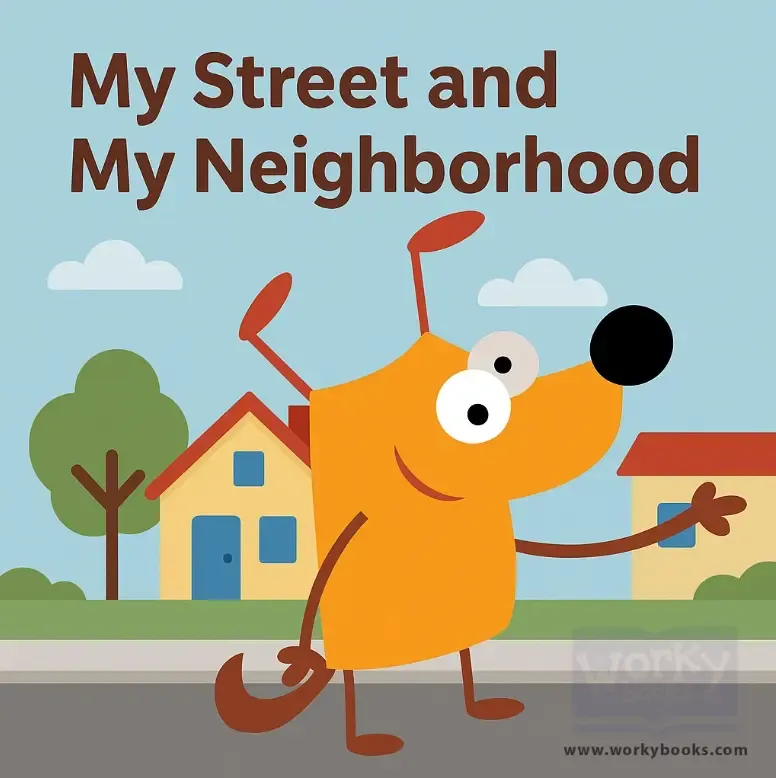
Your street is the road in front of your house. It may have sidewalks, trees, mailboxes, and street signs. Streets help people travel to places nearby.


Many streets together make a neighborhood. A neighborhood has homes, parks, schools, and stores. It’s where people live, work, and play. People in a neighborhood help each other and often know each other well.


🛹 Fun Fact: Some neighborhoods have a name, just like people do!

Comprehension quiz (6 questions)

1. What is the main idea of this passage?

Streets are fun to drive on
Neighborhoods are full of animals
Streets and neighborhoods are where people live and play
Sidewalks are only for walking

2. What can you find in a neighborhood?

Forests and caves
Houses, parks, and schools
Trains and airplanes
Only animals

3. What is the purpose of streets?

To grow flowers
To fly kites
To help people travel nearby
To collect water

4. What happens when people know their neighbors?

They fight often
They help each other
They move away
They forget their names

5. What can you infer about neighborhoods?

People never talk to each other
People live far apart
People can go to nearby parks and stores
All streets are made of dirt

6. Why did the author write this passage?

To teach how to make a street
To show how people live together in a community
To describe how cars work
To tell a story about a dog on the road
Who it's for

Perfect for the way you teach

Teachers
  • Build comprehension skills
  • Auto-graded quiz
  • Differentiated reading
Parents
  • Read together at home
  • Improve fluency
  • Quiet reading time
Homeschoolers
  • Reading curriculum support
  • Independent practice
  • Track Lexile growth
Topics

Reviews & Ratings

No reviews yet. Be the first to share your experience!

More reading you might love

19 more
Passage
What Is a Hemisphere? - reading educational content
Grades 3–7

What Is a Hemisphere?

earth and space science · FL.SS.2.G.1.1

$1.50
Passage
What Is a Topographic Map? - reading educational content
Grades 3–7

What Is a Topographic Map?

earth and space science · FL.SS.2.G.1.1

Free
Passage
Finding Our Way with Cardinal Directions - reading educational content
Grades 3–7

Finding Our Way with Cardinal Directions

earth and space science · FL.SS.2.G.1.1

$1.50
Passage
In Between the Main Directions - reading educational content
Grades 3–7

In Between the Main Directions

earth and space science · FL.SS.2.G.1.1

$1.50
Passage
What Is a Population Map? - reading educational content
Grades 3–7

What Is a Population Map?

earth and space science · FL.SS.2.G.1.1

$1.50
Passage
What Is a Political Map? - reading educational content
Grades 1–5

What Is a Political Map?

earth and space science · FL.SS.2.G.1.1

$1.50
Passage
The Western Hemisphere - reading educational content
Grades 3–7

The Western Hemisphere

earth and space science · FL.SS.2.G.1.1

Free
Passage
Which Continents Are in the Western Hemisphere? - reading educational content
Grades 3–7

Which Continents Are in the Western Hemisphere?

earth and space science · FL.SS.2.G.1.1

$1.50
Passage
The Northern Hemisphere - reading educational content
Grades 3–7

The Northern Hemisphere

earth and space science · FL.SS.2.G.1.1

$1.50
Passage
Northern and Southern Hemispheres - reading educational content
Grades 3–7

Northern and Southern Hemispheres

earth and space science · FL.SS.2.G.1.1

Free
Passage
Where Is the Equator? - reading educational content
Grades 3–7

Where Is the Equator?

earth and space science · FL.SS.2.G.1.1

Free
Passage
Countries on the Equator - reading educational content
Grades 3–7

Countries on the Equator

earth and space science · FL.SS.2.G.1.1

$1.50
Passage
Understanding Cardinal Directions - reading educational content
Grades 3–7

Understanding Cardinal Directions

earth and space science · FL.SS.2.G.1.1

$1.50
Passage
What Is the Prime Meridian? - reading educational content
Grades 3–7

What Is the Prime Meridian?

earth and space science · FL.SS.2.G.1.1

$1.50
Passage
What Is the Longitude of the Prime Meridian? - reading educational content
Grades 3–7

What Is the Longitude of the Prime Meridian?

earth and space science · FL.SS.2.G.1.1

Free
Passage
Are Directions Capitalized? - reading educational content
Grades 3–7

Are Directions Capitalized?

earth and space science · FL.SS.2.G.1.1

$1.50
Passage
My Room and My House - reading educational content
Grades 1–5

My Room and My House

social · FL.SS.2.G.1.1

Free
Passage
My Town or City - reading educational content
Grades 1–5

My Town or City

social · FL.SS.2.G.1.1

$1.50
Passage
My State or Province - reading educational content
Grades 1–5

My State or Province

social · FL.SS.2.G.1.1

$1.50
Copyright © 2026 Workybooks. Made with ♥ in California.