Understanding Cardinal Directions
Interactive passage with audio narration, comprehension questions, and printable PDF.
What's included
Understanding Cardinal Directions preview and details
About this printable Understanding Cardinal Directions reading passage (Grades 3-7)
Sample passage and quiz from Understanding Cardinal Directions
Reading passage and comprehension quiz preview
Understanding Cardinal Directions
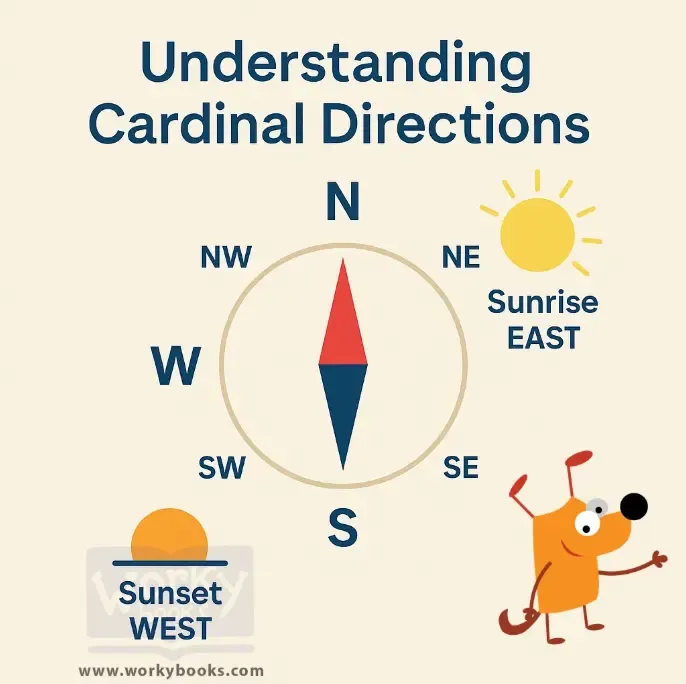
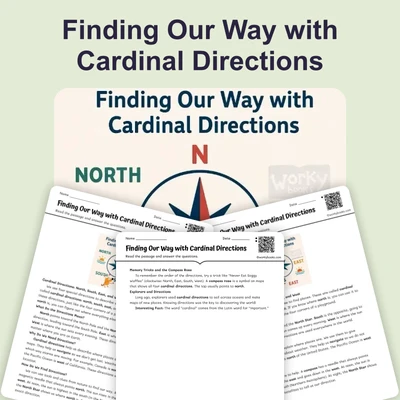
Cardinal directions are the four main points of a compass: north, south, east, and west. These directions help people describe locations, navigate from one place to another, and read maps. They are important in geography, travel, science, and everyday life. Knowing how to use cardinal directions helps us understand where things are in the world and how to get there.
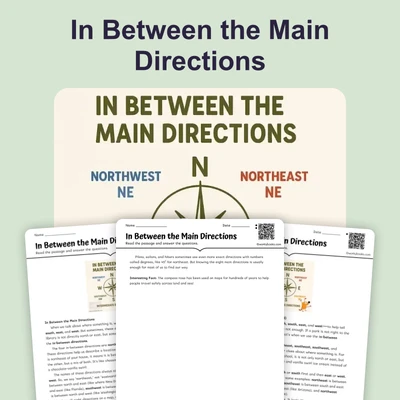
The compass rose is a symbol that shows directions on a map. The four cardinal directions—north (N), south (S), east (E), and west (W)—are evenly spaced on the compass rose. Between these main points are intermediate directions like northeast (NE), southeast (SE), southwest (SW), and northwest (NW). These help give more exact directions.
The sun can help you figure out directions. In the morning, the sun rises in the east, and in the evening, it sets in the west. If you face the sunrise, you are facing east. Behind you is west, to your left is north, and to your right is south. This method is useful when you don’t have a compass.
In real life, cardinal directions are used in many ways. Pilots and sailors rely on them to travel across skies and seas. Hikers use them to follow trails in nature. Maps in books or on phones use cardinal directions to show how places relate to one another. Even animals like birds use Earth’s magnetic field and directions to migrate across continents.
Understanding cardinal directions helps people communicate clearly about location and direction. Whether you are reading a map, giving someone directions, or finding your way outdoors, these directions guide your way.
Fun Fact: The word “cardinal” comes from the Latin word cardo, meaning “hinge”—because everything else hinges or depends on these main directions
Comprehension quiz (8 questions)
1. What are the four cardinal directions?
2. What symbol on a map shows directions?
3. In which direction does the sun rise?
4. What happens when you face the sunrise?
5. Why are intermediate directions useful?
6. How do birds use cardinal directions?
7. What is the main idea of this passage?
8. If a hiker is lost and sees the sun setting, what direction is that?
Perfect for the way you teach
- Build comprehension skills
- Auto-graded quiz
- Differentiated reading
- Read together at home
- Improve fluency
- Quiet reading time
- Reading curriculum support
- Independent practice
- Track Lexile growth