What Is a Hemisphere?
Interactive passage with audio narration, comprehension questions, and printable PDF.
By completing this purchase you agree to our Terms of Use and Privacy Policy. Your subscription renews automatically until you cancel. You can cancel anytime from your account settings. All sales are final and non-refundable. Digital content is available for download in your account immediately upon purchase.
What's included
What Is a Hemisphere? preview and details
About this printable What Is a Hemisphere? reading passage (Grades 3-7)
Sample passage and quiz from What Is a Hemisphere?
Reading passage and comprehension quiz preview
What Is a Hemisphere?
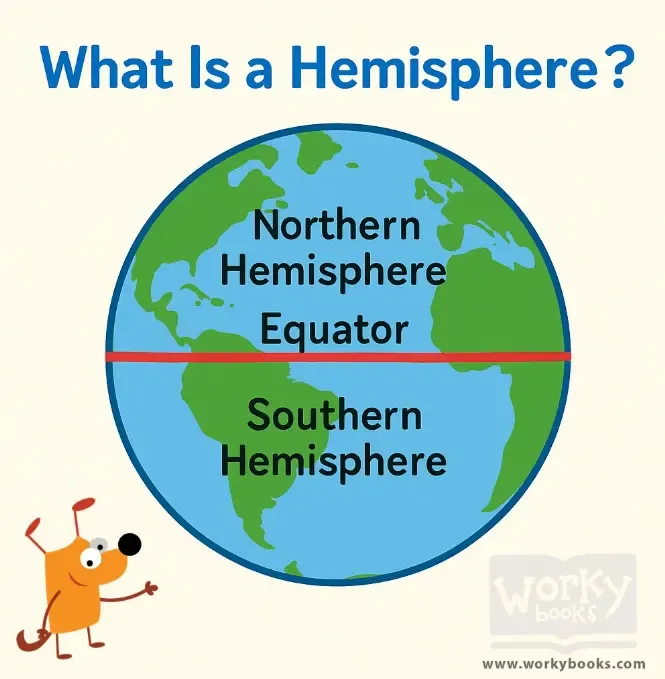
What Is a Hemisphere?
A hemisphere is half of a sphere. The word comes from two parts: 'hemi' means half, and 'sphere' means a round ball. So, a hemisphere is just a half-ball shape!
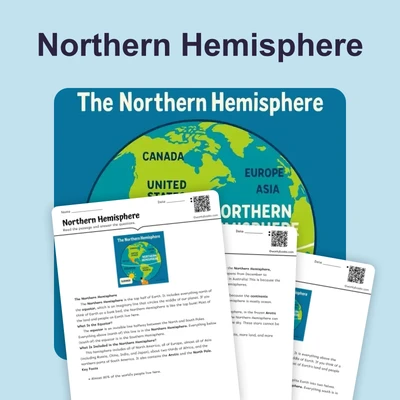
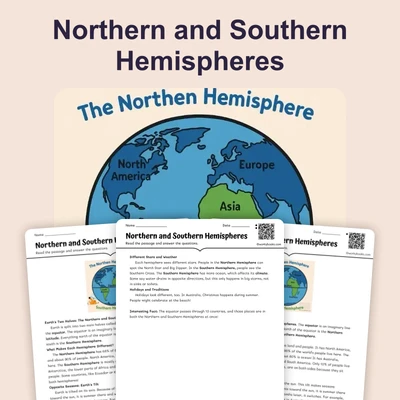
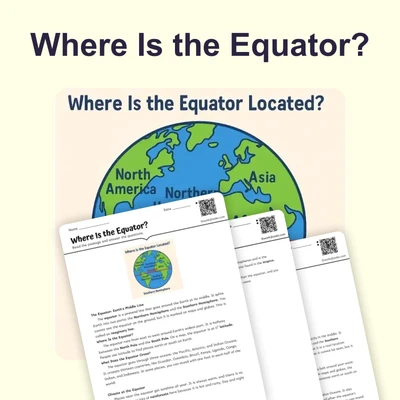
When we talk about Earth, we use imaginary lines to split it into four hemispheres. The first line is the equator. The equator circles the middle of Earth and divides it into two halves: the Northern Hemisphere and the Southern Hemisphere. Everything north of the equator, like most of North America, Europe, and Asia, is in the Northern Hemisphere. Everything south, such as most of South America, the bottom half of Africa, Australia, and Antarctica, is in the Southern Hemisphere.
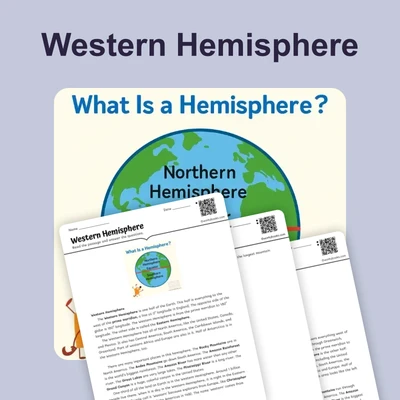
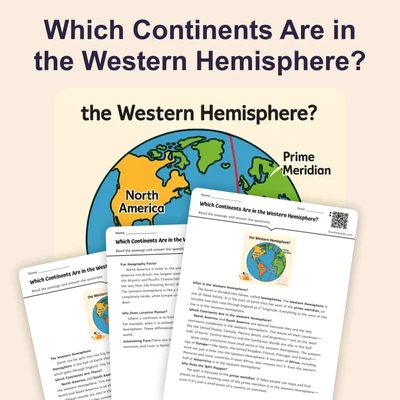
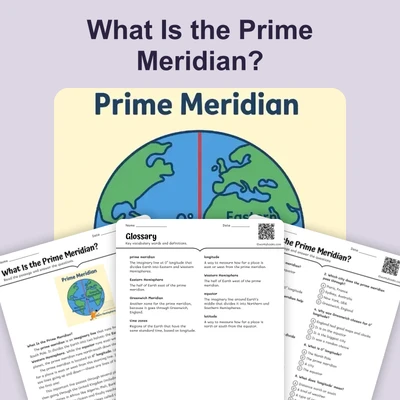
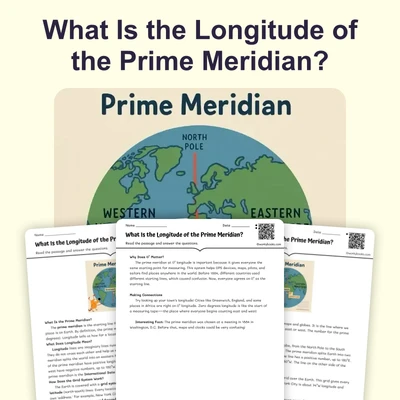
The second important line is the prime meridian. This line runs from the North Pole to the South Pole. It divides Earth into the Eastern Hemisphere and the Western Hemisphere. The Western Hemisphere includes North and South America. The Eastern Hemisphere includes Europe, Africa, Asia, and Australia.
Every place on Earth is in two hemispheres at once! For example, the United States is in both the Northern Hemisphere and the Western Hemisphere.
Why do hemispheres matter? Hemispheres help us locate places on maps and globes. They also explain why we have different seasons. When it is summer in the Northern Hemisphere, it is winter in the Southern Hemisphere. Hemispheres also affect what stars and constellations we can see and even the direction water drains, because of something called the Coriolis effect.
Hemispheres are not just found on Earth. The moon and other planets have hemispheres too! You can think of hemispheres like slicing an orange: if you cut it one way, you get a top and bottom half (like the equator); if you cut it another way, you get left and right halves (like the prime meridian).
Interesting Fact: The word 'hemisphere' is also used in math, sports, and even in talking about the brain!
Comprehension quiz (8 questions)
1. What does 'hemi' mean?
2. Which line divides north and south?
3. Where is Australia located?
4. Why do hemispheres matter?
5. Which hemisphere is the United States in?
6. What happens when it is summer in the north?
7. The prime meridian divides east and west. True or false?
8. What is the equator?
Perfect for the way you teach
- Build comprehension skills
- Auto-graded quiz
- Differentiated reading
- Read together at home
- Improve fluency
- Quiet reading time
- Reading curriculum support
- Independent practice
- Track Lexile growth