This learning resource is available in interactive and printable formats. The interactive worksheet can be played online and assigned to students. The Printable PDF version can be downloaded and printed for completion by hand.
This engaging reading passage introduces students to Aristophanes, one of the most influential playwrights of Ancient Greece and a master of satirical comedy. The passage explores the social, political, and cultural context of Athens in the 5th century BCE, highlighting how Aristophanes used humor to criticize powerful leaders and everyday citizens. Students will examine specific examples from Aristophanes’s plays, learn about the structure of ancient Greek theater, and understand the impact of comedy on society. The passage is aligned with standards 6.4.1, 6.7, and CCSS.RI.6-8.1, and includes a glossary of academic vocabulary, multiple-choice quiz, writing prompts, graphic organizers, and a timeline. Audio read-aloud and a full Spanish translation support accessibility. This resource is ideal for exploring the connections between art, society, and politics in ancient civilizations.
CONTENT PREVIEW
Expand content preview
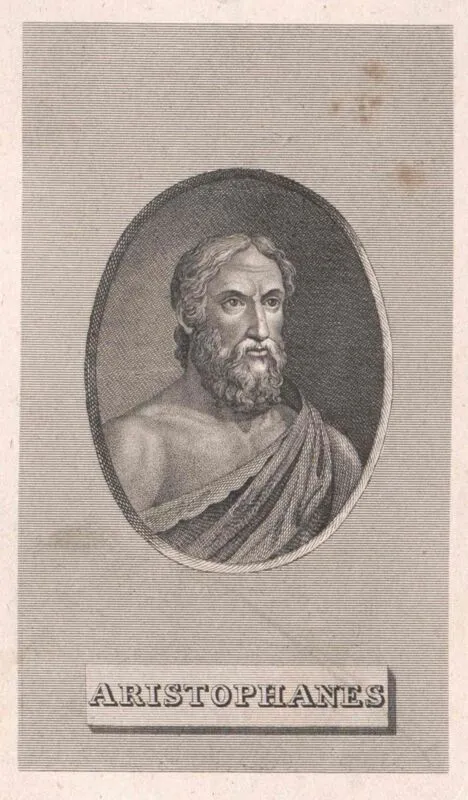
"Aristophanes" / Europeana (Public domain).
Aristophanes was one of the most famous playwrights of ancient Athens during the 5th century BCE. He is best known for his sharp satire, which used humor to criticize political leaders, social customs, and even other playwrights. Through his comedies, Aristophanes created a unique window into Athenian society and its complex democracy.
The city-state of Athens was a center of culture and learning in the ancient Mediterranean world. Theater played a central role in public life, especially during festivals like the Dionysia, where citizens watched performances of both tragedies and comedies. Aristophanes wrote over forty plays, though only eleven survive today. His first play, 'The Banqueters,' was produced in 427 BCE, but his most celebrated works include 'The Clouds,' 'Lysistrata,' and 'The Frogs.' In his plays, Aristophanes often used parody—a humorous imitation—to mock famous figures such as the philosopher Socrates or politicians like Cleon. For example, in 'The Clouds,' Socrates is portrayed as a foolish thinker, which gives historians insight into how some Athenians viewed new ideas.
Aristophanes’s comedies were more than just entertainment; they provided sharp social commentary. For instance, in 'Lysistrata' (411 BCE), women from different Greek city-states unite to end the Peloponnesian War by refusing to let their husbands return home until peace is made. This play not only shows the role of women in Greek society but also criticizes the destructive nature of war. The use of chorus—a group of actors who commented on the action—added to the performance and deepened its message. Ancient sources like the works of Aristotle and later historians help confirm the impact of Aristophanes’s plays on public opinion in Athens.
Over time, the style and function of Greek comedy evolved. Early plays by Aristophanes were called 'Old Comedy' and focused on political satire, while later playwrights developed 'New Comedy,' which centered more on everyday life and family issues. Aristophanes’s works have survived through the efforts of ancient scribes who copied his texts, and through archaeological discoveries of theater remains in Athens. The large open-air theaters, such as the Theater of Dionysus, could hold thousands of spectators and were important sites for civic participation.
Aristophanes’s legacy continues to influence literature and drama today. His use of comedy to address serious issues demonstrates the power of art to challenge authority and encourage discussion. Studying his plays helps historians understand both the achievements and the challenges of Athenian democracy, and how ordinary citizens responded to the events of their time.
Aristophanes’s work connects to broader themes in world history, such as the relationship between art and society, the evolution of political systems, and the enduring power of humor as a tool for change.
Interesting Fact: The ancient Greeks even awarded prizes for the best comedies at festivals, showing that humor was highly valued in public life.
When did Aristophanes write 'Lysistrata'?
411 BCE427 BCE500 BCE300 BCE
What type of government did Athens have?
DemocracyMonarchyEmpireDictatorship
How many of Aristophanes’s plays survive today?
ElevenTwentyFiveForty
Why did Aristophanes use satire?
To criticize societyTo teach mathTo write tragediesTo praise leaders
What was the chorus in Greek plays?
A group commenting on the actionThe main actorA political leaderA musical instrument
What effect did 'Lysistrata' have?
It criticized warIt started a warIt banned comedyIt was a tragedy
Greek comedy never criticized leaders. True or false?
TrueFalse
Which word means 'a funny imitation'?
ParodyDemocracyLegacyTragedy
Perfect For:
👩🏫 Teachers
• Reading comprehension practice
• Auto-graded assessments
• Literacy skill development
👨👩👧👦 Parents
• Reading practice at home
• Comprehension improvement
• Educational reading time
🏠 Homeschoolers
• Reading curriculum support
• Independent reading practice
• Progress monitoring
Reading Features:
📖
Reading Passage
Engaging fiction or nonfiction text
❓
Comprehension Quiz
Auto-graded questions
📊
Instant Feedback
Immediate results and scoring
📄
Printable Version
Download for offline reading
🔊
Read Aloud
Voice-over with word highlighting
Reviews & Ratings
No reviews yet. Be the first to share your experience!
Related Content
Geography of Ancient Greece
This rigorous history reading passage explores 'The Geography of Ancient Greece,' examining how the region’s mountains, ...
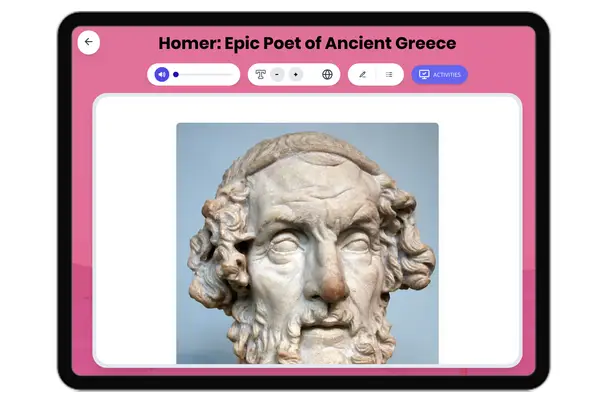
Homer: Epic Poet of Ancient Greece
This history reading passage explores the life and historical significance of Homer, the legendary epic poet of Ancient ...
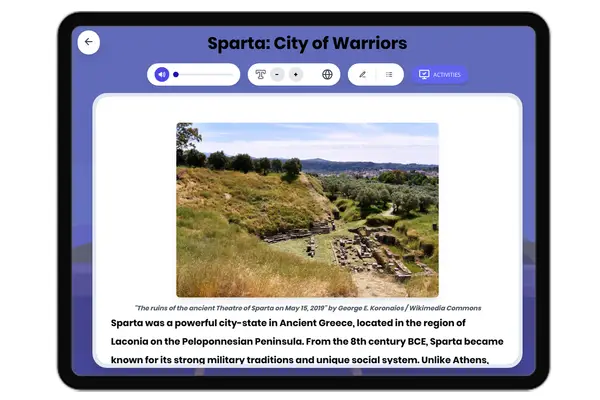
Ancient Sparta
This reading passage explores the unique military society of Sparta, an influential city-state in Ancient Greece. Studen...
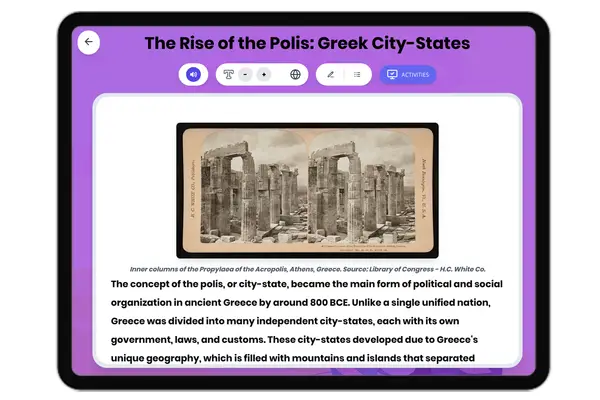
Greek Polis
This in-depth history reading passage explores the rise and development of the Greek polis, or city-state, a foundationa...
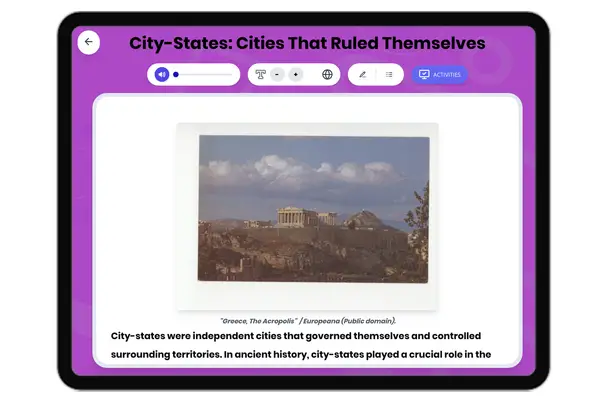
Ancient Greek City-States
This history reading passage explores the development and significance of city-states in ancient civilizations, focusing...
Greece's Lasting Legacy
This engaging history reading passage explores the enduring legacy of Ancient Greece and its profound influence on the m...
Evidence in Ancient History
This engaging history reading passage investigates how archaeologists and historians discover clues about how ancient pe...
Ancient Philosophy
This reading passage takes students on a journey through the philosophical traditions of ancient Greece, India, and Chin...
Euripides and Greek Drama
This engaging passage introduces students to Euripides, one of the greatest ancient Greek playwrights, known for his exp...
Women in Ancient Societies
This reading passage explores the complex roles of women in the ancient world, focusing on civilizations such as Mesopot...
Sophocles and Greek Tragedy
This passage explores the life and legacy of Sophocles, one of the most influential playwrights of ancient Greece, whose...
Ancient Literature
This passage explores the importance of ancient stories and poems from civilizations such as Greece, India, and Israel. ...
Ancient Science and Medicine
This comprehensive reading passage explores the development of science and medicine in ancient civilizations, including ...
Slavery in Ancient World
This passage explores the complex history of slavery in the ancient world, examining its presence in societies such as M...
Ancient Theocracy
This engaging history reading passage explores the concept of theocracy in ancient civilizations, where priests and reli...
Ancient Mathematics
This passage explores the essential role of mathematics in ancient civilizations, including Mesopotamia, Egypt, Greece, ...
Ancient Canaan
This educational passage explores the land of Canaan, the historical homeland of the ancient Israelites. Students will l...
Geography of Ancient Israel
This passage explores the rich geography of Ancient Israel, focusing on how landforms, climate, and natural resources sh...
Ancient Writing Systems
This engaging history reading passage explores the origins and evolution of ancient writing systems, including cuneiform...
Ancient Agriculture Farming
This passage explores the transformative impact of farming on ancient societies, examining how the Neolithic Revolution ...