This learning resource is available in interactive and printable formats. The interactive worksheet can be played online and assigned to students. The Printable PDF version can be downloaded and printed for completion by hand.
This engaging history reading passage explores how Athens developed the world's first democracy. Students will learn how the geography of Greece shaped its city-states, how Athenian democracy emerged, and the effects of this political innovation on ancient society. The passage includes details about key figures like Cleisthenes and Pericles, the structure of the assembly, the rights and limits of citizenship, and connections to archaeological and written sources. Activities include a multiple-choice quiz, writing prompts, graphic organizers, and a timeline. Spanish translation and read aloud audio are available. Aligned to CA HSS 6.4 and CCSS RH.6-8, this resource builds historical thinking skills and meets ELA informational text standards for evidence and analysis.
CONTENT PREVIEW
Expand content preview
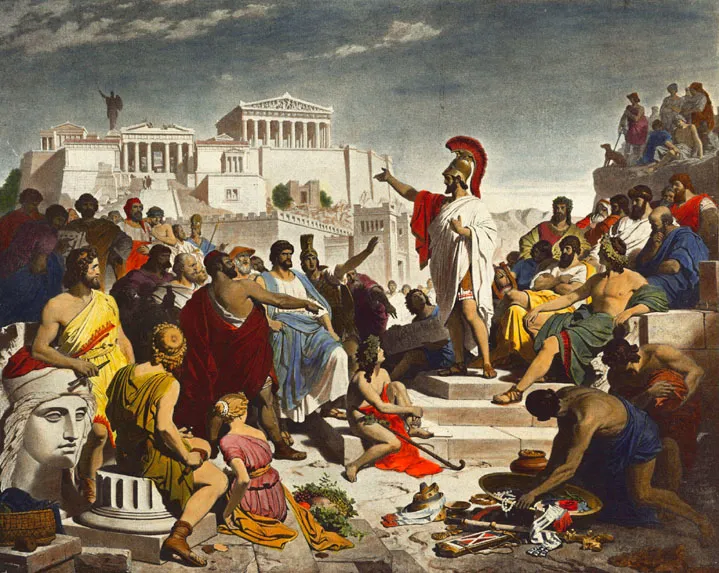
"Discurso funebre pericles" by Philipp Foltz / Source: Wikimedia Commons (Public domain).
Athens, a powerful city-state in ancient Greece, is recognized as the birthplace of democracy. Located on the rocky Attica peninsula, Athens developed unique political ideas that influenced the world. Around the fifth century BCE, Athenians changed from being ruled by kings and aristocrats to a government where free male citizens could participate directly in decision-making.
The geography of Greece, with its mountains and scattered islands, led to the rise of independent city-states like Athens and Sparta. In Athens, the early government was controlled by aristocrats, a small group of wealthy families. Over time, economic and social tensions grew. By 594 BCE, the reformer Solon created new laws to reduce conflict, such as ending debt slavery and allowing more citizens to have a say in government. However, true democracy emerged later under Cleisthenes in 508 BCE. Cleisthenes reorganized the population into ten tribes and created the assembly, where citizens could vote on laws and policies. Archaeological evidence, such as broken pottery shards called ostraka, shows how Athenians practiced ostracism to exile dangerous leaders for ten years.
Athenian democracy was a direct democracy, meaning citizens themselves debated and voted on issues instead of choosing representatives. The assembly met regularly on the Pnyx hill, and sometimes thousands attended. Citizens also served on juries and councils, chosen by lottery to ensure fairness. However, not everyone could participate. Women, slaves, and foreigners were excluded from citizenship. Primary sources, like speeches by Pericles and inscriptions on stone, reveal how Athenians valued freedom, civic duty, and equality among citizens, even as social divisions remained.
During the leadership of Pericles (461–429 BCE), Athens experienced its "Golden Age." Pericles expanded democracy by paying citizens for public service, allowing poorer men to participate. The city built magnificent structures like the Parthenon and became a center for art, philosophy, and science. Yet, challenges existed. The Peloponnesian War and internal tensions eventually weakened Athenian democracy. Despite this, the Athenian model inspired later democratic systems around the world.
The development of democracy in Athens shows how geography, social conflict, and new ideas can lead to lasting political changes. Studying Athens helps us understand how people in the past shaped systems of government and citizenship that still influence societies today.
Interesting Fact: In Athens, citizens could vote to exile a leader for ten years by writing their name on a piece of pottery called an ostrakon.
Who created reforms in 594 BCE?
SolonPericlesCleisthenesAristotle
What did Cleisthenes create?
The assemblyThe ParthenonJuriesPhilosophy
Where did the assembly meet?
Pnyx hillAgoraAcropolisOlympia
Who could NOT be a citizen?
WomenFree menLandownersAssembly members
Why was ostracism used?
To exile leadersTo make lawsTo build templesTo elect kings
How did Pericles expand democracy?
Paid citizens for serviceBanned assembliesBuilt shipsReduced voting age
Athens was always ruled by kings. True or false?
TrueFalse
What is a 'direct democracy'?
Citizens vote on all issuesOne person rulesOnly women voteOnly aristocrats vote
Perfect For:
👩🏫 Teachers
• Reading comprehension practice
• Auto-graded assessments
• Literacy skill development
👨👩👧👦 Parents
• Reading practice at home
• Comprehension improvement
• Educational reading time
🏠 Homeschoolers
• Reading curriculum support
• Independent reading practice
• Progress monitoring
Reading Features:
📖
Reading Passage
Engaging fiction or nonfiction text
❓
Comprehension Quiz
Auto-graded questions
📊
Instant Feedback
Immediate results and scoring
📄
Printable Version
Download for offline reading
🔊
Read Aloud
Voice-over with word highlighting
Reviews & Ratings
No reviews yet. Be the first to share your experience!
Related Content
Geography of Ancient Greece
This rigorous history reading passage explores 'The Geography of Ancient Greece,' examining how the region’s mountains, ...
Homer: Epic Poet of Ancient Greece
This history reading passage explores the life and historical significance of Homer, the legendary epic poet of Ancient ...
Ancient Sparta
This reading passage explores the unique military society of Sparta, an influential city-state in Ancient Greece. Studen...
Greek Polis
This in-depth history reading passage explores the rise and development of the Greek polis, or city-state, a foundationa...
Ancient Greek City-States
This history reading passage explores the development and significance of city-states in ancient civilizations, focusing...
Greece's Lasting Legacy
This engaging history reading passage explores the enduring legacy of Ancient Greece and its profound influence on the m...
Evidence in Ancient History
This engaging history reading passage investigates how archaeologists and historians discover clues about how ancient pe...
Ancient Philosophy
This reading passage takes students on a journey through the philosophical traditions of ancient Greece, India, and Chin...
Euripides and Greek Drama
This engaging passage introduces students to Euripides, one of the greatest ancient Greek playwrights, known for his exp...
Women in Ancient Societies
This reading passage explores the complex roles of women in the ancient world, focusing on civilizations such as Mesopot...
Sophocles and Greek Tragedy
This passage explores the life and legacy of Sophocles, one of the most influential playwrights of ancient Greece, whose...
Ancient Literature
This passage explores the importance of ancient stories and poems from civilizations such as Greece, India, and Israel. ...
Ancient Science and Medicine
This comprehensive reading passage explores the development of science and medicine in ancient civilizations, including ...
Slavery in Ancient World
This passage explores the complex history of slavery in the ancient world, examining its presence in societies such as M...
Ancient Theocracy
This engaging history reading passage explores the concept of theocracy in ancient civilizations, where priests and reli...
Ancient Mathematics
This passage explores the essential role of mathematics in ancient civilizations, including Mesopotamia, Egypt, Greece, ...
Ancient Canaan
This educational passage explores the land of Canaan, the historical homeland of the ancient Israelites. Students will l...
Geography of Ancient Israel
This passage explores the rich geography of Ancient Israel, focusing on how landforms, climate, and natural resources sh...
Ancient Writing Systems
This engaging history reading passage explores the origins and evolution of ancient writing systems, including cuneiform...
Ancient Agriculture Farming
This passage explores the transformative impact of farming on ancient societies, examining how the Neolithic Revolution ...