Aztec Accounts of the Spanish Conquest — Reading Comprehension
Rate this
Premium Resource
Present
Present in classroom. No work saved
Assign
Classroom with student accounts, Track progress
Quick Play
No student accounts, assign with a link
Grades
5
6
7
8
PRINT+DIGITAL RESOURCE
This learning resource is available in interactive and printable formats. The interactive worksheet can be played online and assigned to students. The Printable PDF version can be downloaded and printed for completion by hand.
This reading passage explores the Aztec accounts of the Spanish Conquest, focusing on primary sources and indigenous perspectives. Students will learn about Moctezuma, Hernán Cortés, the fall of Tenochtitlan, and the significance of these events in the broader context of ancient Americas and world history. The passage integrates vocabulary development and critical thinking, featuring a glossary, comprehension and writing activities, graphic organizers, and a timeline. Activities align with CA HSS 6.7 and CCSS RH.6-8, making this a rigorous and engaging resource for history education. Read aloud audio and Spanish translation are included to support diverse learners. Students will analyze cause and effect, use evidence from historical sources, and examine the impact of conquest on social hierarchy and daily life.
CONTENT PREVIEW
Expand content preview
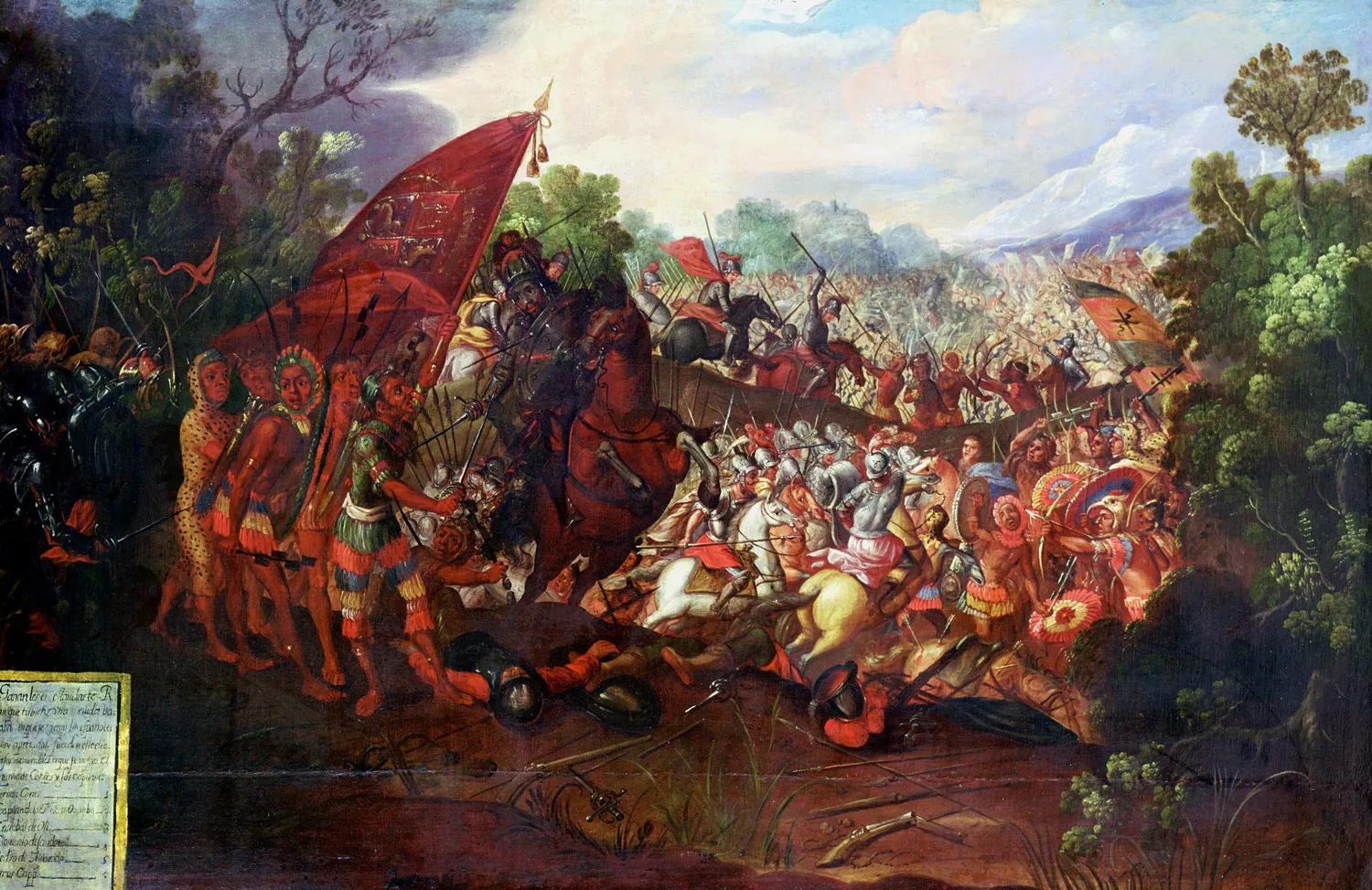
"Battle of Otumba (Conquest of Mexico) Painting" Source: Wikimedia Commons (Public domain).
The Aztec Empire, centered in the city-state of Tenochtitlan in present-day Mexico, faced a dramatic turning point in 1519 with the arrival of Spanish conquistadors led by Hernán Cortés. While much of what we know comes from Spanish sources, the Aztecs themselves also recorded their experiences. These accounts, often written in the Nahuatl language and later translated, offer a different perspective on the encounter that changed the Americas forever.
Aztec records describe the arrival of the Spanish as both mysterious and terrifying. According to the Florentine Codex, a key primary source compiled with the help of Aztec elders, people in Tenochtitlan first saw Spanish ships as “mountains moving on the sea.” Some believed the newcomers might be gods or fulfillments of ancient prophecies. When Moctezuma II, the powerful Aztec emperor, received news of the Spanish landing, he sent gifts of gold and feathers, hoping to keep peace. These actions reveal the complex diplomatic strategies and beliefs of Aztec society.
The Spanish arrival soon led to conflict and violence. The Aztecs’ own accounts, such as those in the Broken Spears collection, describe the massacre at the Templo Mayor during a religious festival in 1520. Spanish soldiers attacked unarmed worshippers, causing panic and anger. This event deepened mistrust and set off a series of battles. Aztec sources detail the siege of Tenochtitlan, highlighting the suffering caused by starvation, disease, and advanced Spanish weapons. These accounts often emphasize the devastation brought by smallpox, which killed thousands and weakened resistance.
Despite fierce resistance, Tenochtitlan fell to the Spanish in August 1521. The Aztec accounts mourn the loss of their city and culture, describing “a great destruction and darkness.” Yet, they also record acts of bravery and attempts at adaptation. After the conquest, many Aztec nobles tried to preserve their traditions and knowledge by working with Spanish priests to record their history. Over time, the Aztec world changed dramatically, but some customs and languages survived.
The Aztec perspective on the Spanish conquest reminds us that history can be told in many voices. By studying primary sources from both sides, historians gain a fuller understanding of the causes, effects, and human experiences of this transformative event.
Interesting Fact: The Florentine Codex, which preserves many Aztec voices, was created by Spanish friar Bernardino de Sahagún and his Nahua collaborators between 1545 and 1590.
Who led the Spanish conquistadors?
Hernán CortésMoctezuma IIBernardino de SahagúnChristopher Columbus
What city was the Aztec capital?
TenochtitlanFlorenceMadridCuzco
When did Tenochtitlan fall?
August 1521151914921545
Why did Moctezuma send gifts to the Spanish?
To keep peaceTo start a warTo get goldTo become emperor
How did smallpox affect the Aztecs?
It killed thousandsIt helped them winIt made goldIt improved crops
What did Aztec accounts describe after the conquest?
Destruction and darknessNew temples builtSpanish leavingPeaceful trade only
The Aztecs thought Spanish ships were mountains. True or false?
TrueFalse
What is a primary source?
An original recordA textbookA guessA statue
Perfect For:
👩🏫 Teachers
• Reading comprehension practice
• Auto-graded assessments
• Literacy skill development
👨👩👧👦 Parents
• Reading practice at home
• Comprehension improvement
• Educational reading time
🏠 Homeschoolers
• Reading curriculum support
• Independent reading practice
• Progress monitoring
Reading Features:
📖
Reading Passage
Engaging fiction or nonfiction text
❓
Comprehension Quiz
Auto-graded questions
📊
Instant Feedback
Immediate results and scoring
📄
Printable Version
Download for offline reading
🔊
Read Aloud
Voice-over with word highlighting
Reviews & Ratings
No reviews yet. Be the first to share your experience!
Related Content
Evidence in Ancient History
This engaging history reading passage investigates how archaeologists and historians discover clues about how ancient pe...
Ancient Theocracy
This engaging history reading passage explores the concept of theocracy in ancient civilizations, where priests and reli...
Ancient Canaan
This educational passage explores the land of Canaan, the historical homeland of the ancient Israelites. Students will l...
Slavery in Ancient Rome and in the Americas
This educational passage examines the history of slavery in two distinct regions and eras: Ancient Rome and Colonial Ame...
The Americas: Developing in Isolation
This rigorous history reading passage explores how ancient civilizations in the Americas developed in isolation due to t...
Ancient Literature
This passage explores the importance of ancient stories and poems from civilizations such as Greece, India, and Israel. ...
Geography of Ancient Israel
This passage explores the rich geography of Ancient Israel, focusing on how landforms, climate, and natural resources sh...
Ancient Writing Systems
This engaging history reading passage explores the origins and evolution of ancient writing systems, including cuneiform...
Ancient Agriculture Farming
This passage explores the transformative impact of farming on ancient societies, examining how the Neolithic Revolution ...
Ancient Mathematics
This passage explores the essential role of mathematics in ancient civilizations, including Mesopotamia, Egypt, Greece, ...
Ancient Philosophy
This reading passage takes students on a journey through the philosophical traditions of ancient Greece, India, and Chin...
Ancient Athens Democracy
This history reading passage explores the origins and practice of direct democracy in Ancient Athens, one of the world's...
How Maize Transformed Life in the Americas
This passage explores the dramatic impact of maize (corn) on ancient civilizations throughout the Americas. Students wil...
Ancient Science and Medicine
This comprehensive reading passage explores the development of science and medicine in ancient civilizations, including ...
Ancient Monarchy
This reading passage explores the concept of monarchy in ancient civilizations, focusing on the origins, structure, and ...
Women in Ancient Societies
This reading passage explores the complex roles of women in the ancient world, focusing on civilizations such as Mesopot...
Geography of Ancient Egypt
This passage explores the vital role of geography in the rise of Ancient Egypt, focusing on the importance of the Nile R...
Ancient Money Barter
This passage explores the fascinating evolution from barter to the earliest coins in ancient civilizations, focusing on ...
Geography of Ancient Greece
This rigorous history reading passage explores 'The Geography of Ancient Greece,' examining how the region’s mountains, ...
Slavery in Ancient World
This passage explores the complex history of slavery in the ancient world, examining its presence in societies such as M...