Ruby Bridges and the Little Rock Nine — Reading Comprehension
Rate this
Premium Resource
Present
Present in classroom. No work saved
Assign
Classroom with student accounts, Track progress
Quick Play
No student accounts, assign with a link
Grades
3
4
5
Standards
D2.HIS.2.3-5
D2.HIS.14.3-5
RI.4.3
RI.4.4
RI.5.3
RI.5.4
PRINT+DIGITAL RESOURCE
This learning resource is available in interactive and printable formats. The interactive worksheet can be played online and assigned to students. The Printable PDF version can be downloaded and printed for completion by hand.
This engaging history reading passage explores the stories of Ruby Bridges and the Little Rock Nine, two important groups of students who helped change schools in the United States. Students will learn about school integration and the bravery it took to challenge unfair laws. The passage uses simple language and a clear sequence to help young readers understand how these students made a difference. It includes a glossary of key terms, a timeline of important events, and activities that build reading and writing skills. The content aligns with the C3 Framework and Common Core standards, making it perfect for classroom use. Students can listen to the passage with read aloud audio and read a Spanish translation for bilingual learning. With multiple choice questions, writing prompts, and a timeline activity, this resource helps students connect the past to the present while building literacy and historical thinking.
CONTENT PREVIEW
Expand content preview
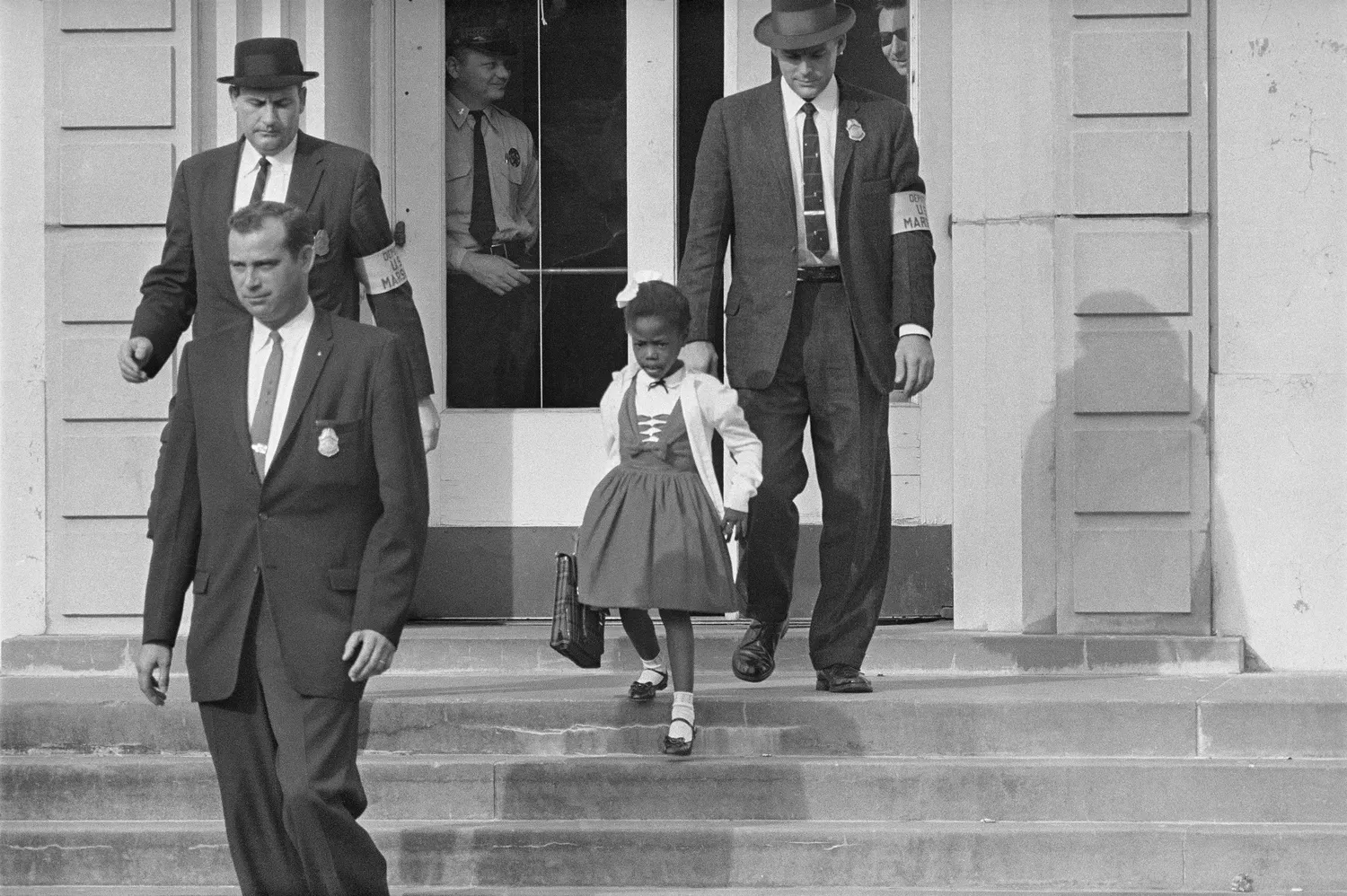
US Marshals with Young Ruby Bridges on School Steps - Original.jpg Source: Wikimedia Commons - Uncredited DOJ photographer
In 1957, nine Black students became known as the Little Rock Nine. They were the first Black students to attend Central High School in Little Rock, Arkansas. Before this, schools in many parts of the United States were segregated. This means Black and white students went to different schools.
In 1954, the Supreme Court ruled in a case called Brown v. Board of Education that segregation in public schools was unfair and illegal. Schools had to become integrated, which means students of all races could learn together. But some states did not want to change.
Three years later, in September 1957, Central High School was chosen for integration. The nine Black students were chosen because of their good grades and strong character. Their names were Elizabeth Eckford, Ernest Green, Minnijean Brown, Melba Pattillo, Carlotta Walls, Terrence Roberts, Gloria Ray, Thelma Mothershed, and Jefferson Thomas.
When the Little Rock Nine tried to enter Central High School, they faced angry crowds. Many people did not want Black students at the school. The governor of Arkansas, Orval Faubus, ordered soldiers to block the students from entering.
President Dwight D. Eisenhower sent federal soldiers to protect the Little Rock Nine. With the soldiers’ help, the students finally walked into Central High School on September 25, 1957. They showed great courage and did not give up, even when people yelled at them and treated them badly.
The Little Rock Nine went to school every day under the protection of soldiers. They studied hard, even though it was often scary. Their actions helped change schools across the country. They became symbols of equality and hope for fair education.
The bravery of the Little Rock Nine led to more schools being integrated. Their story showed that young people could make a big difference in the fight for civil rights. Today, their courage is remembered as a key moment in American history.
Interesting Fact: Ernest Green was the first Black student to graduate from Central High School. Dr. Martin Luther King, Jr. attended his graduation.
What year did the Little Rock Nine go to Central High?
1957196419451980
How many students made up the Little Rock Nine?
NineFiveTwelveSeven
Which school did the Little Rock Nine attend?
Central High SchoolWest High SchoolEast Middle SchoolSouth Elementary
Why did the governor send soldiers to the school?
To block the studentsTo help the studentsFor a paradeTo teach a class
What did President Eisenhower do?
Sent federal soldiersClosed the schoolGave a speechVisited the students
What is school integration?
Students of all races learn togetherOnly Black students in schoolOnly white students in schoolStudents study at home
The Little Rock Nine were brave. True or false?
TrueFalse
What does 'segregated' mean?
Separated by raceWorking togetherLearning about sciencePlaying sports
Perfect For:
👩🏫 Teachers
• Reading comprehension practice
• Auto-graded assessments
• Literacy skill development
👨👩👧👦 Parents
• Reading practice at home
• Comprehension improvement
• Educational reading time
🏠 Homeschoolers
• Reading curriculum support
• Independent reading practice
• Progress monitoring
Reading Features:
📖
Reading Passage
Engaging fiction or nonfiction text
❓
Comprehension Quiz
Auto-graded questions
📊
Instant Feedback
Immediate results and scoring
📄
Printable Version
Download for offline reading
🔊
Read Aloud
Voice-over with word highlighting
Reviews & Ratings
No reviews yet. Be the first to share your experience!
Related Content
Colonial Trade with England and Africa
This history reading passage explores colonial trade between the American colonies, England, and Africa, focusing on the...
D2.HIS.2.3-5D2.HIS.14.3-5RI.4.3RI.4.4
John Adams: Second President
This engaging U.S. history reading passage introduces students to John Adams, the second President of the United States....
D2.HIS.2.3-5D2.HIS.14.3-5RI.4.3RI.4.4
Building Washington D.C., Our Capital
This history reading passage explores the building of Washington D.C., the capital of the United States. Students will l...
D2.HIS.1-3.3-5D2.HIS.14.3-5RI.4.3RI.4.4
Dolley Madison Saves Washington's Portrait
This engaging history reading passage tells the inspiring story of Dolley Madison and her brave actions during the War o...
D2.HIS.2.3-5D2.HIS.14.3-5RI.4.3RI.4.4
Boomtowns Spring Up Out West
This engaging passage explores the exciting rise of boomtowns in the American West during the 1800s, focusing on the Gol...
D2.HIS.2.3-5D2.HIS.14.3-5RI.4.3RI.4.4
Franklin D. Roosevelt and the New Deal
This engaging history reading passage explores the life and leadership of Franklin D. Roosevelt and his creation of the ...
D2.HIS.2.3-5D2.HIS.14.3-5RI.4.3RI.4.4
Rationing and Life on the Home Front
This history reading passage explores rationing and life on the home front during World War II, focusing on how American...
D2.HIS.2.3-5D2.HIS.14.3-5RI.4.3RI.4.4
D-Day and the End of World War II
This engaging reading passage explores the key events of D-Day and how it helped bring World War II to a close. Students...
D2.HIS.2.3-5D2.HIS.14.3-5RI.4.3RI.4.4
Martin Luther King Jr. and "I Have a Dream"
This engaging history reading passage introduces students to the life and legacy of Martin Luther King Jr., focusing on ...
D2.HIS.2.3-5D2.HIS.14.3-5RI.4.1RI.4.3.
Cesar Chavez and Farm Workers' Rights
This engaging history reading passage explores the life and impact of Cesar Chavez, a key leader in the fight for farm w...
D2.HIS.2.3-5D2.HIS.14.3-5RI.4.3RI.4.4
When Mexico Took Over California
This engaging U.S. history reading passage explores the period when Mexico took over California during the era of Westwa...
D2.HIS.2.3-5D2.HIS.3.3-5D2.HIS.14.3-5RI.4.3
Californios Culture
This history reading passage explores the story of the Californios—Spanish and Mexican settlers who shaped California be...
D2.HIS.2.3-5D2.HIS.3.3-5D2.HIS.14.3-5RI.4.3
The 31st State: California Joins the Union
This engaging U.S. history reading passage explores California's journey to becoming the 31st state in 1850. Students le...
D2.HIS.3.3-5D2.HIS.14.3-5RI.4.3RI.4.4
Routes to the Gold Fields
This engaging history reading passage explores the three main routes people took to reach the California gold fields dur...
D2.HIS.2.3-5D2.HIS.14.3-5RI.4.3RI.4.4
The Golden Spike: Connecting California to the Nation
This engaging U.S. history reading passage teaches students about the Golden Spike and how the first transcontinental ra...
D2.HIS.1.3-5D2.HIS.2.3-5D2.HIS.14.3-5RI.4.3
California Women Win the Vote in 1911
This engaging history reading passage explores how women in California fought and won the right to vote in 1911. Aligned...
D2.HIS.2.3-5D2.HIS.14.3-5RI.4.3RI.4.4
The 1965 Immigration Act
Discover the story of the 1965 Immigration Act with this engaging U.S. history reading passage. Perfect for building rea...
D2.HIS.4.3-5D2.HIS.14.3-5RI.5.3RI.5.4
Protecting California's Environment
This engaging U.S. history reading passage explores the story of how California has worked to protect its unique environ...
D2.HIS.2.3-5D2.HIS.14.3-5RI.4.3RI.4.4
Religious Freedom in the Middle Colonies
This engaging U.S. History reading passage explores the theme of religious freedom in the Middle Colonies during colonia...