California Women Win the Vote in 1911 — Reading Comprehension
Rate this
Premium Resource
Present
Present in classroom. No work saved
Assign
Classroom with student accounts, Track progress
Quick Play
No student accounts, assign with a link
Grades
3
4
5
Standards
D2.HIS.2.3-5
D2.HIS.14.3-5
RI.4.3
RI.4.4
W.4.2
PRINT+DIGITAL RESOURCE
This learning resource is available in interactive and printable formats. The interactive worksheet can be played online and assigned to students. The Printable PDF version can be downloaded and printed for completion by hand.
This engaging history reading passage explores how women in California fought and won the right to vote in 1911. Aligned with C3 Framework and Common Core standards, students will learn about the events of the Progressive Era, key figures like Clara Shortridge Foltz, and the methods used by suffragists to achieve change. The passage features a timeline of events, glossary with key vocabulary, and activities designed to build historical understanding and literacy skills. Students can deepen their learning with a multiple choice quiz, writing prompts, and a cause-and-effect graphic organizer. The resource also includes a Spanish translation and read aloud audio, making it accessible for diverse learners. Perfect for classroom or independent study, it supports standards D2.His.2.3-5, D2.His.14.3-5, RI.4.3, RI.4.4, W.4.2.
CONTENT PREVIEW
Expand content preview
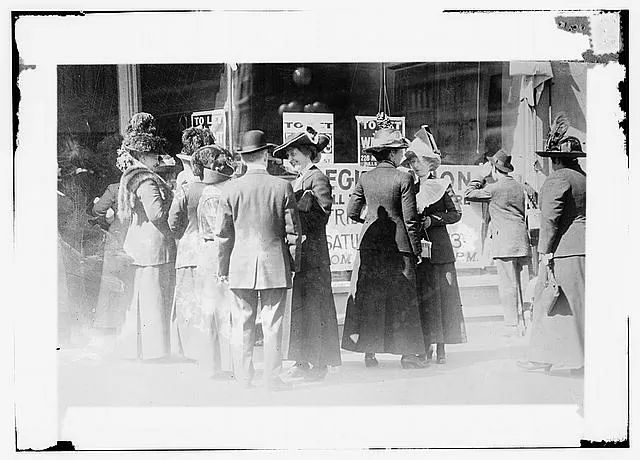
Women Voters Frisco - Registering shop girls & clerks Source: Library of Congress - Bain News Service
In 1911, California women won the right to vote in all elections. This made California the sixth state in the country to allow women full voting rights. This important change happened nine years before the United States gave all women the right to vote with the 19th Amendment.
The fight for suffrage in California took many years. Women wanted equal rights and the power to help make laws. Many people believed women should only take care of homes and families. Women disagreed and believed their voices mattered in their communities and government.
In the late 1800s, women began to organize. They held meetings, gave speeches, and wrote letters to newspapers. Groups like the California Equal Suffrage Association worked together for change. Some women, such as Clara Shortridge Foltz and Selina Solomons, became leaders. They traveled across the state, talking to people and encouraging them to support voting equality.
In 1896, California held an election to decide if women should vote. The proposal lost. Many women were sad, but they did not give up. They learned that they needed to reach more people and explain why voting rights were important for everyone, not just women.
By 1911, the movement had grown much bigger. Women marched in parades, handed out pamphlets, and spoke at rallies. Men and women both joined the cause. This teamwork made a difference. On October 10, 1911, California held another vote on women’s suffrage. This time, the proposal passed by a small margin.
After the vote, women in California could finally vote in all state and local elections. Their victory inspired women in other states to keep fighting for their rights. California’s success showed that change was possible when people worked together and did not give up.
In 1920, the 19th Amendment became law, giving all American women the right to vote. California’s win in 1911 helped lead the way for this national change.
Interesting Fact: Many California women celebrated their victory by marching through the streets, waving yellow banners and singing songs about freedom.
When did California women win the vote?
1911192018961869
What was the main goal of California women?
To get voting rightsTo fight a warTo start new citiesTo make new laws
Who were Clara Shortridge Foltz and Selina Solomons?
Suffrage leadersTeachersPresidentsArtists
Why did women keep working after 1896?
They wanted equal rightsThey wanted more moneyThey wanted to travelThey wanted new homes
How did women spread their message?
Parades and pamphletsBy moving awayBy building housesBy farming
What effect did California's win have on others?
Inspired other statesStopped all votingEnded paradesStarted a war
Women could vote after 1911. True or false?
TrueFalse
What does 'suffrage' mean in the passage?
The right to voteA kind of paradeA new lawA type of food
Perfect For:
👩🏫 Teachers
• Reading comprehension practice
• Auto-graded assessments
• Literacy skill development
👨👩👧👦 Parents
• Reading practice at home
• Comprehension improvement
• Educational reading time
🏠 Homeschoolers
• Reading curriculum support
• Independent reading practice
• Progress monitoring
Reading Features:
📖
Reading Passage
Engaging fiction or nonfiction text
❓
Comprehension Quiz
Auto-graded questions
📊
Instant Feedback
Immediate results and scoring
📄
Printable Version
Download for offline reading
🔊
Read Aloud
Voice-over with word highlighting
Reviews & Ratings
No reviews yet. Be the first to share your experience!
Related Content
Colonial Trade with England and Africa
This history reading passage explores colonial trade between the American colonies, England, and Africa, focusing on the...
D2.HIS.2.3-5D2.HIS.14.3-5RI.4.3RI.4.4
Building Washington D.C., Our Capital
This history reading passage explores the building of Washington D.C., the capital of the United States. Students will l...
D2.HIS.1-3.3-5D2.HIS.14.3-5RI.4.3RI.4.4
John Adams: Second President
This engaging U.S. history reading passage introduces students to John Adams, the second President of the United States....
D2.HIS.2.3-5D2.HIS.14.3-5RI.4.3RI.4.4
Dolley Madison Saves Washington's Portrait
This engaging history reading passage tells the inspiring story of Dolley Madison and her brave actions during the War o...
D2.HIS.2.3-5D2.HIS.14.3-5RI.4.3RI.4.4
Boomtowns Spring Up Out West
This engaging passage explores the exciting rise of boomtowns in the American West during the 1800s, focusing on the Gol...
D2.HIS.2.3-5D2.HIS.14.3-5RI.4.3RI.4.4
African Americans Fight for the Union
This engaging U.S. history reading passage explores the important role African Americans played in helping the Union dur...
D2.HIS.2.3-5D2.HIS.14.3-5RI.4.3RI.4.4
Franklin D. Roosevelt and the New Deal
This engaging history reading passage explores the life and leadership of Franklin D. Roosevelt and his creation of the ...
D2.HIS.2.3-5D2.HIS.14.3-5RI.4.3RI.4.4
Rationing and Life on the Home Front
This history reading passage explores rationing and life on the home front during World War II, focusing on how American...
D2.HIS.2.3-5D2.HIS.14.3-5RI.4.3RI.4.4
D-Day and the End of World War II
This engaging reading passage explores the key events of D-Day and how it helped bring World War II to a close. Students...
D2.HIS.2.3-5D2.HIS.14.3-5RI.4.3RI.4.4
Martin Luther King Jr. and "I Have a Dream"
This engaging history reading passage introduces students to the life and legacy of Martin Luther King Jr., focusing on ...
D2.HIS.2.3-5D2.HIS.14.3-5RI.4.1RI.4.3.
Ruby Bridges and the Little Rock Nine
This engaging history reading passage explores the stories of Ruby Bridges and the Little Rock Nine, two important group...
D2.HIS.2.3-5D2.HIS.14.3-5RI.4.3RI.4.4
Cesar Chavez and Farm Workers' Rights
This engaging history reading passage explores the life and impact of Cesar Chavez, a key leader in the fight for farm w...
D2.HIS.2.3-5D2.HIS.14.3-5RI.4.3RI.4.4
When Mexico Took Over California
This engaging U.S. history reading passage explores the period when Mexico took over California during the era of Westwa...
D2.HIS.2.3-5D2.HIS.3.3-5D2.HIS.14.3-5RI.4.3
Californios Culture
This history reading passage explores the story of the Californios—Spanish and Mexican settlers who shaped California be...
D2.HIS.2.3-5D2.HIS.3.3-5D2.HIS.14.3-5RI.4.3
The 31st State: California Joins the Union
This engaging U.S. history reading passage explores California's journey to becoming the 31st state in 1850. Students le...
D2.HIS.3.3-5D2.HIS.14.3-5RI.4.3RI.4.4
Routes to the Gold Fields
This engaging history reading passage explores the three main routes people took to reach the California gold fields dur...
D2.HIS.2.3-5D2.HIS.14.3-5RI.4.3RI.4.4
The Golden Spike: Connecting California to the Nation
This engaging U.S. history reading passage teaches students about the Golden Spike and how the first transcontinental ra...
D2.HIS.1.3-5D2.HIS.2.3-5D2.HIS.14.3-5RI.4.3
The 1965 Immigration Act
Discover the story of the 1965 Immigration Act with this engaging U.S. history reading passage. Perfect for building rea...
D2.HIS.4.3-5D2.HIS.14.3-5RI.5.3RI.5.4
Protecting California's Environment
This engaging U.S. history reading passage explores the story of how California has worked to protect its unique environ...