John Adams: Second President — Reading Comprehension
Rate this
Premium Resource
Present
Present in classroom. No work saved
Assign
Classroom with student accounts, Track progress
Quick Play
No student accounts, assign with a link
Grades
3
4
5
Standards
D2.HIS.2.3-5
D2.HIS.14.3-5
RI.4.3
RI.4.4
PRINT+DIGITAL RESOURCE
This learning resource is available in interactive and printable formats. The interactive worksheet can be played online and assigned to students. The Printable PDF version can be downloaded and printed for completion by hand.
This engaging U.S. history reading passage introduces students to John Adams, the second President of the United States. Students will learn about Adams's life, his role in the American Revolution, his work helping write the Declaration of Independence, and his years as president. The passage highlights key historical events, the cause and effect of Adams’s decisions, and uses vocabulary suitable for young readers. Aligned with the C3 Framework and Common Core standards, this resource includes a glossary, Spanish translation, reading comprehension quiz, writing activity, and a timeline of Adams’s life. A public domain image, read aloud audio, and accessible Spanish translation enhance learning for all students. This resource is ideal for classrooms teaching about U.S. presidents and American history.
CONTENT PREVIEW
Expand content preview
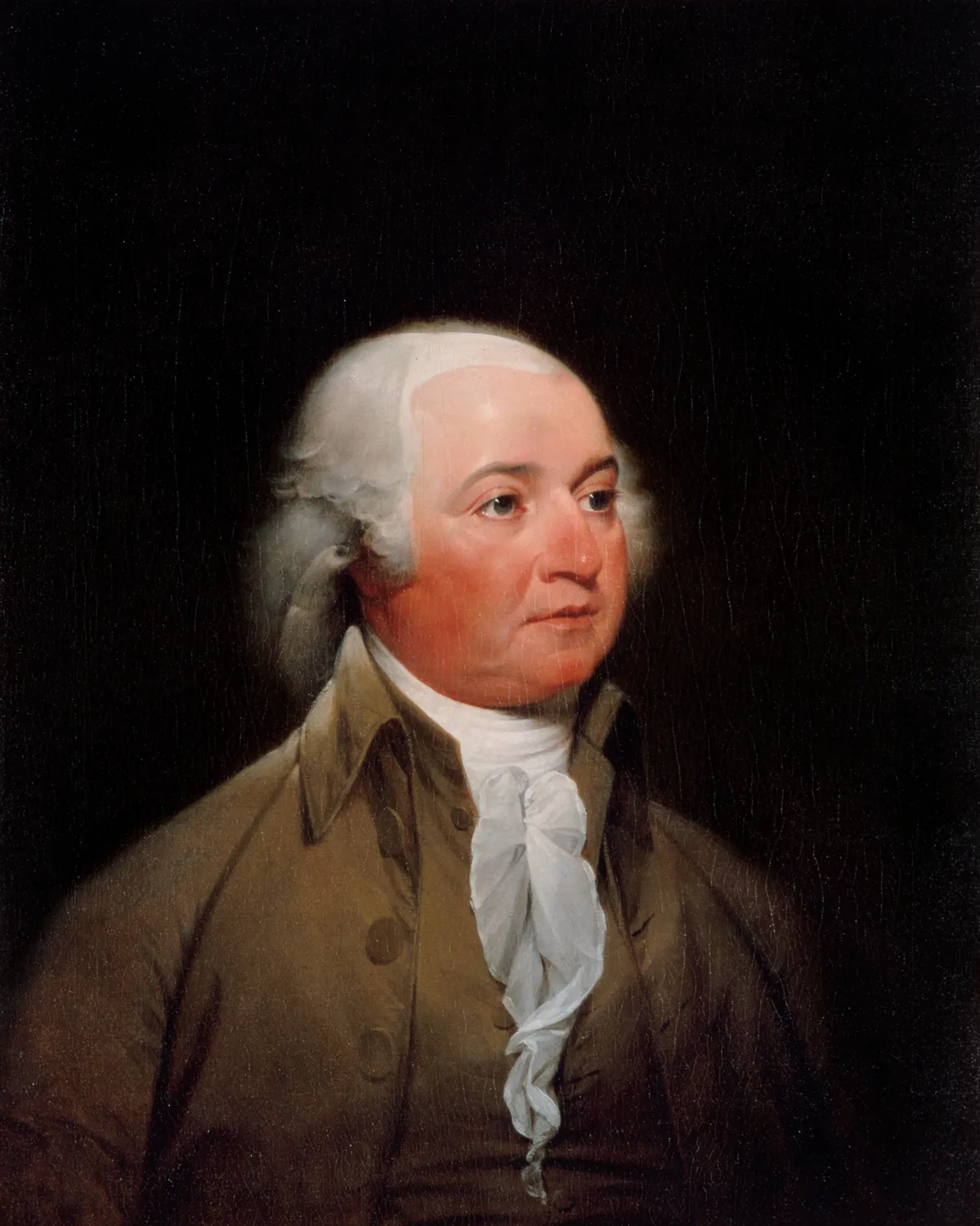
Official Presidential portrait of John Adams (by John Trumbull, circa 1792).jpg Source: Wikimedia Commons - John Trumbull
John Adams was the second President of the United States. He became president in 1797, after George Washington, the most popular man in America. Adams had a hard job, because he needed to follow a leader everyone admired.
John Adams was born in Massachusetts in 1735. Before he was president, he helped lead the colonies during the American Revolution. Adams believed strongly in freedom and independence. He worked hard to help create a new government for the United States.
When Adams became president, the country was very young. It faced many problems, especially with other countries. At this time, France and Britain were at war. Both countries wanted the United States to take sides, but Adams wanted peace. He did not want America to get involved in another war.
France began attacking American ships in the Atlantic Ocean. Many people in the United States wanted to fight back. Adams knew war would be costly and dangerous for the new nation. He sent American diplomats to France to try to make peace. It was not easy. The talks with France failed at first, and many Americans began to mistrust the French.
Even though it was unpopular, Adams refused to declare war. He kept talking to the French leaders. Finally, both sides agreed to stop fighting. Because of Adams’s leadership, America avoided a major war. This helped the new country stay strong and grow.
Adams also made history by moving into the brand new White House in Washington, D.C. The city was still being built, and the White House was not finished. Adams and his wife, Abigail, were the first president and first lady to live there. He wrote to Abigail that he hoped future presidents would always do what was right for the country.
John Adams only served one term as president, but his choices helped shape the United States. He taught future leaders to think about peace and unity. Adams’s courage and wisdom helped the nation survive a difficult time.
Interesting Fact: John Adams and Thomas Jefferson, who were sometimes rivals, both died on July 4, 1826—exactly 50 years after the Declaration of Independence was signed.
Who was the second president?
John AdamsGeorge WashingtonThomas JeffersonAbraham Lincoln
What year did Adams move into the White House?
1800177617971826
Who did Adams follow as president?
George WashingtonThomas JeffersonJames MadisonJohn Quincy Adams
Why did Adams want peace with France?
War was costlyHe liked FranceFrance was weakHe wanted land
How did Adams try to solve problems with France?
Sent diplomatsDeclared warIgnored FranceAsked Britain
What was the effect of Adams’s leadership?
America avoided warAmerica lost landAdams became kingFrance ruled America
John Adams was the first to live in the White House.
TrueFalse
What is a diplomat?
A person who solves problems between countriesA soldier in a warA famous writerA ship captain
Perfect For:
👩🏫 Teachers
• Reading comprehension practice
• Auto-graded assessments
• Literacy skill development
👨👩👧👦 Parents
• Reading practice at home
• Comprehension improvement
• Educational reading time
🏠 Homeschoolers
• Reading curriculum support
• Independent reading practice
• Progress monitoring
Reading Features:
📖
Reading Passage
Engaging fiction or nonfiction text
❓
Comprehension Quiz
Auto-graded questions
📊
Instant Feedback
Immediate results and scoring
📄
Printable Version
Download for offline reading
🔊
Read Aloud
Voice-over with word highlighting
Reviews & Ratings
No reviews yet. Be the first to share your experience!
Related Content
Colonial Trade with England and Africa
This history reading passage explores colonial trade between the American colonies, England, and Africa, focusing on the...
D2.HIS.2.3-5D2.HIS.14.3-5RI.4.3RI.4.4
Building Washington D.C., Our Capital
This history reading passage explores the building of Washington D.C., the capital of the United States. Students will l...
D2.HIS.1-3.3-5D2.HIS.14.3-5RI.4.3RI.4.4
Dolley Madison Saves Washington's Portrait
This engaging history reading passage tells the inspiring story of Dolley Madison and her brave actions during the War o...
D2.HIS.2.3-5D2.HIS.14.3-5RI.4.3RI.4.4
Boomtowns Spring Up Out West
This engaging passage explores the exciting rise of boomtowns in the American West during the 1800s, focusing on the Gol...
D2.HIS.2.3-5D2.HIS.14.3-5RI.4.3RI.4.4
Franklin D. Roosevelt and the New Deal
This engaging history reading passage explores the life and leadership of Franklin D. Roosevelt and his creation of the ...
D2.HIS.2.3-5D2.HIS.14.3-5RI.4.3RI.4.4
Rationing and Life on the Home Front
This history reading passage explores rationing and life on the home front during World War II, focusing on how American...
D2.HIS.2.3-5D2.HIS.14.3-5RI.4.3RI.4.4
D-Day and the End of World War II
This engaging reading passage explores the key events of D-Day and how it helped bring World War II to a close. Students...
D2.HIS.2.3-5D2.HIS.14.3-5RI.4.3RI.4.4
Martin Luther King Jr. and "I Have a Dream"
This engaging history reading passage introduces students to the life and legacy of Martin Luther King Jr., focusing on ...
D2.HIS.2.3-5D2.HIS.14.3-5RI.4.1RI.4.3.
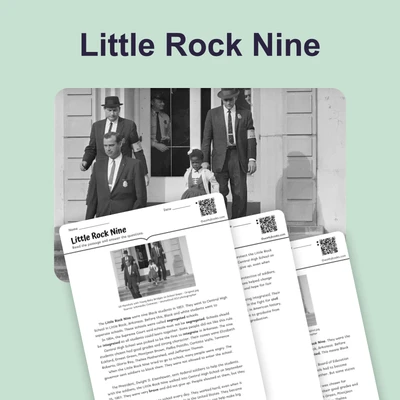
Ruby Bridges and the Little Rock Nine
This engaging history reading passage explores the stories of Ruby Bridges and the Little Rock Nine, two important group...
D2.HIS.2.3-5D2.HIS.14.3-5RI.4.3RI.4.4
Cesar Chavez and Farm Workers' Rights
This engaging history reading passage explores the life and impact of Cesar Chavez, a key leader in the fight for farm w...
D2.HIS.2.3-5D2.HIS.14.3-5RI.4.3RI.4.4
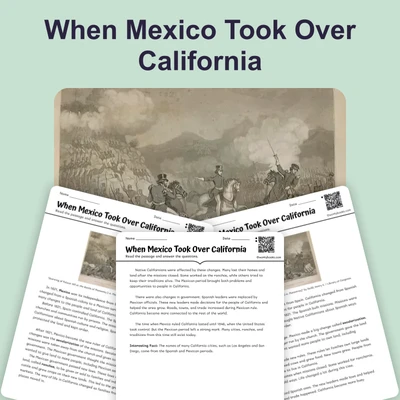
When Mexico Took Over California
This engaging U.S. history reading passage explores the period when Mexico took over California during the era of Westwa...
D2.HIS.2.3-5D2.HIS.3.3-5D2.HIS.14.3-5RI.4.3
Californios Culture
This history reading passage explores the story of the Californios—Spanish and Mexican settlers who shaped California be...
D2.HIS.2.3-5D2.HIS.3.3-5D2.HIS.14.3-5RI.4.3
The 31st State: California Joins the Union
This engaging U.S. history reading passage explores California's journey to becoming the 31st state in 1850. Students le...
D2.HIS.3.3-5D2.HIS.14.3-5RI.4.3RI.4.4
Routes to the Gold Fields
This engaging history reading passage explores the three main routes people took to reach the California gold fields dur...
D2.HIS.2.3-5D2.HIS.14.3-5RI.4.3RI.4.4
The Golden Spike: Connecting California to the Nation
This engaging U.S. history reading passage teaches students about the Golden Spike and how the first transcontinental ra...
D2.HIS.1.3-5D2.HIS.2.3-5D2.HIS.14.3-5RI.4.3
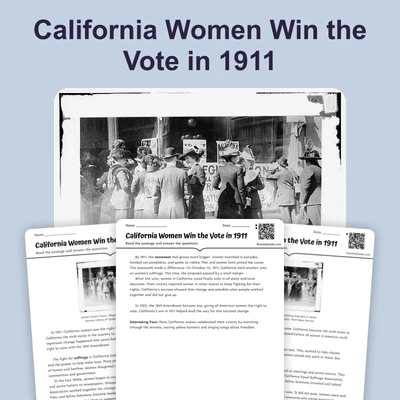
California Women Win the Vote in 1911
This engaging history reading passage explores how women in California fought and won the right to vote in 1911. Aligned...
D2.HIS.2.3-5D2.HIS.14.3-5RI.4.3RI.4.4
The 1965 Immigration Act
Discover the story of the 1965 Immigration Act with this engaging U.S. history reading passage. Perfect for building rea...
D2.HIS.4.3-5D2.HIS.14.3-5RI.5.3RI.5.4
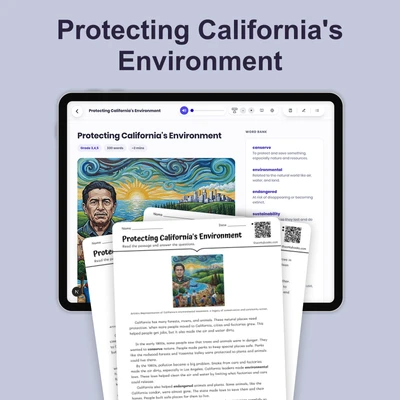
Protecting California's Environment
This engaging U.S. history reading passage explores the story of how California has worked to protect its unique environ...
D2.HIS.2.3-5D2.HIS.14.3-5RI.4.3RI.4.4
Religious Freedom in the Middle Colonies
This engaging U.S. History reading passage explores the theme of religious freedom in the Middle Colonies during colonia...