Martin Luther King Jr. and "I Have a Dream"
Interactive passage with audio narration, comprehension questions, and printable PDF.
By completing this purchase you agree to our Terms of Use and Privacy Policy. Your subscription renews automatically until you cancel. You can cancel anytime from your account settings. All sales are final and non-refundable. Digital content is available for download in your account immediately upon purchase.
What's included
Martin Luther King Jr. and "I Have a Dream" preview and details
About this printable Martin Luther King Jr. and "I Have a Dream" reading passage (Grades 3-5)
Sample passage and quiz from Martin Luther King Jr. and "I Have a Dream"
Reading passage and comprehension quiz preview
MLK I Have Dream
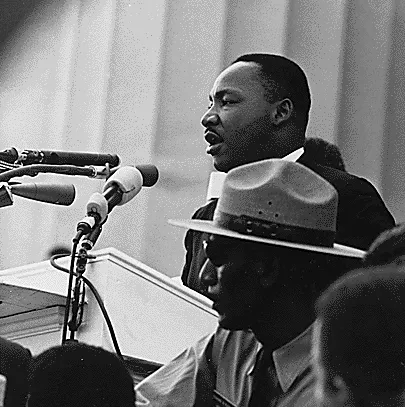
Source: Wikimedia Commons - National Archives and Records Administration
On August 28, 1963, Dr. Martin Luther King Jr. gave his famous speech called "I Have a Dream." He spoke in front of the Lincoln Memorial in Washington, D.C. Over 250,000 people listened to him that day. Dr. King was a leader in the Civil Rights Movement. He wanted all people to be treated fairly and equally.
At that time, many laws in the United States kept Black and White people apart. These laws made life much harder for Black Americans. They could not eat at the same restaurants or go to the same schools as White people. Dr. King and many others worked to change these unfair rules.
Dr. King believed in nonviolence. This means he wanted to change laws without using force or hurting others. He organized peaceful marches and protests. The March on Washington was one of the biggest. People from all over the country came together to ask for justice and equal rights.
During his speech, Dr. King shared his vision of a better America. He dreamed of a country where people would be judged by their character, not the color of their skin. His words gave hope to millions. He said, “I have a dream that one day this nation will rise up and live out the true meaning of its creed: 'We hold these truths to be self-evident, that all men are created equal.'”
Dr. King’s speech was a turning point. It inspired people to keep fighting for equality. After the speech, more laws were passed to protect civil rights. The Civil Rights Act of 1964 and the Voting Rights Act of 1965 are examples. These new laws helped end unfair treatment and gave more rights to everyone.
Today, Dr. King’s dream still inspires people. His words remind us to stand up for what is right. People around the world use his message to fight for freedom and unity. Dr. King taught us that even one person’s voice can make a big difference.
Interesting Fact: Dr. King was the youngest person to win the Nobel Peace Prize in 1964.
Comprehension quiz (8 questions)
1. When did Dr. King give his speech?
2. Where did the March on Washington happen?
3. What was Dr. King’s dream?
4. Why did people march in Washington?
5. What happened after the speech?
6. How did Dr. King want to bring change?
7. Dr. King spoke for fairness. True or false?
8. What does 'unity' mean?
Common Core standards for Martin Luther King Jr. and "I Have a Dream"
Refer to details and examples in a text when explaining what the text says explicitly and when drawing inferences from the text.
Perfect for the way you teach
- Build comprehension skills
- Auto-graded quiz
- Differentiated reading
- Read together at home
- Improve fluency
- Quiet reading time
- Reading curriculum support
- Independent practice
- Track Lexile growth