Greek Art and Architecture
Interactive passage with audio narration, comprehension questions, and printable PDF.
By completing this purchase you agree to our Terms of Use and Privacy Policy. Your subscription renews automatically until you cancel. You can cancel anytime from your account settings. All sales are final and non-refundable. Digital content is available for download in your account immediately upon purchase.
What's included
Part of this bundle

Greek Art and Architecture preview and details
About this printable Greek Art and Architecture reading passage (Grades 5-8)
Sample passage and quiz from Greek Art and Architecture
Reading passage and comprehension quiz preview
Greek Art and Architecture
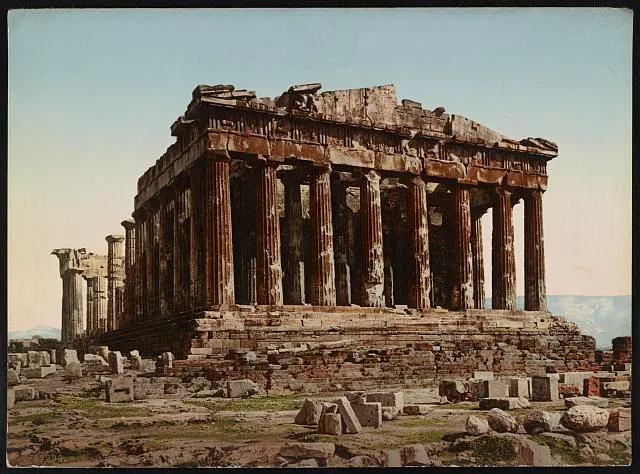
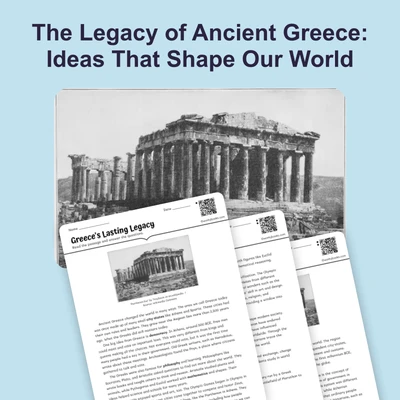
"Athènes. Parthenon" by Photoglob Co. / Library of Congress.
In the heart of ancient Athens, the Parthenon stands as a symbol of Greek achievement in art and architecture. Constructed between 447 and 432 BCE on the Acropolis hill, the Parthenon was dedicated to the goddess Athena, protector of the city-state. The design of this temple demonstrates the Greeks' mastery of proportion, balance, and mathematical principles, most famously the Golden Ratio.
The Parthenon is an example of Classical Greek architecture, which valued order, symmetry, and harmony. Its architects, Iktinos and Kallikrates, used precise measurements to create a building that appears perfectly balanced from all sides. The Golden Ratio, approximately 1.618 to 1, is a mathematical relationship often found in nature and art. Ancient Greeks believed that using this ratio made their structures more beautiful and pleasing to the eye. Archaeological studies show that the Parthenon's façade and many of its elements closely follow the Golden Ratio, although scholars still debate how consciously the Greeks applied it.
The Parthenon's columns are another example of Greek skill. Each of the 46 outer columns is slightly curved and tilted inward—a technique called entasis—to correct the optical illusion of sagging lines. The sculptor Phidias coordinated the creation of the temple's sculpted decorations, including the famous frieze that tells stories of gods and Athenians. These artistic choices reflected the daily life, religious beliefs, and social hierarchy of Athens. Only skilled artisans and craftsmen, often at the top of social ranks, could work on such important projects.
Archaeological evidence, such as ancient tools and unfinished columns, helps historians reconstruct building methods. Inscriptions from the Acropolis describe contracts for stonework and payments to workers, showing the organization behind such a massive project. Over time, the Parthenon has changed—from a temple to a church, mosque, and even a storehouse—demonstrating its continuity and adaptation through history.
The Parthenon's location on a rocky hill gave it visibility, protecting both the city and its art. Its design influenced later buildings across the world, from Roman temples to modern government buildings. The principles of proportion and the Golden Ratio continue to inspire artists and architects, linking ancient Greece to the present.
This focus on art, mathematics, and cultural values shows how geography and human ingenuity shaped Greek civilization. The Parthenon remains a lasting example of the power of design and the importance of harmony in society.
Interesting Fact: The Parthenon once held a giant statue of Athena, made of gold and ivory, which was over 12 meters tall!
Comprehension quiz (8 questions)
1. When was the Parthenon built?
2. Who was the Parthenon dedicated to?
3. Where is the Parthenon located?
4. Why did Greeks use the Golden Ratio?
5. How do we know about Parthenon building methods?
6. What is entasis?
7. The Parthenon is in Rome. True or false?
8. What does 'proportion' mean?
Perfect for the way you teach
- Build comprehension skills
- Auto-graded quiz
- Differentiated reading
- Read together at home
- Improve fluency
- Quiet reading time
- Reading curriculum support
- Independent practice
- Track Lexile growth