Tools of the Stone Age
Interactive passage with audio narration, comprehension questions, and printable PDF.
By completing this purchase you agree to our Terms of Use and Privacy Policy. Your subscription renews automatically until you cancel. You can cancel anytime from your account settings. All sales are final and non-refundable. Digital content is available for download in your account immediately upon purchase.
What's included
Part of this bundle

Tools of the Stone Age preview and details
About this printable Tools of the Stone Age reading passage (Grades 6-8)
Sample passage and quiz from Tools of the Stone Age
Reading passage and comprehension quiz preview
Tools of the Stone Age
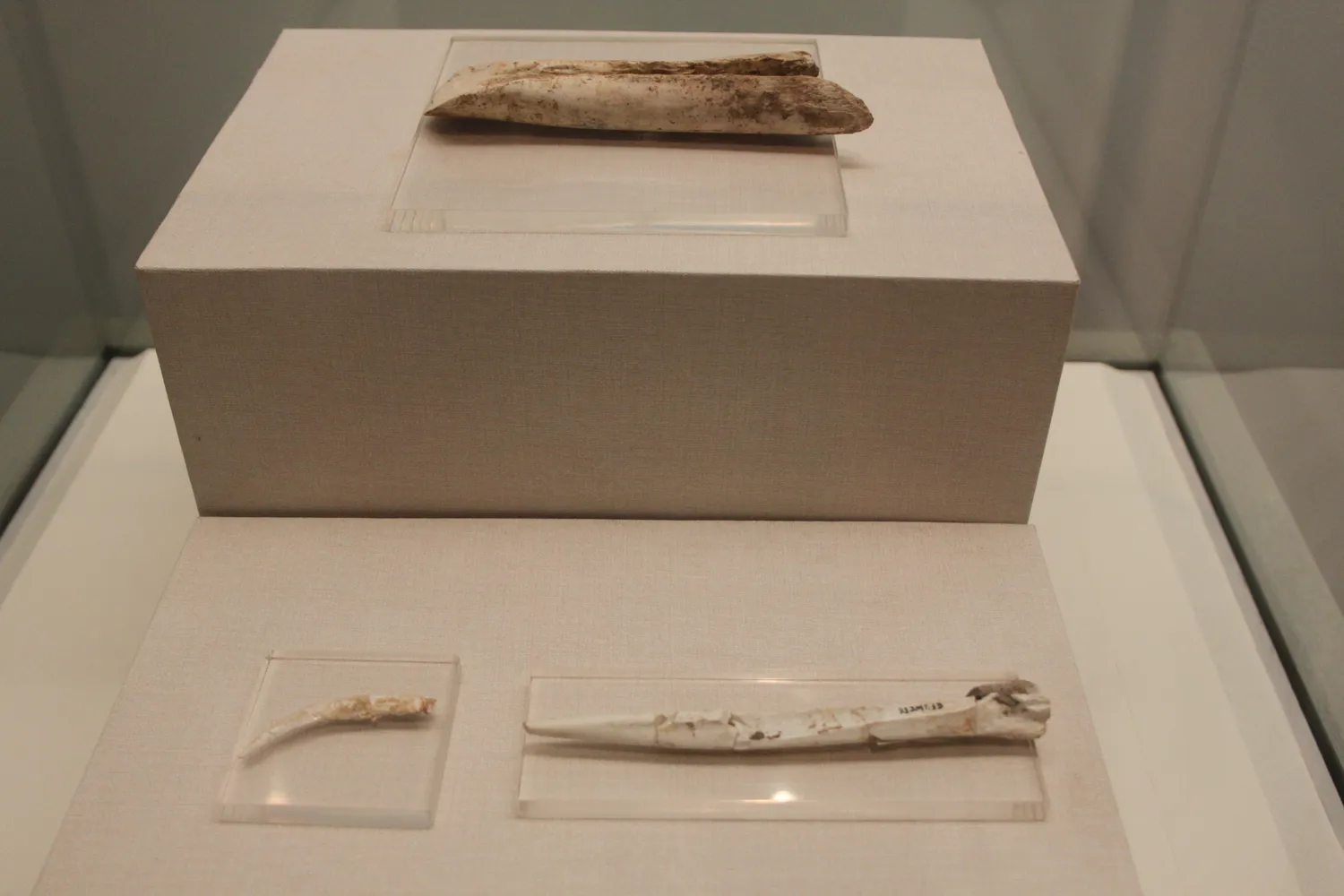
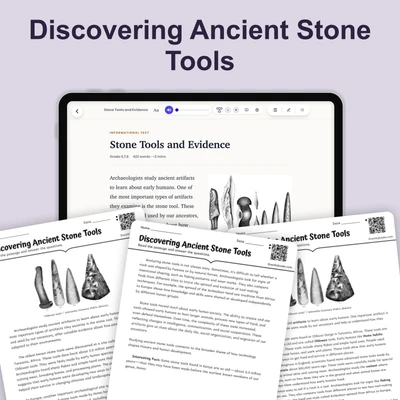
"Paleolithic Bone Tools (10112020286)" by Gary Todd from Xinzheng, China /
Source: Wikimedia Commons
The Paleolithic era, also known as the Old Stone Age, marks a period in human history when people relied heavily on stone, bone, and antler tools for survival. Archaeological evidence shows that early humans, such as Homo sapiens and Neanderthals, developed specialized spearheads and bone tools between about 2.6 million and 10,000 years ago. These technologies played a crucial role in allowing humans to hunt large animals, adapt to different environments, and expand to new regions of the world.
One of the earliest known examples of stone spearheads comes from the site of Kathu Pan in South Africa, dating back around 500,000 years. Here, archaeologists found carefully shaped stone points likely attached to wooden shafts to form projectiles. In Europe, the Schöningen Spears, discovered in Germany and dated to about 300,000 years ago, provide direct evidence of wooden spears used by Homo heidelbergensis for hunting. These spears, each about two meters long, were balanced for throwing and thrusting at large prey such as horses and deer. The development of these weapons allowed groups of hunters to work together, increasing their chances of success and supporting larger, more stable communities.
Bone tools also became a vital part of daily life during the Upper Paleolithic period (around 50,000 to 10,000 years ago). Early humans fashioned bones into needles, fishing hooks, and barbed points. At sites like Abri Blanchard in France, archaeologists have discovered decorated bone tools, showing both functional and artistic abilities. The use of bone was especially important in regions where stone was scarce. For example, in the tundra of Siberia, people made harpoons and awls from reindeer antler and mammoth bone. These adaptations allowed humans to survive in diverse and harsh environments, from ice-age steppes to dense forests.
The innovation of specialized tools and weapons had a powerful impact on early human societies. Spearheads and bone tools made hunting more efficient and safer, leading to more reliable food supplies. This, in turn, supported the growth of population and the development of social hierarchies, as successful hunters often gained higher status within their groups. The ability to make and use these tools also reflects changes in cognitive skills, such as planning, cooperation, and symbolic thinking.
Studying Paleolithic spearheads and bone tools helps historians and archaeologists understand how early humans responded to changes in climate, landscape, and animal populations. These inventions demonstrate how technology, environment, and social organization are tightly connected throughout history.
Interesting Fact: Some of the oldest known bone needles, used for sewing clothing, were found at Denisova Cave in Siberia and are over 40,000 years old.
Comprehension quiz (8 questions)
1. Where were the Schöningen Spears found?
2. What is a benefit of bone tools?
3. When did humans begin using stone tools?
4. Why were spearheads important?
5. How did toolmaking affect communities?
6. What does 'cognitive' mean in the passage?
7. Bone needles were found in Africa. True or False?
8. What is a 'projectile'?
Perfect for the way you teach
- Build comprehension skills
- Auto-graded quiz
- Differentiated reading
- Read together at home
- Improve fluency
- Quiet reading time
- Reading curriculum support
- Independent practice
- Track Lexile growth