This engaging history reading passage explores the rise of Ancient Egypt during the New Kingdom, when Egypt became a powerful empire led by extraordinary pharaohs. Students will learn about key leaders like Hatshepsut and Ramses II, the expansion into Nubia and the Levant, and how Egypt's geography and resources shaped its development. The passage highlights archaeological evidence, social hierarchies, daily life, and the significance of Egypt's imperial ambitions. Activities include a multiple-choice quiz, writing prompts, and graphic organizers to support historical thinking skills. Spanish translation and read aloud audio are included. Aligned with CA HSS 6.2 and CCSS RH.6-8.2. Keywords: Ancient Egypt, New Kingdom, imperial power, pharaohs, empire, CA HSS 6.2.
Written by Workybooks TeamPublished by Workybooks
Preview
Sample passage and quiz content
CONTENT PREVIEW
Expand content preview
Egypt. Luxor. Statue of Rameses II [i.e., Ramses II] in Temple of Luxor. Source: Library of Congress - Matson Photo Service
The New Kingdom (c. 1550–1070 BCE) was a period when Egypt reached its greatest strength and became an imperial power. During this era, Egypt’s rulers, called pharaohs, expanded their territory far beyond the Nile Valley. Powerful armies, grand monuments, and a complex social order made the New Kingdom the golden age of Ancient Egypt.
The New Kingdom began after the defeat of the Hyksos, foreign rulers who had controlled parts of Egypt. Pharaoh Ahmose I, who ruled around 1550 BCE, led successful military campaigns to drive out the Hyksos and reunite Egypt. With a strong army, Egypt started to conquer nearby regions, including Nubia to the south and the lands of the Levant to the northeast. These conquests brought wealth and resources to Egypt, such as gold, ivory, and exotic animals. Archaeologists have discovered inscriptions at Karnak Temple and tomb paintings that show soldiers, chariots, and the spoils of war.
One of the most famous New Kingdom rulers was Hatshepsut, a rare female pharaoh. She ruled around 1473-1458 BCE. Hatshepsut focused on building projects, trade, and diplomatic relations instead of constant warfare. Her mortuary temple at Deir el-Bahri is one of Egypt’s architectural masterpieces. Another key pharaoh, Ramses II (reigned 1279–1213 BCE), expanded Egyptian territory and signed one of the world’s earliest peace treaties with the Hittites after the Battle of Kadesh. Ramses II was known for constructing massive statues and temples, including Abu Simbel, which still stand today as evidence of his power.
Egypt’s social hierarchy during the New Kingdom was very structured. At the top was the pharaoh, supported by nobles, priests, scribes, and soldiers. Most people were farmers, laborers, or craftsmen. The use of hieroglyphics on tombs and monuments helped record important events and maintain order. The Nile River was crucial, providing fertile land and enabling trade and communication between regions.
As Egypt’s empire expanded, it became richer and more diverse. However, maintaining such a large empire was challenging. Over time, internal conflicts and foreign invasions weakened Egypt, leading to the end of the New Kingdom. Despite these changes, the achievements of the New Kingdom left a lasting legacy in art, architecture, and government.
This period connects to broader themes of power, leadership, and the rise and fall of empires in world history.
Interesting Fact: The tomb of Tutankhamun, a New Kingdom pharaoh, was discovered almost intact in 1922, revealing treasures that amazed the world.
Who defeated the Hyksos?
Ahmose IHatshepsutRamses IITutankhamun
Which pharaoh built Abu Simbel?
Ahmose IRamses IIHatshepsutAkhenaten
Where did Egypt expand during the New Kingdom?
Greece and RomeNubia and LevantPersia and IndiaChina and Mesopotamia
Why was the Nile River important?
It provided fertile landIt was a desertIt was a mountainIt was a city
What did Hatshepsut focus on?
War onlyTrade and buildingFarmingWriting poems
What caused the end of the New Kingdom?
Internal conflict and invasionsBuilding pyramidsToo much tradePeace treaties
The New Kingdom was Egypt's last period of power. True or false?
TrueFalse
What is a 'pharaoh'?
Egyptian kingA soldierA farmerA building
Who it's for
Perfect for the way you teach
Teachers
Build comprehension skills
Auto-graded quiz
Differentiated reading
Parents
Read together at home
Improve fluency
Quiet reading time
Homeschoolers
Reading curriculum support
Independent practice
Track Lexile growth
Topics
Ancient EgyptNew Kingdompharaohsimperial powerHatshepsutRamses IIempirehieroglyphicsCA HSS 6.2RH.6-8.2
Reviews & Ratings
No reviews yet. Be the first to share your experience!
More reading you might love
19 more
Farming in Ancient Mesopotamia
This engaging reading passage explores how the geography of Mesopotamia shaped its civilization through innovative irrig...
CA HSS 6.2RH.6-8.1RH.6-8.2RH.6-8.4
Floods and Droughts in Mesopotamia
This reading passage explores the environmental challenges faced by ancient Mesopotamia, the 'land between the rivers.' ...
CA HSS 6.2RH.6-8.1RH.6-8.2TEKS 6.2A
Ancient Egyptian Afterlife
This engaging history reading passage explores ancient Egyptian beliefs about the afterlife and the construction of the ...
CA HSS 6.2RH.6-8.1RH.6-8.4
Egyptian Social Classes
This engaging reading passage explores the social pyramid of Ancient Egyptian society, delving into how the roles and re...
CA HSS 6.2RI.6.1RI.6.2RI.6.4
Discovering Lost Cities
This passage explores the revolutionary impact of modern technology, specifically drones and satellites, on the field of...
CA HSS 6.2CA HSS 6.4RI.6.1RI.7.1
Juan Bautista de Anza's Expedition
This reading passage explores the remarkable journey of Juan Bautista de Anza and his expedition from Mexico to Californ...
HSS 4.2.3RH.6-8.2
How Explorers Changed California
This engaging U.S. History reading passage explores how explorers from Europe transformed California through the Columbi...
HSS 4.2.2RH.6-8.2
California Gold Discovery
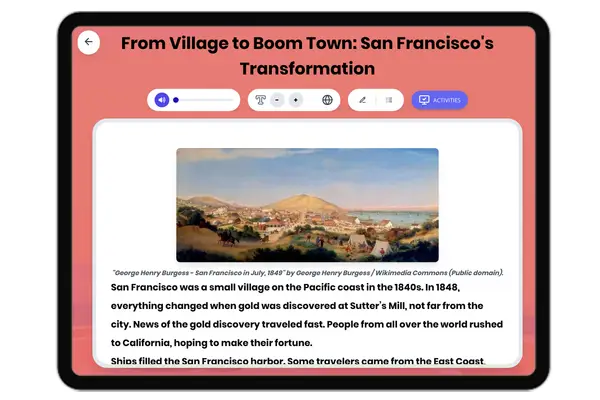
This passage explores the discovery of gold in California at Sutter's Mill by James Marshall in January 1848 and its imp...
HSS 4.4.1RH.6-8.2
California Mining Camps
This engaging history reading passage explores the world of California mining camps during the Gold Rush, aligning with ...
HSS 4.4.2RH.6-8.2
San Francisco Growth
This comprehensive U.S. history passage explores the rapid growth of San Francisco during the California Gold Rush. Stud...
HSS 4.4.3RH.6-8.2
Transcontinental Railroad
This reading passage explores the history and importance of the Transcontinental Railroad, which was completed in 1869. ...
HSS 4.4.1RH.6-8.2
California Agriculture Growth
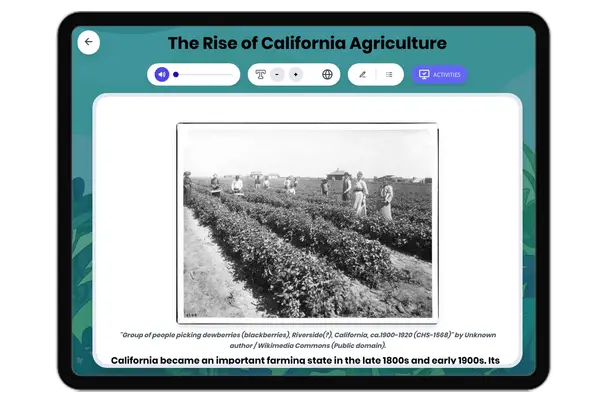
This passage explores the remarkable growth of California's agriculture during the Progressive Era, focusing on how the ...
HSS 4.4.6RH.6-8.2
The 1879 California Constitution
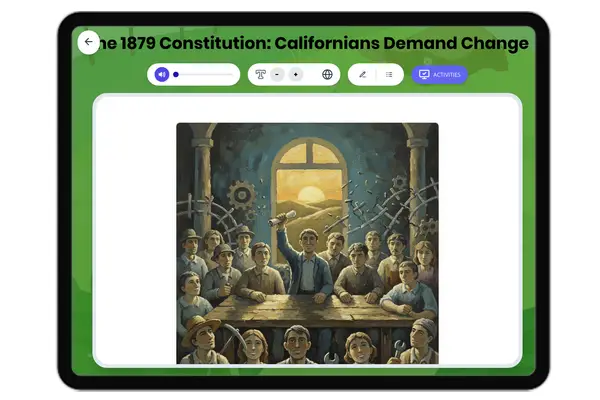
This reading passage explores the significance of the 1879 California Constitution, explaining why California adopted a ...
HSS 4.5.1RH.6-8.2
California Progressive Era
This engaging reading passage explores the California Progressive Era, a crucial period in U.S. history when reformers l...
HSS 4.5.2RH.6-8.2
How a California Bill Becomes Law
This passage guides students through the step-by-step process of how a bill becomes a law in California, from the first ...
HSS 4.5.3RH.6-8.2
Civic Participation in California
This engaging U.S. History reading passage explores California citizen participation, focusing on how ordinary people he...
HSS 4.5.5RH.6-8.2
Meroë Capital of Ancient Kush
This passage explores the rise and significance of Meroë, once the capital of the Kingdom of Kush in ancient Africa. Loc...
CA HSS 6.2.6RH.6-8.1RH.6-8.2WHST.6-8.2
King Tut's Tomb Discovered
This detailed history reading passage explores the remarkable discovery of King Tutankhamun's tomb by Howard Carter in 1...
CA HSS 6.2.9RH.6-8.1RH.6-8.2
First Humans
This engaging history reading passage explores the evolution of early humans, tracing the journey from the earliest homi...