This reading passage explores the significance of the 1879 California Constitution, explaining why California adopted a new constitution during the Progressive Era. Students will learn about the issues of railroad monopolies, the rise of constitutional reform, and the unfair treatment of Chinese immigrants through anti-Chinese provisions. The passage highlights the cause-and-effect relationship between public concerns and government actions, demonstrating how the new constitution reflected both progress in government regulation and prejudice against certain groups. Key vocabulary words are highlighted and defined in a glossary for student understanding. The passage includes a Spanish translation, a simplified differentiated version, and comprehension activities. It also offers a timeline and graphic organizers to support student learning and analysis. This history reading passage includes read aloud audio and aligns with history and Common Core standards HSS 4.5.1 and RH.6-8.2.
Written by Workybooks TeamPublished by Workybooks
Preview
Sample passage and quiz content
CONTENT PREVIEW
Expand content preview
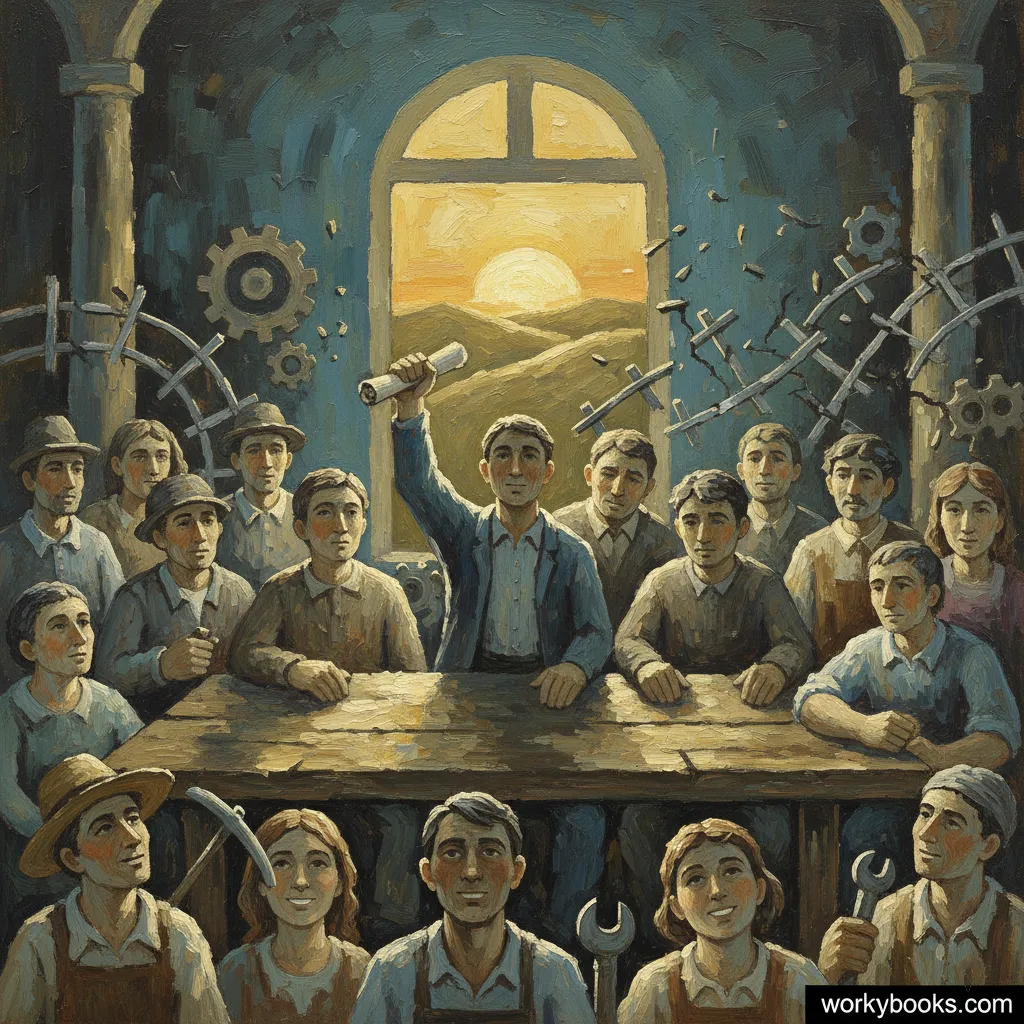
Artist Representation of a new constitution brings hope for change in California.
The 1879 California Constitution was a turning point in the state's history. People in California wanted change. The original constitution from 1849 no longer fit the changing needs of the state. By the late 1800s, California had grown quickly. New problems needed new solutions.
One major concern was the power of the railroad companies. The Central Pacific Railroad was very powerful. It controlled much of California's transport and trade. Many people believed the railroad had too much influence on the government. They worried it hurt small businesses and made prices unfair. Citizens wanted the government to control what the railroad could do. This push for regulation was a big reason for the new constitution.
Many Californians also feared losing jobs to Chinese immigrant workers. Chinese workers helped build the railroads and worked in fields and cities. But prejudice grew among some groups. They blamed Chinese workers for low wages and job competition. The new constitution responded to this by including discriminatoryprovisions. These rules made it hard for Chinese people to get jobs or live freely in California. This was an example of unfair treatment called discrimination.
In 1878, leaders called a convention to write a new constitution. Many people attended. Some wanted more rights and protections for workers. Others wanted strict rules against Chinese immigrants. After months of debate, the new constitution was approved by voters in 1879. It brought more government control over railroads. It also included unfair rules against Chinese people. Some changes helped the state grow. Others caused pain for people who were treated unfairly.
The 1879 California Constitution showed both progress and prejudice. It solved some problems and created others. Over time, California changed many of its unfair laws. Today, the constitution reminds us of the importance of fair rules for all people.
Interesting Fact: California's 1879 constitution was one of the longest in the world at the time, with over 20,000 words.
When was the new California Constitution approved?
1879184918891899
Which company had too much power?
Central Pacific RailroadGold Mining CoPacific TelephoneOcean Shipping
What group faced unfair rules?
Chinese immigrantsIrish settlersFarmersTeachers
Why did people want regulation of railroads?
To make prices fairTo build more schoolsTo raise gold pricesTo help teachers
What did the constitution do for workers?
Offered more rightsBuilt new roadsLowered taxesClosed businesses
How did the constitution treat Chinese immigrants?
With unfair rulesWith friendshipWith giftsWith land
The constitution had over 20,000 words. True or false?
TrueFalse
What is 'regulation'?
A government ruleA train stationA type of jobA city in California
Who it's for
Perfect for the way you teach
Teachers
Build comprehension skills
Auto-graded quiz
Differentiated reading
Parents
Read together at home
Improve fluency
Quiet reading time
Homeschoolers
Reading curriculum support
Independent practice
Track Lexile growth
Topics
California Constitution1879railroad regulationdiscriminationChinese immigrantsreformprogressive erahistory reading passage
Reviews & Ratings
No reviews yet. Be the first to share your experience!
More reading you might love
18 more
Juan Bautista de Anza's Expedition
This reading passage explores the remarkable journey of Juan Bautista de Anza and his expedition from Mexico to Californ...
HSS 4.2.3RH.6-8.2
How Explorers Changed California
This engaging U.S. History reading passage explores how explorers from Europe transformed California through the Columbi...
HSS 4.2.2RH.6-8.2
California Gold Discovery
This passage explores the discovery of gold in California at Sutter's Mill by James Marshall in January 1848 and its imp...
HSS 4.4.1RH.6-8.2
California Mining Camps
This engaging history reading passage explores the world of California mining camps during the Gold Rush, aligning with ...
HSS 4.4.2RH.6-8.2
San Francisco Growth
This comprehensive U.S. history passage explores the rapid growth of San Francisco during the California Gold Rush. Stud...
HSS 4.4.3RH.6-8.2
Transcontinental Railroad
This reading passage explores the history and importance of the Transcontinental Railroad, which was completed in 1869. ...
HSS 4.4.1RH.6-8.2
California Agriculture Growth
This passage explores the remarkable growth of California's agriculture during the Progressive Era, focusing on how the ...
HSS 4.4.6RH.6-8.2
California Progressive Era
This engaging reading passage explores the California Progressive Era, a crucial period in U.S. history when reformers l...
HSS 4.5.2RH.6-8.2
How a California Bill Becomes Law
This passage guides students through the step-by-step process of how a bill becomes a law in California, from the first ...
HSS 4.5.3RH.6-8.2
Civic Participation in California
This engaging U.S. History reading passage explores California citizen participation, focusing on how ordinary people he...
HSS 4.5.5RH.6-8.2
Meroë: Capital of Kush
This passage explores the rise and significance of Meroë, once the capital of the Kingdom of Kush in ancient Africa. Loc...
CA HSS 6.2.6RH.6-8.1RH.6-8.2WHST.6-8.2
New Kingdom Egypt
This engaging history reading passage explores the rise of Ancient Egypt during the New Kingdom, when Egypt became a pow...
CA HSS 6.2RH.6-8.2WHST.6-8.2
First Humans
This engaging history reading passage explores the evolution of early humans, tracing the journey from the earliest homi...
CA HSS 6.1RH.6-8.1RH.6-8.2W.6.2
Han Dynasty: Wheelbarrow
This passage explores the invention and historical significance of the wheelbarrow during the Han dynasty in ancient Chi...
CA HSS 6.6CCSS RH.6-8.1RH.6-8.2RH.6-8.4
Han Dynasty: Seismograph
Discover the groundbreaking invention of the seismograph during the Han dynasty in ancient China in this engaging histor...
HSS 6.6.7RH.6-8.1RH.6-8.2WHST.6-8.2
Early Human Migration
This comprehensive history reading passage explores the Out of Africa movement and how early humans migrated across cont...
CA HSS 6.1.1CCSS RH.6-8.1RH.6-8.2RH.6-8.4
Paleolithic Migration by Land and Sea
This passage explores the migration of Paleolithic humans from Africa to the rest of the world, focusing on the routes t...
6.1RH.6-8.1RH.6-8.2RH.6-8.4
Origins of Social Classes
This engaging history reading passage explores how the rise of farming and the spread of pastoral nomads across the Eura...