First Human Jewelry
Interactive passage with audio narration, comprehension questions, and printable PDF.
What's included
First Human Jewelry preview and details
About this printable First Human Jewelry reading passage (Grades 6-8)
Sample passage and quiz from First Human Jewelry
Reading passage and comprehension quiz preview
First Human Jewelry
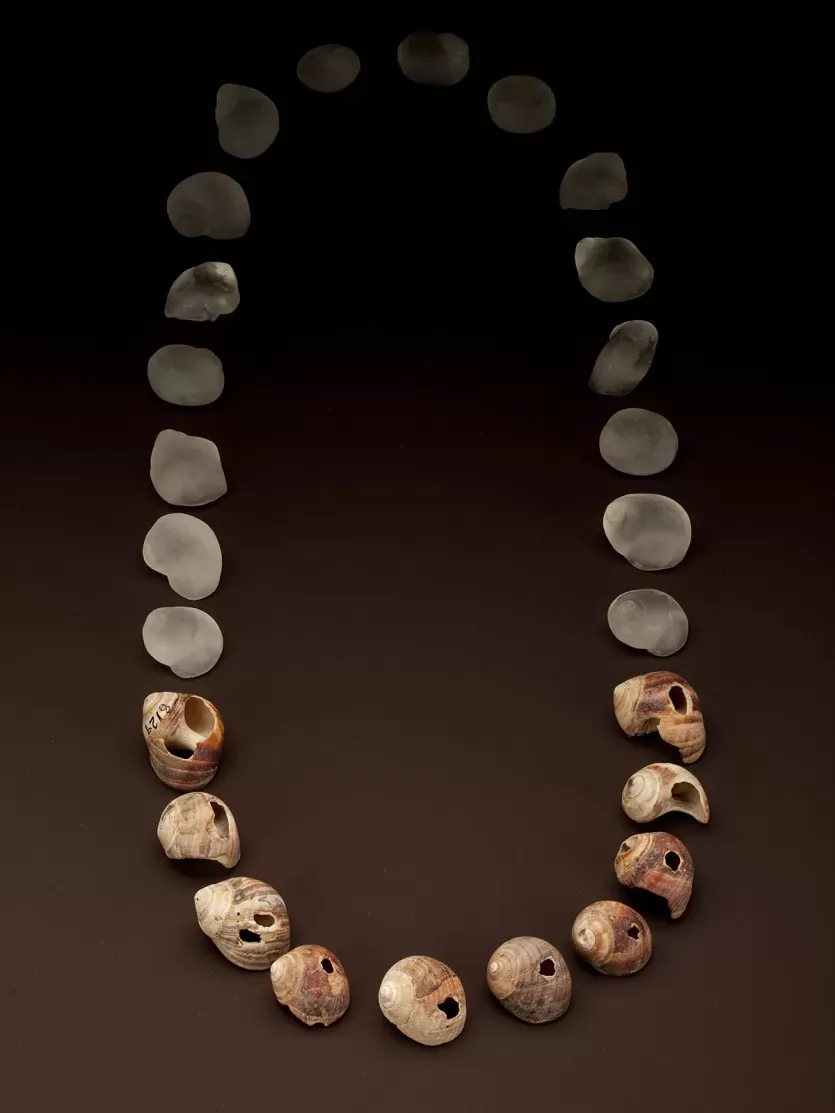
"Shell bead necklace" / Wikimedia Commons
Archaeologists have discovered the earliest known decorative shells made by humans, dating back more than 142,000 years. These small beads, found in Morocco and South Africa, provide evidence that ancient humans engaged in symbolic activities much earlier than previously thought. The discovery challenges earlier beliefs about when humans first began to use objects for personal expression and social communication.
The oldest of these shells were unearthed at Bizmoune Cave in Morocco. Scientists used advanced dating techniques to confirm their age at about 142,000 years old. The shells, from the Nassarius genus, were pierced with small holes and show traces of red ochre, a natural pigment. This suggests the shells were likely strung together as necklaces or worn as ornaments. Similar shell beads were also found at Blombos Cave in South Africa, dating to about 75,000 years ago. These sites are nearly 5,000 miles apart, showing that different groups of early humans across Africa developed similar cultural practices.
Archaeological evidence suggests these beads were more than just decoration. Researchers believe that wearing shell ornaments was a way for early humans to communicate identity, group membership, or status within their community. The use of red ochre, a symbolic color, may have carried specific meanings or represented important rituals. The careful selection, preparation, and transport of shells from the coast, sometimes over long distances, shows planning and cooperation among individuals.
The discovery of such ancient decorative shells provides insight into the cognitive and social abilities of early Homo sapiens. It marks a significant development in the history of human creativity, symbolism, and shared meaning. These artifacts demonstrate that even in the prehistoric past, people valued more than just survival—they sought ways to express themselves and connect with others. The continuity of shell bead use over tens of thousands of years shows how traditions and symbolic behaviors were passed down through generations, shaping human culture.
This evidence connects to larger themes in ancient history, such as the development of art, technology, and society. By studying decorative artifacts, historians and archaeologists gain a better understanding of how early humans adapted to their environment and built complex social structures.
Interesting Fact: Some shell beads from Blombos Cave still contain traces of red ochre, suggesting that people carefully selected and colored their jewelry for special meaning.
Comprehension quiz (8 questions)
1. Where were the oldest shells found?
2. How old are the Bizmoune Cave beads?
3. What color pigment was used on the shells?
4. Why did early humans wear shell beads?
5. What does the use of beads show?
6. How are Bizmoune and Blombos sites connected?
7. Decorative shells were used just for food. True or False?
8. What does 'cognitive' mean?
Perfect for the way you teach
- Build comprehension skills
- Auto-graded quiz
- Differentiated reading
- Read together at home
- Improve fluency
- Quiet reading time
- Reading curriculum support
- Independent practice
- Track Lexile growth