Florentine Codex Aztec
Interactive passage with audio narration, comprehension questions, and printable PDF.
By completing this purchase you agree to our Terms of Use and Privacy Policy. Your subscription renews automatically until you cancel. You can cancel anytime from your account settings. All sales are final and non-refundable. Digital content is available for download in your account immediately upon purchase.
What's included
Florentine Codex Aztec preview and details
About this printable Florentine Codex Aztec reading passage (Grades 5-8)
Sample passage and quiz from Florentine Codex Aztec
Reading passage and comprehension quiz preview
The Florentine Codex: An Indigenous View
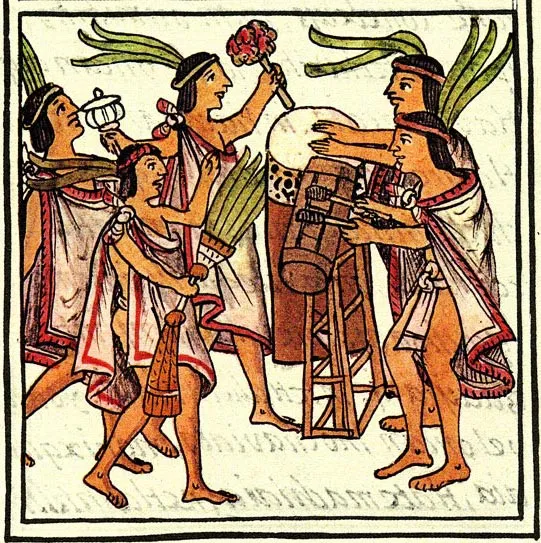
"Aztec drums, Florentine Codex." /
Source: Wikimedia Commons (Public domain).
The Florentine Codex is a remarkable manuscript that provides a detailed indigenous perspective on the Spanish conquest of the Aztec Empire in the 16th century. Created in the city of Tlatelolco, near present-day Mexico City, it was compiled between 1545 and 1590 by the Spanish friar Bernardino de Sahagún and a team of Nahua scholars. The Codex contains twelve books written in both Spanish and Nahuatl, the language of the Aztec people, making it a unique blend of European and indigenous knowledge.
One of the main goals of Sahagún and his Nahua collaborators was to record the beliefs, daily life, and history of the Aztec civilization before they disappeared under Spanish rule. The Codex includes descriptions of religious ceremonies, social hierarchy, and the geography of central Mexico. It also preserves primary sources—firsthand accounts from Nahua elders who witnessed key events. For example, Book 12 details the arrival of Hernán Cortés in 1519 and the dramatic encounters between the Spanish and Moctezuma II, the Aztec emperor. Nahua testimonies describe the fear, confusion, and violence that followed, offering a viewpoint very different from Spanish chronicles.
The Florentine Codex is also valuable for its attention to cause-and-effect relationships. It explains how the introduction of new diseases, such as smallpox, devastated the indigenous population and helped the Spanish conquer Tenochtitlan in 1521. The Codex shows the impact of conquest on daily life, including the destruction of temples and changes in social structure. The Nahua authors document both continuity and change: while some traditions survived, many aspects of Aztec society were transformed or lost.
The Codex’s creation was influenced by both indigenous perspectives and Spanish colonial interests. Sahagún wanted to convert Nahua people to Christianity, but he also respected their knowledge and traditions. The Nahua scholars, meanwhile, used the project to preserve their own stories and worldview. Because of this collaboration, the Codex is considered a multifaceted source, reflecting both cooperation and tension between cultures. Today, historians use the Florentine Codex to study not only the fall of the Aztec Empire, but also the complexities of cultural exchange and adaptation in the Americas.
The Florentine Codex remains one of the most important sources for understanding indigenous voices during the Spanish conquest. Its detailed descriptions and firsthand accounts help us see history through the eyes of those who lived it. Studying the Codex connects us to larger themes of world history, such as the effects of conquest, the preservation of culture, and the mixing of societies.
Interesting Fact: The Florentine Codex contains over 2,400 illustrations made by indigenous artists, making it one of the richest visual sources from the Americas.
Comprehension quiz (8 questions)
1. Who led the creation of the Florentine Codex?
2. Which empire is described in the Codex?
3. What year did Cortés arrive?
4. Why is Book 12 important?
5. What effect did smallpox have?
6. What type of source is the Codex?
7. The Codex contains over 2,400 illustrations. True or false?
8. What does 'hierarchy' mean?
Perfect for the way you teach
- Build comprehension skills
- Auto-graded quiz
- Differentiated reading
- Read together at home
- Improve fluency
- Quiet reading time
- Reading curriculum support
- Independent practice
- Track Lexile growth