This learning resource is available in interactive and printable formats. The interactive worksheet can be played online and assigned to students. The Printable PDF version can be downloaded and printed for completion by hand.
This comprehensive middle school science passage explores the scientific principles behind wind energy and how wind turbines convert the kinetic energy of moving air into usable electricity. Aligned with NGSS standards MS-PS3-4, MS-ESS3-3, and MS-ESS3-4, the passage covers the main components of wind turbines, such as blades, rotors, generators, and towers. It explains the mechanisms of energy conversion, the differences between onshore and offshore wind farms, and discusses both the advantages (clean, renewable, low operating costs) and the challenges (intermittency, noise, visual impact, and wildlife considerations) of wind energy. Real-world examples and quantitative data highlight the rapid global growth of wind power. The passage is supported by multiple-choice and writing activities, a glossary, and graphic organizers, making it suitable for diverse learners. Audio integration further supports accessibility and comprehension.
CONTENT PREVIEW
Expand content preview
How wind energy becomes electricity
Wind energy is a rapidly growing source of electricity that transforms the natural movement of air into usable power. As countries seek cleaner alternatives to fossil fuels, wind turbines are becoming more common on landscapes and coastlines around the world. The process of converting the kinetic energy of wind into electrical energy involves several scientific principles and specialized machinery. Understanding how wind turbines work helps explain both the possibilities and the challenges of using wind as a sustainable resource.
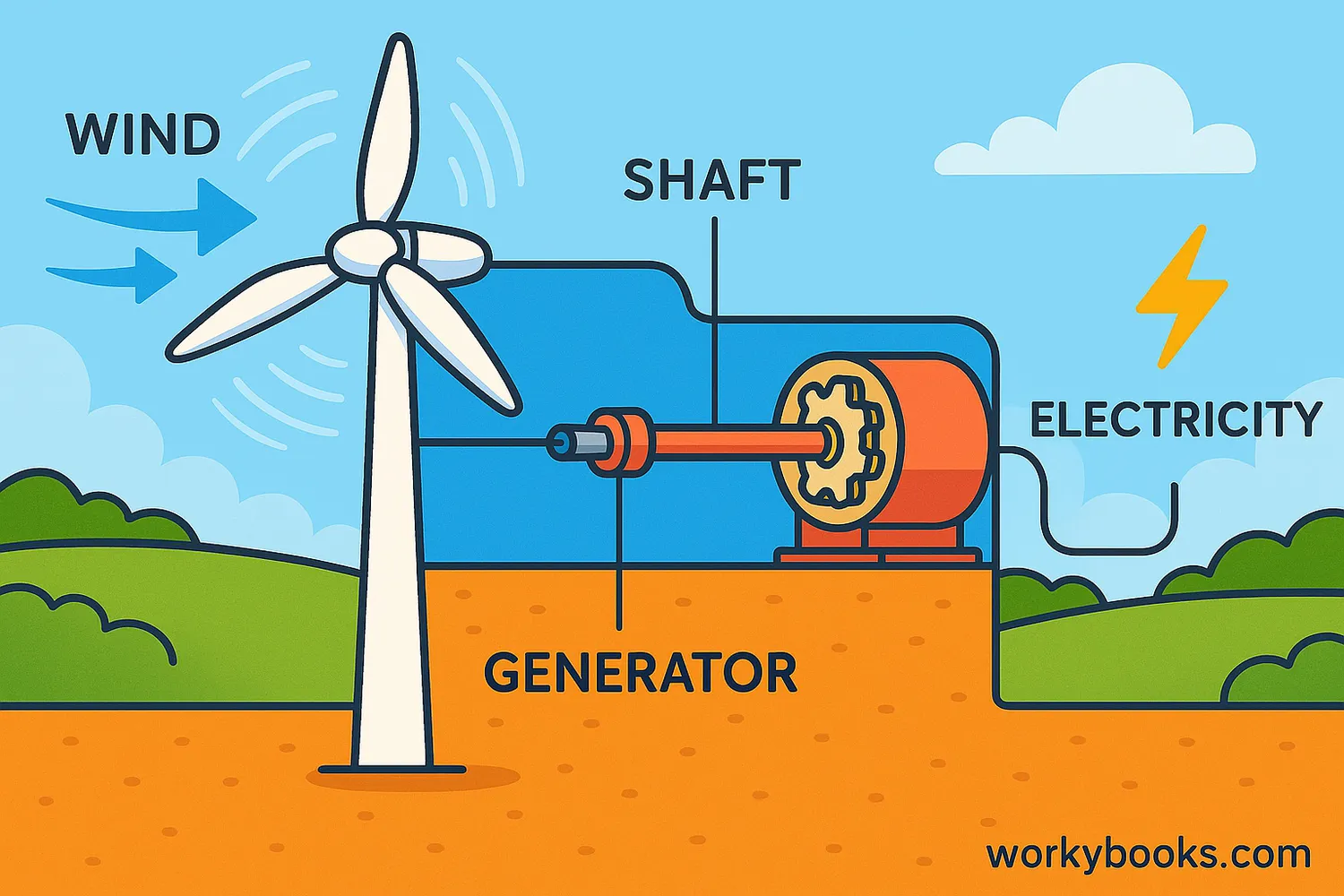
How Wind Turbines Work At the heart of wind energy systems are wind turbines, which are tall structures with large blades. When wind blows, it pushes against the blades, causing them to spin. This spinning motion turns a rotor, which is connected to a generator inside the turbine. The generator uses magnets and coils of wire to convert the mechanical motion into electricity. The amount of energy produced depends on wind speed: doubling the wind speed can increase power output by up to eight times. The tower raises the blades higher, where winds are generally stronger and less turbulent, improving efficiency. Each part of the turbine—blades, rotor, generator, and tower—plays a critical role in turning moving air into electrical energy.
Wind Farms and Applications Wind turbines are often grouped together in wind farms to generate large amounts of electricity. These farms can be found on land (onshore) or out at sea (offshore). Offshore wind farms benefit from steadier, stronger winds but are more expensive to build and maintain. For example, the United States added over 16,000 megawatts of new wind capacity in 2020 alone, enough to power millions of homes. Wind energy is now one of the fastest-growing sources of electricity worldwide, making up over 6% of global electricity generation. By integrating wind power into national grids, countries can reduce their dependence on fossil fuels and decrease greenhouse gas emissions.
Advantages and Challenges Wind energy offers several important advantages: it is clean, renewable, and has low operating costs after installation. Unlike fossil fuels, wind power does not release harmful pollutants or carbon dioxide. However, there are challenges. Wind is an intermittent resource, meaning it does not blow consistently. This makes it difficult to rely on wind alone for all electricity needs. Some people are concerned about the noise and visual impact of turbines, and wind farms can pose risks to birds and bats. Location is also important: not every place has enough wind to make turbines worthwhile. Ongoing research is focused on minimizing these impacts, improving turbine technology, and finding the best sites for new wind farms.
Wind energy demonstrates the interaction between natural forces and human technology. By harnessing the kinetic energy of the wind, we can generate large amounts of electricity without depleting resources or polluting the environment. As technology improves, wind power will likely play an even greater role in a sustainable energy future.
Interesting Fact: Some of the world’s largest wind turbines have blades longer than the wingspan of a Boeing 747 airplane and can generate enough electricity to power thousands of homes!
What does a wind turbine use to generate electricity?
The movement of air (wind)Burning fossil fuelsSolar panelsWater from rivers
Which part of the wind turbine is responsible for raising the blades higher where winds are stronger?
RotorGeneratorTowerBlade
What is one advantage of wind energy mentioned in the passage?
It creates harmful pollutionIt is a renewable resourceIt always produces electricity at the same rateIt depends on burning fuel
According to the passage, what does the generator inside a wind turbine do?
It stores wind energy for later useIt converts mechanical motion into electricityIt measures wind speedIt supports the blades
What does the word "intermittent" mean in the context of wind energy?
Always availableHappening at regular timesHappening at irregular timesVery strong
What is the main difference between onshore and offshore wind farms?
Onshore farms are on land, offshore farms are at seaOnshore farms are more expensiveOffshore farms use solar energyOffshore farms are always smaller
Why is location important for building wind turbines?
To avoid using electricityNot every place has enough wind to make turbines worthwhileBecause turbines are very smallSo they can be hidden from view
If wind speed doubles, how does it affect the power output of a wind turbine?
It doubles the power outputIt decreases power outputIt can increase power output up to eight timesIt has no effect
True or False: Wind energy releases carbon dioxide into the atmosphere.
TrueFalse
True or False: One challenge of wind energy is that it can harm birds and bats.
TrueFalse
Perfect For:
👩🏫 Teachers
• Reading comprehension practice
• Auto-graded assessments
• Literacy skill development
👨👩👧👦 Parents
• Reading practice at home
• Comprehension improvement
• Educational reading time
🏠 Homeschoolers
• Reading curriculum support
• Independent reading practice
• Progress monitoring
Reading Features:
📖
Reading Passage
Engaging fiction or nonfiction text
❓
Comprehension Quiz
Auto-graded questions
📊
Instant Feedback
Immediate results and scoring
📄
Printable Version
Download for offline reading
🔊
Read Aloud
Voice-over with word highlighting
Reviews & Ratings
No reviews yet. Be the first to share your experience!
Related Content
Natural Disaster: Volcanic Eruptions
Volcanoes can erupt with lava and ash, changing the landscape. While dangerous, they also create fertile land and new la...
RI.3.1RI.4.4RI.4.2RI.5.2
Human Impacts: Pollution
This middle school science reading passage, aligned with NGSS standards MS-LS2-4 and MS-ESS3-3, examines the mechanisms ...
MS-LS2-4MS-ESS3-3
Human Impacts: Habitat Destruction
This grade 6-8 science passage explores human impacts on ecosystems, focusing on habitat destruction as the leading caus...
MS-LS2-4MS-LS2-5MS-ESS3-3
Ecosystem Services
This engaging middle school science passage introduces students to the concept of ecosystem services, the vital benefits...
MS-LS2-5MS-ESS3-3
Environmental Problems and Solutions
This passage for grades 6-8 introduces major environmental problems such as habitat loss, pollution, climate change, inv...
MS-LS2-4MS-ESS3-3MS-ESS3-4
Remote Sensing
This middle school science passage introduces students to the concept of remote sensing—the collection of information ab...
MS-ESS3-3MS-PS4-2MS-ETS1-1MS-ETS1-3
Geographic Information Systems (GIS)
This engaging middle school science passage introduces students to Geographic Information Systems (GIS), aligning with N...
MS-ESS3-3MS-ETS1-1MS-ETS1-2MS-ETS1-3
Renewable vs. Nonrenewable Energy
This engaging passage, aligned with NGSS standards MS-PS3-4, MS-ESS3-3, and MS-ESS3-4, helps middle school students diff...
MS-PS3-4MS-ESS3-3MS-ESS3-4
Fossil Fuels: Coal
This middle school science reading passage explores the science behind coal, a major fossil fuel. Students will learn ho...
MS-PS3-4MS-ESS3-3MS-ESS3-4
Solar Energy
This engaging passage for grades 6-8 explores the science of solar energy, focusing on how sunlight is converted into el...
MS-PS3-4MS-ESS3-3MS-ESS3-4
Hydroelectric Energy
This comprehensive passage introduces middle school students to the science behind hydroelectric energy, directly aligni...
MS-PS3-4MS-ESS3-3MS-ESS3-4
Geothermal Energy
This comprehensive science passage introduces middle school students to the mechanisms and applications of geothermal en...
MS-PS3-4MS-ESS3-3MS-ESS3-4
Biomass and Biofuels
This NGSS-aligned passage introduces grades 6-8 students to the science of biomass and biofuels, explaining how organic ...
MS-PS3-4MS-ESS3-3MS-ESS3-4
Nuclear Energy as a Resource
This NGSS-aligned informational science passage, designed for grades 6-8, explores nuclear energy as a resource in the c...
MS-PS3-4MS-ESS3-3MS-ESS3-4
Water Quality
This middle school science reading passage covers the topic of water quality, aligned with NGSS standards MS-ESS3-1 and ...
MS-ESS3-1MS-ESS3-3
Florida Everglades
This comprehensive passage introduces middle school students to the Florida Everglades, a distinctive wetland ecosystem ...
MS-LS2-1MS-LS2-4MS-ESS3-3MS-ESS3-4
Congo Rainforest
This middle school science passage explores the Congo Rainforest—Earth’s second-largest rainforest, located in Central A...
MS-LS2-1MS-ESS3-3
Nuclear Power Plants
This comprehensive reading passage introduces middle school students (grades 6-8) to the science of nuclear power plants...
MS-PS3-4MS-ESS3-3
Nuclear Safety and Waste
This middle school science passage explores the critical topic of nuclear safety and waste management, aligned with NGSS...