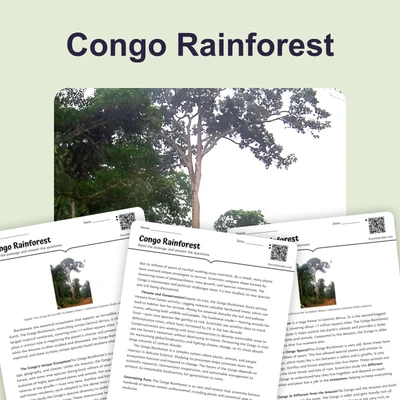
How Rainforests Help the Planet — Reading Comprehension
Rate this
Present
Present in classroom. No work saved
Assign
Classroom with student accounts, Track progress
Quick Play
No student accounts, assign with a link
Grades
5
6
7
8
Standards
MS-ESS2-6
MS-LS2-5
PRINT+DIGITAL RESOURCE
This learning resource is available in interactive and printable formats. The interactive worksheet can be played online and assigned to students. The Printable PDF version can be downloaded and printed for completion by hand.
This NGSS-aligned reading passage for middle school students explains how rainforests help regulate Earth’s climate and support biodiversity. Students will learn how photosynthesis, carbon storage, and habitat diversity make rainforests vital to both the planet and human life. The passage explores scientific vocabulary and includes real-world connections to medicine, indigenous communities, and deforestation challenges. This resource is ideal for teaching ecosystem functions, environmental impact, and human dependence on natural resources. It supports standards in life science and builds key reading comprehension and science literacy skills through clear explanations and examples.
CONTENT PREVIEW
Expand content preview
Rainforests play a critical role in maintaining Earth’s environment. These ecosystems are found in tropical regions near the Equator and are filled with trees, plants, animals, and microbes. Though they cover only about 6% of Earth’s surface, they are essential to the health of the entire planet.
One of the most important functions of rainforests is producing oxygen. Through photosynthesis, plants take in carbon dioxide (CO₂) and release oxygen (O₂). Tropical rainforests like the Amazon help produce around 20% of the world’s oxygen, which humans and animals need to breathe.
Rainforests are also known as carbon sinks. This means they absorb more carbon dioxide than they release. By storing carbon, they help slow down climate change caused by the buildup of greenhouse gases in the atmosphere. The dense vegetation of rainforests holds carbon in leaves, trunks, and soil, making them natural climate protectors.
In addition to climate regulation, rainforests provide habitats for over half of the world’s plant and animal species. These include colorful birds, amphibians, insects, and mammals that often exist nowhere else. This biodiversity makes rainforests a key area for scientific research and discovery.
Rainforests are also valuable to humans. People rely on them for medicines, food, rubber, and building materials. Many rainforest plants have been used to develop treatments for diseases like cancer and malaria. Indigenous communities live sustainably in rainforests and pass on deep ecological knowledge.
Despite their importance, rainforests are being destroyed at an alarming rate due to deforestation for farming, logging, and mining. Scientists, governments, and communities are working to protect these ecosystems through reforestation, protected areas, and education.
Fun Fact: Over 25% of modern medicines come from rainforest plants!
What is one main way rainforests help the planet?
They lower ocean levelsThey release oxygenThey create desertsThey stop earthquakes
What does the term “carbon sink” mean?
A place that makes carbonA machine that filters carbonA system that stores carbon dioxideA hole full of carbon rocks
How do plants produce oxygen?
By absorbing waterThrough photosynthesisWhen animals sleepFrom lightning
Why are rainforests important to medicine?
They grow herbs to feed animalsThey provide fresh waterMany useful plants grow thereThey grow fast
What is one danger facing rainforests today?
Too much rainCold wintersDeforestationEarthquakes
Why is rainforest biodiversity valuable?
It makes farming easierIt reduces oxygen levelsIt supports rare and unique speciesIt causes flooding
What is the main idea of the passage?
Rainforests are dangerous placesRainforests are home to people onlyRainforests help the planet in many waysRainforests are all in Africa
If a rainforest is destroyed, what might happen?
Less oxygen and more CO₂ in the airMore wildfires in the desertLess snow in the mountainsEarthquakes increase worldwide
Perfect For:
👩🏫 Teachers
• Reading comprehension practice
• Auto-graded assessments
• Literacy skill development
👨👩👧👦 Parents
• Reading practice at home
• Comprehension improvement
• Educational reading time
🏠 Homeschoolers
• Reading curriculum support
• Independent reading practice
• Progress monitoring
Reading Features:
📖
Reading Passage
Engaging fiction or nonfiction text
❓
Comprehension Quiz
Auto-graded questions
📊
Instant Feedback
Immediate results and scoring
📄
Printable Version
Download for offline reading
🔊
Read Aloud
Voice-over with word highlighting
Reviews & Ratings
No reviews yet. Be the first to share your experience!
Related Content
Understanding the Koppen Climate Classification System
This NGSS-aligned science reading passage explains the Köppen Climate Classification System, a scientific method used to...
MS-ESS2-6MS-LS2-5
What Is a Temperate Climate?
This NGSS-aligned science reading passage introduces middle school students to temperate climates, which have moderate t...
MS-ESS2-6
What Is the Temperate Zone?
This NGSS-aligned reading passage explains the location and characteristics of the temperate zone. Students learn that t...
MS-ESS2-6
Humid Continental Climate Characteristics
This NGSS-aligned reading passage introduces middle school students to the humid continental climate zone. It explains t...
MS-ESS2-6
Humid Continental Climate Countries
This NGSS-aligned reading passage introduces students to countries that have a humid continental climate, including part...
MS-ESS2-6
How Do Highland Climates Differ from Polar Climates?
This NGSS-aligned reading passage helps middle school students compare and contrast highland and polar climates. It expl...
MS-ESS2-6
Which Factor Controls the Water Cycle?
This NGSS-aligned science reading passage explores the question: Which factor controls the water cycle? Students will le...
MS-ESS2-6
What Is Condensation in the Water Cycle?
This NGSS-aligned reading passage introduces students to the role of condensation in the water cycle. Written for middle...
MS-ESS2-6
What Are Natural Causes That Lead to Increased CO₂ Levels in the Carbon Cycle?
This NGSS-aligned middle school science passage explains natural causes that increase carbon dioxide levels in the carbo...
MS-ESS2-6
Earth's Spheres
This middle school science passage introduces students to Earth's four major spheres: the geosphere, hydrosphere, atmosp...
MS-ESS2-4MS-ESS2-6
Weather vs. Climate
This comprehensive passage for grades 6-8 explores the difference between weather and climate, aligning with NGSS standa...
MS-ESS2-6
Factors Affecting Climate
This informative science passage for grades 6-8 explains the main factors that determine climate in different regions of...
MS-ESS2-6
Climate Zones
This passage provides an in-depth look at Earth’s climate zones using the Köppen classification system, covering tropica...
MS-ESS2-6
The Greenhouse Effect
This comprehensive middle school science passage explores the greenhouse effect, a process essential to maintaining Eart...
MS-ESS2-6MS-ESS3-5
Global Wind Patterns
This comprehensive passage introduces middle school students to global wind patterns and atmospheric circulation, aligni...
MS-ESS2-6
Wind
This comprehensive science passage introduces middle school students to the mechanisms of wind formation, focusing on ai...
MS-ESS2-5MS-ESS2-6
El Niño
This middle school science passage provides an in-depth exploration of El Niño, the warm phase of the El Niño-Southern O...
MS-ESS2-6MS-ESS3-5
Hurricanes and Ocean Heat
This middle school science passage explores the relationship between hurricanes and ocean heat, aligning with NGSS stand...
MS-ESS2-6MS-ESS3-2
ENSO and Global Climate
This comprehensive passage explores the El Niño-Southern Oscillation (ENSO), a crucial driver of global climate variabil...