Global Wind Patterns
Interactive passage with audio narration, comprehension questions, and printable PDF.
By completing this purchase you agree to our Terms of Use and Privacy Policy. Your subscription renews automatically until you cancel. You can cancel anytime from your account settings. All sales are final and non-refundable. Digital content is available for download in your account immediately upon purchase.
What's included
Global Wind Patterns preview and details
About this printable Global Wind Patterns science reading passage, NGSS-aligned (Grades 5-8)
Sample passage and quiz from Global Wind Patterns
Reading passage and comprehension quiz preview
Global Wind Patterns
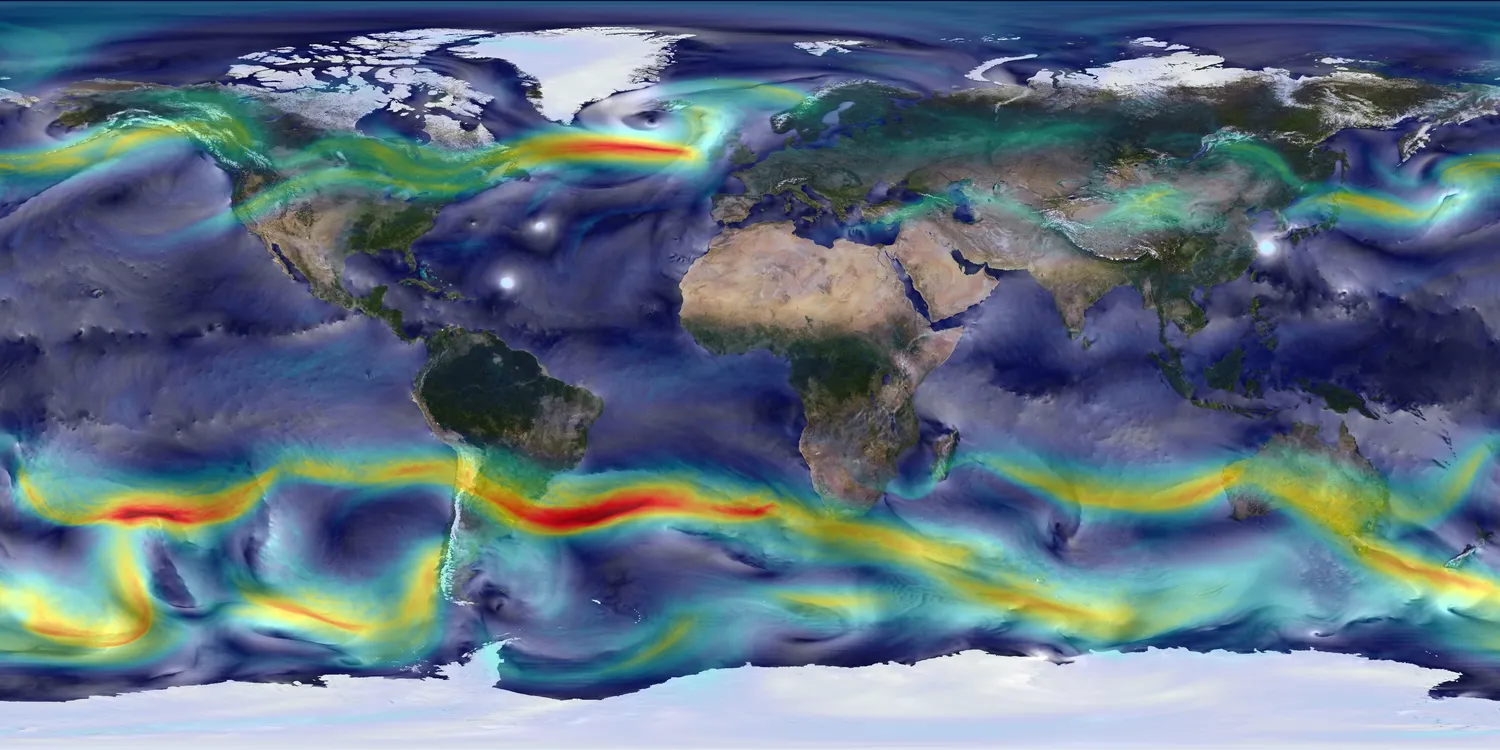
High-resolution global atmospheric modeling provides a unique tool to study the role of weather within Earth’s climate system. NASA’s Goddard Earth Observing System Model (GEOS-5) is capable of simulating worldwide weather at resolutions as fine as 3.5 kilometers.This visualization shows global winds from a GEOS-5 simulation using 10-kilometer resolution. Surface winds (0 to 40 meters/second) are shown in white and trace features including Atlantic and Pacific cyclones. Upper-level winds (250 hectopascals) are colored by speed (0 to 175 meters/second), with red indicating faster. NASA Goddard Space Flight Center / Wikimedia Commons (Public domain).
Global wind patterns are a fundamental part of Earth’s climate system, influencing weather, ocean currents, and the distribution of heat and moisture across the planet. Scientists have observed that winds do not move in straight lines from the equator to the poles. Instead, they follow complex paths shaped by several interacting forces. Understanding these patterns helps explain why certain regions are wet, dry, warm, or cold, and why weather can change rapidly.
Uneven Heating and Convection Cells
The driving force behind global wind patterns is the uneven heating of Earth’s surface. The equator receives more direct solar energy than the poles, causing air at the equator to warm, expand, and rise. This rising air creates a low-pressure zone. As the air ascends, it cools and moves toward higher latitudes. Around 30° north and south, the cooled air sinks, forming high-pressure zones. This cycle establishes a convection cell called the Hadley cell, which operates from the equator to about 30° latitude. Between 30° and 60° latitude lies the Ferrel cell, which is driven by the movement of neighboring cells. Near the poles, the Polar cell circulates air from 60° to 90° latitude. Each hemisphere contains these three main convection cells, creating a repeating pattern north and south of the equator.
Surface Wind Belts and the Jet Stream
The movement of air within these cells produces distinct surface wind belts. Near the equator, the doldrums are calm regions with little wind, while between 0° and 30°, steady trade winds blow from east to west. Around 30°, the horse latitudes are again calm. From 30° to 60°, the westerlies blow from west to east, and from 60° to the poles, cold polar easterlies flow from east to west. Above these surface winds, narrow bands of strong wind called jet streams flow in the upper atmosphere. These jet streams, which can reach speeds over 250 kilometers per hour, influence the movement of storms and weather systems.
Interactions and Real-World Impacts
Global wind patterns do more than move air. They transport heat from the equator toward the poles, balancing Earth’s temperature differences. This process affects rainfall, ocean currents, and even the paths of hurricanes. For example, the westerlies are important for carrying weather systems across North America and Europe, while trade winds helped early sailors travel across the Atlantic and Pacific Oceans. Scientists use satellites and weather balloons to study these winds and predict weather changes. Understanding global wind patterns is crucial for forecasting, preparing for extreme weather, and addressing climate change.
In summary, global wind patterns result from the interplay of solar energy, Earth’s rotation, and convection currents. These patterns connect different parts of the atmosphere in a giant system, supporting life by moving air, water, and energy around the globe.
Interesting Fact: The strongest jet streams in Earth’s atmosphere can travel faster than some commercial airplanes, sometimes reaching over 400 kilometers per hour!
Comprehension quiz (10 questions)
1. What is the main cause of global wind patterns?
2. What is the name of the convection cell that operates from the equator to about 30° latitude?
3. Which wind belt is known for being calm and windless near the equator?
4. What is one role of the westerlies mentioned in the passage?
5. What does the term 'jet stream' mean as used in the passage?
6. What does 'convection cell' mean in this context?
7. Why do trade winds blow from east to west between the equator and 30° latitude?
8. How do global wind patterns help balance Earth's temperature?
9. True or False: The Ferrel cell is found between 30° and 60° latitude.
10. True or False: Jet streams move slower than all surface winds.
Perfect for the way you teach
- Build comprehension skills
- Auto-graded quiz
- Differentiated reading
- Read together at home
- Improve fluency
- Quiet reading time
- Reading curriculum support
- Independent practice
- Track Lexile growth