This learning resource is available in interactive and printable formats. The interactive worksheet can be played online and assigned to students. The Printable PDF version can be downloaded and printed for completion by hand.
This comprehensive middle school science passage explores the greenhouse effect, a process essential to maintaining Earth’s temperature and supporting life. Aligned with NGSS standards MS-ESS2-6 and MS-ESS3-5, the text explains the step-by-step mechanism by which greenhouse gases like carbon dioxide, water vapor, methane, and nitrous oxide trap heat in the atmosphere. Students will learn how sunlight enters the atmosphere, how some energy is converted to infrared radiation, and how this heat is retained, keeping Earth about 33°C warmer than it would be otherwise. The passage also discusses the impact of increased greenhouse gas concentrations, connections to climate change, and the balance required for a stable climate. Activities include a reading comprehension quiz, open-ended writing prompts, and two graphic organizers, making it ideal for classroom use. Audio integration supports diverse learners.
CONTENT PREVIEW
Expand content preview
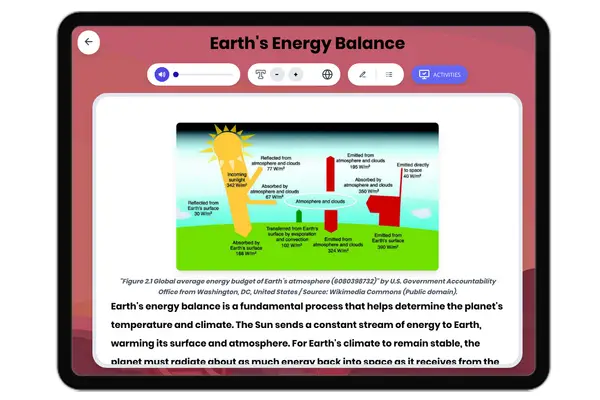
Earth’s atmosphere acts like a protective blanket that helps control the planet’s temperature. Without it, the average surface temperature would be about -18°C, which is far too cold for most life forms to survive. The reason Earth stays much warmer—at an average of 15°C—is due to the greenhouse effect. This process is vital for maintaining conditions that support a wide range of organisms, from tiny bacteria to humans.
How the Greenhouse Effect Works
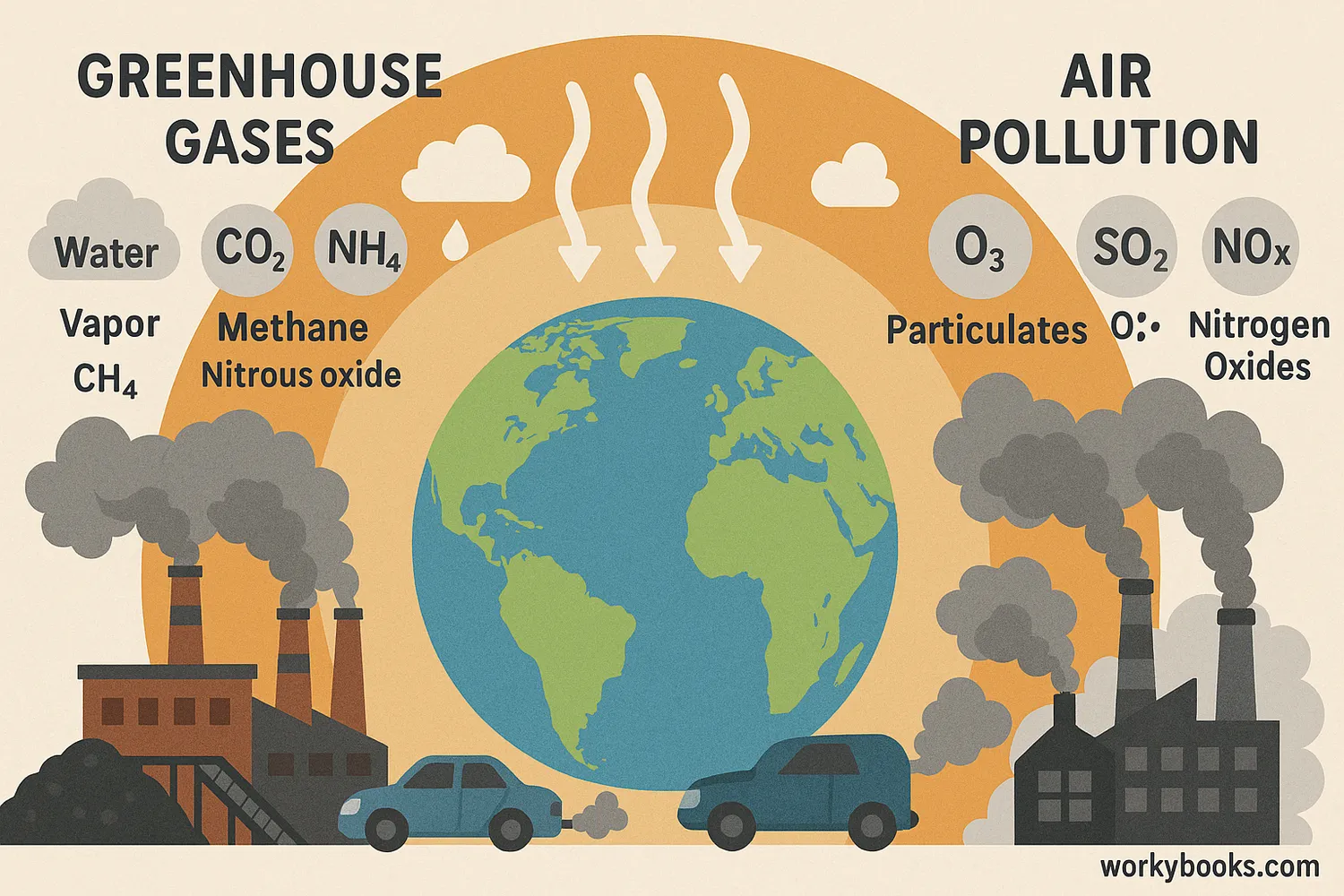
When sunlight reaches Earth, some of its energy is absorbed by the land and oceans, warming the planet’s surface. The surface then releases this energy back into the atmosphere as infrared radiation, which is a type of heat energy. However, not all the infrared radiation escapes into space. Certain gases in the atmosphere, called greenhouse gases, trap some of this heat. The main greenhouse gases are carbon dioxide (CO2), water vapor, methane (CH4), and nitrous oxide (N2O). These gases allow sunlight to enter but absorb and re-emit infrared radiation, keeping the lower atmosphere warm. In fact, the greenhouse effect makes Earth about 33°C warmer than it would be without these gases.
Interactions and Examples
The greenhouse effect works as a system involving the Sun, the surface, and the atmosphere. For example, after a clear night following a cloudy day, temperatures often drop more because clouds, which contain water vapor, act as extra insulation. Another example is how deserts, with dry air and few clouds, can be very hot during the day but cold at night, because less heat is trapped. NASA and other research agencies use satellites and ground-based measurements to study the amounts of greenhouse gases and their effects on Earth’s heat balance. These scientific observations help us understand how small changes in gas concentrations can alter the entire system.
Human Impact and Global Change
Although the greenhouse effect is natural and necessary, human activities are changing its balance. Burning fossil fuels, cutting down forests, and raising large numbers of livestock increase the levels of greenhouse gases like CO2 and methane. Since the late 1800s, the concentration of CO2 in the atmosphere has risen by over 40%. This increase has led to more heat being trapped, causing the average global temperature to rise—a process known as global warming. The enhanced greenhouse effect has serious consequences, including melting ice caps, rising sea levels, and more extreme weather events.
Understanding the greenhouse effect is important for making decisions about energy use, conservation, and climate action. It connects to larger scientific ideas about Earth’s systems and how living things depend on stable environments. Scientists continue to research these interactions to help predict future changes and to inform public policy.
Interesting Fact: Venus, the second planet from the Sun, has a much stronger greenhouse effect than Earth. Its atmosphere is mostly carbon dioxide, making its surface hotter than a pizza oven—over 460°C!
What is the main function of Earth's atmosphere in relation to temperature?
It acts like a protective blanket that keeps the planet warm.It provides food for living things.It blocks all sunlight from reaching the surface.It increases the speed of Earth's rotation.
Which process makes Earth about 33°C warmer than it would be otherwise?
The greenhouse effectCondensationEvaporationOcean currents
Which of the following is NOT a greenhouse gas mentioned in the passage?
OxygenCarbon dioxideMethaneWater vapor
What is the role of greenhouse gases in the atmosphere?
They trap some of the heat energy released by Earth’s surface.They reflect all sunlight away from Earth.They produce food for plants.They cool the surface by allowing all heat to escape.
In the passage, what does 'infrared radiation' mean?
A type of heat energy released by Earth's surfaceA kind of visible light from the SunA sound wave traveling in the atmosphereA chemical reaction in plants
What is an example of the greenhouse effect in daily life described in the passage?
Cloudy nights being warmer than clear nightsThe formation of rainbowsWaves in the oceanThe growth of trees in forests
How have human activities changed the greenhouse effect, according to the passage?
By increasing greenhouse gases like CO2 and methaneBy removing all water vapor from the airBy blocking the Sun’s energy completelyBy decreasing the Earth's temperature
Which statement best explains why deserts can be very hot during the day but cold at night?
They have little water vapor and clouds, so less heat is trapped.They are closer to the Sun.They have more trees to absorb heat.They receive more rain than other places.
The greenhouse effect is necessary for life on Earth. (True/False)
TrueFalse
Global warming is caused by a decrease in greenhouse gases. (True/False)
FalseTrue
Perfect For:
👩🏫 Teachers
• Reading comprehension practice
• Auto-graded assessments
• Literacy skill development
👨👩👧👦 Parents
• Reading practice at home
• Comprehension improvement
• Educational reading time
🏠 Homeschoolers
• Reading curriculum support
• Independent reading practice
• Progress monitoring
Reading Features:
📖
Reading Passage
Engaging fiction or nonfiction text
❓
Comprehension Quiz
Auto-graded questions
📊
Instant Feedback
Immediate results and scoring
📄
Printable Version
Download for offline reading
🔊
Read Aloud
Voice-over with word highlighting
Reviews & Ratings
No reviews yet. Be the first to share your experience!
Related Content
How Rainforests Help the Planet
This NGSS-aligned reading passage for middle school students explains how rainforests help regulate Earth’s climate and ...
MS-ESS2-6MS-LS2-5
Understanding the Koppen Climate Classification System
This NGSS-aligned science reading passage explains the Köppen Climate Classification System, a scientific method used to...
MS-ESS2-6MS-LS2-5
What Is a Temperate Climate?
This NGSS-aligned science reading passage introduces middle school students to temperate climates, which have moderate t...
MS-ESS2-6
What Is the Temperate Zone?
This NGSS-aligned reading passage explains the location and characteristics of the temperate zone. Students learn that t...
MS-ESS2-6
Humid Continental Climate Characteristics
This NGSS-aligned reading passage introduces middle school students to the humid continental climate zone. It explains t...
MS-ESS2-6
Humid Continental Climate Countries
This NGSS-aligned reading passage introduces students to countries that have a humid continental climate, including part...
MS-ESS2-6
How Do Highland Climates Differ from Polar Climates?
This NGSS-aligned reading passage helps middle school students compare and contrast highland and polar climates. It expl...
MS-ESS2-6
Which Factor Controls the Water Cycle?
This NGSS-aligned science reading passage explores the question: Which factor controls the water cycle? Students will le...
MS-ESS2-6
What Is Condensation in the Water Cycle?
This NGSS-aligned reading passage introduces students to the role of condensation in the water cycle. Written for middle...
MS-ESS2-6
What Are Natural Causes That Lead to Increased CO₂ Levels in the Carbon Cycle?
This NGSS-aligned middle school science passage explains natural causes that increase carbon dioxide levels in the carbo...
MS-ESS2-6
Earth's Spheres
This middle school science passage introduces students to Earth's four major spheres: the geosphere, hydrosphere, atmosp...
MS-ESS2-4MS-ESS2-6
Weather vs. Climate
This comprehensive passage for grades 6-8 explores the difference between weather and climate, aligning with NGSS standa...
MS-ESS2-6
Factors Affecting Climate
This informative science passage for grades 6-8 explains the main factors that determine climate in different regions of...
MS-ESS2-6
Climate Zones
This passage provides an in-depth look at Earth’s climate zones using the Köppen classification system, covering tropica...
MS-ESS2-6
Global Wind Patterns
This comprehensive passage introduces middle school students to global wind patterns and atmospheric circulation, aligni...
MS-ESS2-6
Wind
This comprehensive science passage introduces middle school students to the mechanisms of wind formation, focusing on ai...
MS-ESS2-5MS-ESS2-6
El Niño
This middle school science passage provides an in-depth exploration of El Niño, the warm phase of the El Niño-Southern O...
MS-ESS2-6MS-ESS3-5
Hurricanes and Ocean Heat
This middle school science passage explores the relationship between hurricanes and ocean heat, aligning with NGSS stand...
MS-ESS2-6MS-ESS3-2
ENSO and Global Climate
This comprehensive passage explores the El Niño-Southern Oscillation (ENSO), a crucial driver of global climate variabil...