Which Factor Controls the Water Cycle? — Reading Comprehension
Rate this
Premium Resource
Present
Present in classroom. No work saved
Assign
Classroom with student accounts, Track progress
Quick Play
No student accounts, assign with a link
Grades
5
6
7
8
Standards
MS-ESS2-6
PRINT+DIGITAL RESOURCE
This learning resource is available in interactive and printable formats. The interactive worksheet can be played online and assigned to students. The Printable PDF version can be downloaded and printed for completion by hand.
This NGSS-aligned science reading passage explores the question: Which factor controls the water cycle? Students will learn that the Sun is the driving force behind the continuous movement of water through evaporation, condensation, precipitation, and collection. The passage uses clear language suitable for middle school readers and includes scientific vocabulary such as transpiration, atmosphere, and climate. Real-life examples like tropical rain and desert dryness help connect concepts to daily life. Designed to support NGSS standard MS-ESS2-4, this resource helps build reading comprehension while reinforcing science content knowledge related to Earth's systems and energy transfer. Great for reading-to-learn lessons and cross-curricular instruction.
CONTENT PREVIEW
Expand content preview
The water cycle is the continuous movement of water through Earth’s atmosphere, land, and oceans. This cycle includes key processes like evaporation, condensation, precipitation, and collection. The main factor that controls the water cycle is the Sun. Without the Sun’s energy, the water cycle would not happen. The Sun drives the movement of water by heating up Earth’s surface, especially oceans, lakes, and rivers.
When the Sun warms water, it causes evaporation—the process of liquid water turning into water vapor. This vapor rises into the atmosphere. Plants also release water vapor through a process called transpiration. Together, evaporation and transpiration add moisture to the air. As water vapor rises and cools, it undergoes condensation and forms clouds. When these clouds become heavy with water droplets, precipitation occurs as rain, snow, sleet, or hail.
The Sun not only powers evaporation but also helps shape weather patterns. It affects wind, temperature, and the movement of air masses, all of which influence how and where precipitation falls. For example, in warmer climates, more sunlight leads to higher evaporation rates, which often means more rainfall.
Real-world examples show the Sun’s power in action. In tropical areas, the intense sunlight causes rapid evaporation, leading to frequent rainstorms. In contrast, deserts receive lots of sunlight but little moisture to evaporate, so they remain dry. Even seasonal changes in sunlight affect the water cycle, such as spring snowmelt that leads to increased river flow.
Understanding how the Sun controls the water cycle helps scientists predict weather, manage water resources, and study climate change. The Sun is essential to life on Earth, and its role in the water cycle is one of the most important ways it supports ecosystems around the planet.
Fun Fact: The Sun releases more energy in one second than humans have used in all of history!
What is the main factor that controls the water cycle?
The MoonThe WindThe SunThe Clouds
What process changes liquid water into water vapor?
PrecipitationEvaporationCondensationCollection
What happens when water vapor cools in the atmosphere?
It turns into snowIt disappearsIt forms cloudsIt sinks to the ground
What is the term for plants releasing water vapor?
TranspirationCondensationEvaporationPrecipitation
How does the Sun affect rainfall in tropical areas?
It stops all precipitationIt reduces wind patternsIt increases evaporationIt cools the ocean
Why are deserts dry despite a lot of sunlight?
Too many treesLack of cloudsNot enough moistureCold winds
What is the main idea of the passage?
The Sun creates windWater flows into riversThe Sun drives the water cyclePlants help clean the air
If there were no sunlight, what would happen to the water cycle?
It would speed upIt would stopIt would turn into snowIt would grow plants faster
Perfect For:
👩🏫 Teachers
• Reading comprehension practice
• Auto-graded assessments
• Literacy skill development
👨👩👧👦 Parents
• Reading practice at home
• Comprehension improvement
• Educational reading time
🏠 Homeschoolers
• Reading curriculum support
• Independent reading practice
• Progress monitoring
Reading Features:
📖
Reading Passage
Engaging fiction or nonfiction text
❓
Comprehension Quiz
Auto-graded questions
📊
Instant Feedback
Immediate results and scoring
📄
Printable Version
Download for offline reading
🔊
Read Aloud
Voice-over with word highlighting
Reviews & Ratings
No reviews yet. Be the first to share your experience!
Related Content
How Rainforests Help the Planet
This NGSS-aligned reading passage for middle school students explains how rainforests help regulate Earth’s climate and ...
MS-ESS2-6MS-LS2-5
Understanding the Koppen Climate Classification System
This NGSS-aligned science reading passage explains the Köppen Climate Classification System, a scientific method used to...
MS-ESS2-6MS-LS2-5
What Is a Temperate Climate?
This NGSS-aligned science reading passage introduces middle school students to temperate climates, which have moderate t...
MS-ESS2-6
What Is the Temperate Zone?
This NGSS-aligned reading passage explains the location and characteristics of the temperate zone. Students learn that t...
MS-ESS2-6
Humid Continental Climate Characteristics
This NGSS-aligned reading passage introduces middle school students to the humid continental climate zone. It explains t...
MS-ESS2-6
Humid Continental Climate Countries
This NGSS-aligned reading passage introduces students to countries that have a humid continental climate, including part...
MS-ESS2-6
How Do Highland Climates Differ from Polar Climates?
This NGSS-aligned reading passage helps middle school students compare and contrast highland and polar climates. It expl...
MS-ESS2-6
What Is Condensation in the Water Cycle?
This NGSS-aligned reading passage introduces students to the role of condensation in the water cycle. Written for middle...
MS-ESS2-6
What Are Natural Causes That Lead to Increased CO₂ Levels in the Carbon Cycle?
This NGSS-aligned middle school science passage explains natural causes that increase carbon dioxide levels in the carbo...
MS-ESS2-6
Earth's Spheres
This middle school science passage introduces students to Earth's four major spheres: the geosphere, hydrosphere, atmosp...
MS-ESS2-4MS-ESS2-6
Weather vs. Climate
This comprehensive passage for grades 6-8 explores the difference between weather and climate, aligning with NGSS standa...
MS-ESS2-6
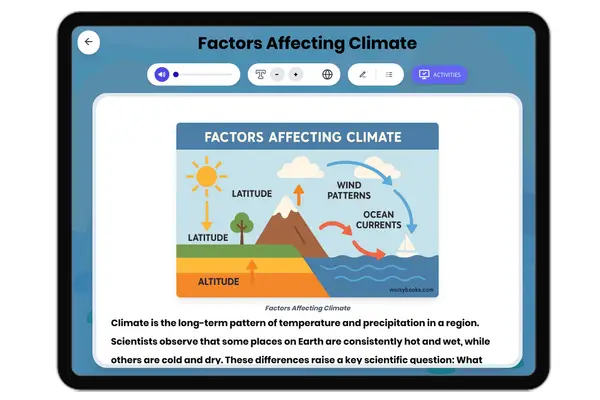
Factors Affecting Climate
This informative science passage for grades 6-8 explains the main factors that determine climate in different regions of...
MS-ESS2-6
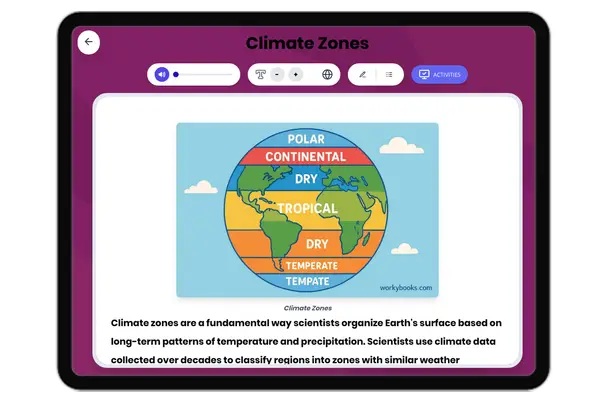
Climate Zones
This passage provides an in-depth look at Earth’s climate zones using the Köppen classification system, covering tropica...
MS-ESS2-6
The Greenhouse Effect
This comprehensive middle school science passage explores the greenhouse effect, a process essential to maintaining Eart...
MS-ESS2-6MS-ESS3-5
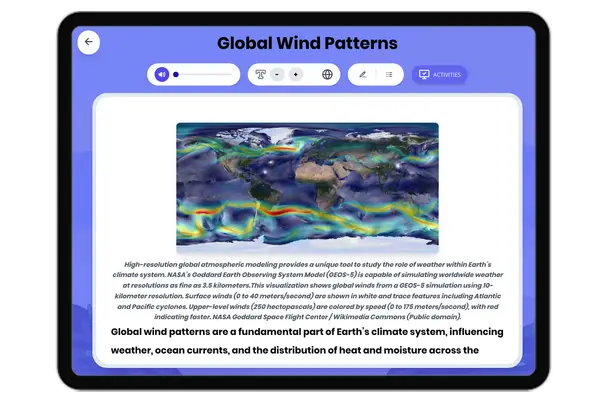
Global Wind Patterns
This comprehensive passage introduces middle school students to global wind patterns and atmospheric circulation, aligni...
MS-ESS2-6
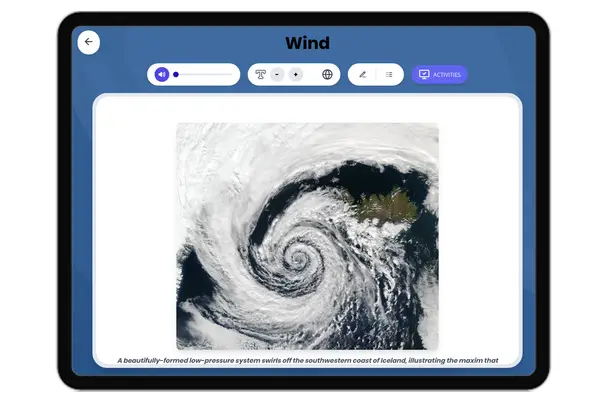
Wind
This comprehensive science passage introduces middle school students to the mechanisms of wind formation, focusing on ai...
MS-ESS2-5MS-ESS2-6
El Niño
This middle school science passage provides an in-depth exploration of El Niño, the warm phase of the El Niño-Southern O...
MS-ESS2-6MS-ESS3-5
Hurricanes and Ocean Heat
This middle school science passage explores the relationship between hurricanes and ocean heat, aligning with NGSS stand...
MS-ESS2-6MS-ESS3-2
ENSO and Global Climate
This comprehensive passage explores the El Niño-Southern Oscillation (ENSO), a crucial driver of global climate variabil...