This learning resource is available in interactive and printable formats. The interactive worksheet can be played online and assigned to students. The Printable PDF version can be downloaded and printed for completion by hand.
This informative science passage for grades 6-8 explains the main factors that determine climate in different regions of the world, including latitude, altitude, distance from water, ocean currents, mountain barriers, and prevailing winds. Aligned to NGSS standard MS-ESS2-6, the text explores the underlying mechanisms that drive climate patterns, explains how multiple factors interact, and provides real-world examples including data and cause-effect relationships. The reading is available in both English and Spanish, with a differentiated version for accessibility. Activities include a multiple-choice quiz, writing prompts with model answers, and two graphic organizers to deepen understanding. The resource is ideal for middle school classrooms and is audio integrated for diverse learners. Keywords: climate, latitude, ocean currents, mountains, winds, altitude, NGSS, bilingual, science literacy.
CONTENT PREVIEW
Expand content preview
Factors Affecting Climate
Climate is the long-term pattern of temperature and precipitation in a region. Scientists observe that some places on Earth are consistently hot and wet, while others are cold and dry. These differences raise a key scientific question: What causes the unique climate patterns found in different parts of the world? The answer lies in a combination of several physical factors that interact to create each region’s climate system. Understanding these factors is essential for predicting weather, managing resources, and preparing for environmental changes.
Latitude and Altitude: The Position and Height Effect
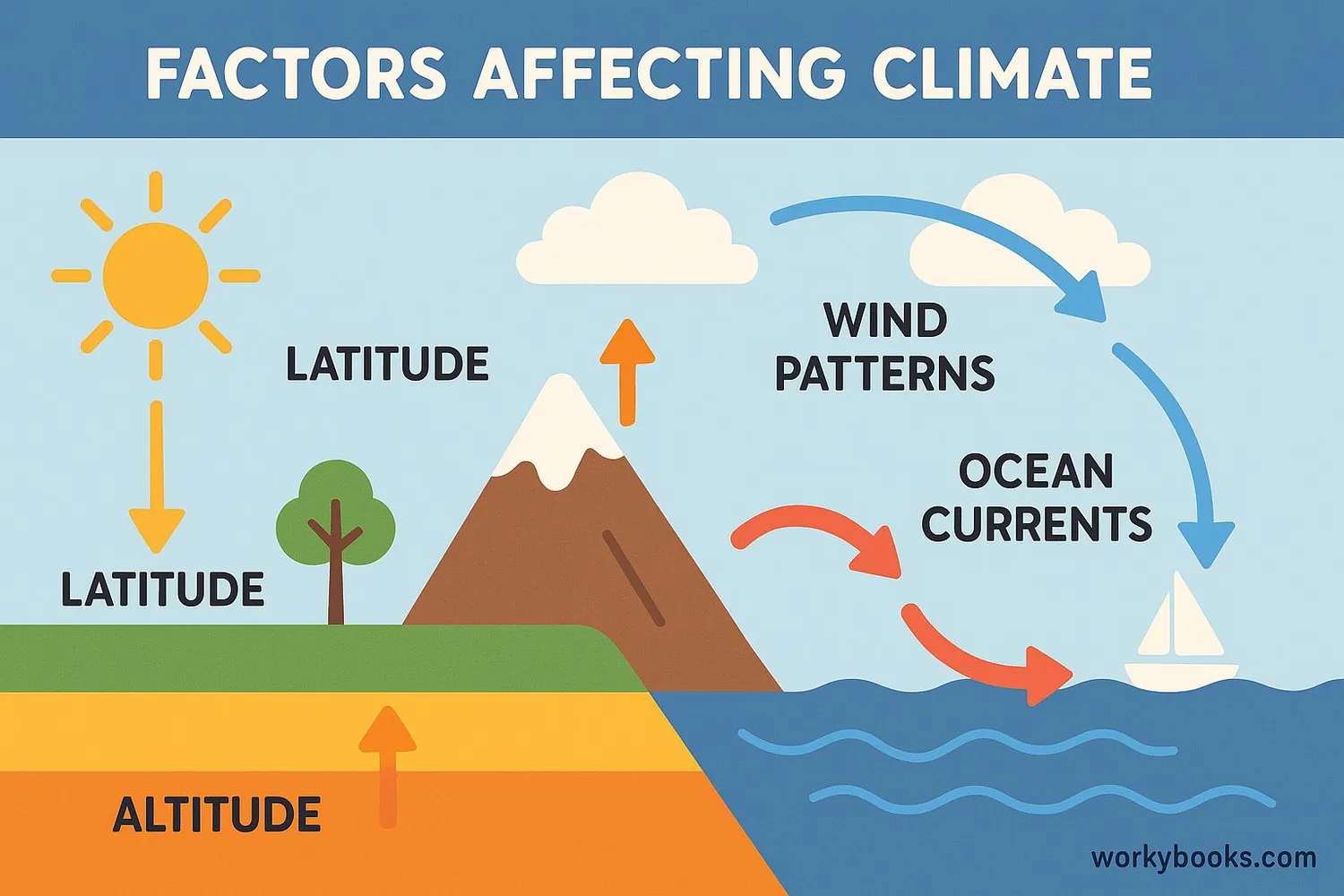
One of the most important factors affecting climate is latitude, or how far a place is from the Equator. Areas near the Equator receive more direct sunlight throughout the year, making them warmer. In contrast, regions closer to the poles get less solar energy and are generally colder. Altitude, or elevation above sea level, also influences climate. As altitude increases, air pressure and temperature decrease by about 6.5°C for every 1,000 meters climbed. For example, cities like Quito, Ecuador, which is near the Equator but at high altitude, remain cool year-round. This demonstrates how latitude and altitude can combine to produce unique climate conditions.
Distance from Water, Ocean Currents, and Prevailing Winds
Another key set of factors are distance from water, ocean currents, and prevailing winds. Water heats and cools more slowly than land, so places near oceans or large lakes tend to have milder climates with smaller temperature changes. Ocean currents move warm or cold water across vast distances, transferring heat and influencing the climate of coastal regions. For instance, the Gulf Stream warms Western Europe, while the Peru Current cools the west coast of South America. Prevailing winds carry air masses with different temperatures and moisture levels, shaping regional climate. Winds blowing from the ocean often bring moisture and moderate temperatures, while winds from land can be dry and more extreme.
Mountains and the Combined Impact
Mountain barriers also play a critical role. When moist air hits a mountain range, it rises, cools, and releases precipitation on the windward side, creating lush environments. The air then descends on the leeward side, becoming dry and forming rain shadows—areas with much less rainfall, like the eastern side of the Sierra Nevada. All these factors—latitude, altitude, proximity to water, ocean currents, prevailing winds, and mountains—combine in complex ways. Scientists use data from satellites, weather stations, and climate models to study these interactions and make predictions. Understanding these mechanisms is crucial for agriculture, city planning, and responding to global climate change.
Ultimately, the climate of any location is the result of many interconnected factors. Changes in one factor can impact others, leading to shifts in regional and global climate systems. The study of climate teaches us about the dynamic nature of Earth’s systems and the importance of scientific observation and modeling.
Interesting Fact: The Sahara Desert is located at about 30° north latitude, where sinking air from global wind patterns creates dry conditions—making it the largest hot desert in the world!
What is the main reason places near the Equator are warmer than places near the poles?
They receive more direct sunlight throughout the year.They are at a higher altitude.They are farther from the ocean.They are surrounded by mountains.
How does altitude affect climate?
Higher altitude means higher temperatures.Higher altitude means lower temperatures.Altitude has no effect on climate.Higher altitude increases rainfall everywhere.
What is a rain shadow?
A dry area on the leeward side of a mountain.A region with constant rainfall.A mountain covered in snow.An area near the Equator.
Which of the following best explains why Western Europe has a milder climate than similar latitudes in Canada?
Because of the warming effect of the Gulf Stream ocean current.Because it is at a lower altitude.Because it is farther from the ocean.Because of frequent rain shadows.
What does the term 'prevailing winds' mean as used in the passage?
Winds that blow from the same direction most of the time.Winds that only occur in mountains.Winds that change direction every day.Winds that cause precipitation to stop.
In the passage, what is one effect of mountains on climate?
They create areas with more rainfall on one side and less on the other.They make all areas warmer.They have no effect on climate.They make the equator colder.
If the prevailing winds in a region change from ocean to land, what might happen to the climate?
The region may become drier and have more extreme temperatures.The region will become wetter and milder.The region will have no change in climate.The area will receive more solar energy.
Why do scientists use satellites and climate models to study climate?
To collect data and make predictions about complex climate interactions.To make weather warmer.To change rain shadows.To increase altitude.
True or False: Water heats and cools faster than land, so places near oceans have larger temperature changes.
TrueFalse
True or False: Changes in one climate factor can affect other factors and change the whole climate system.
TrueFalse
Perfect For:
👩🏫 Teachers
• Reading comprehension practice
• Auto-graded assessments
• Literacy skill development
👨👩👧👦 Parents
• Reading practice at home
• Comprehension improvement
• Educational reading time
🏠 Homeschoolers
• Reading curriculum support
• Independent reading practice
• Progress monitoring
Reading Features:
📖
Reading Passage
Engaging fiction or nonfiction text
❓
Comprehension Quiz
Auto-graded questions
📊
Instant Feedback
Immediate results and scoring
📄
Printable Version
Download for offline reading
🔊
Read Aloud
Voice-over with word highlighting
Reviews & Ratings
No reviews yet. Be the first to share your experience!
Related Content
How Rainforests Help the Planet
This NGSS-aligned reading passage for middle school students explains how rainforests help regulate Earth’s climate and ...
MS-ESS2-6MS-LS2-5
Understanding the Koppen Climate Classification System
This NGSS-aligned science reading passage explains the Köppen Climate Classification System, a scientific method used to...
MS-ESS2-6MS-LS2-5
What Is a Temperate Climate?
This NGSS-aligned science reading passage introduces middle school students to temperate climates, which have moderate t...
MS-ESS2-6
What Is the Temperate Zone?
This NGSS-aligned reading passage explains the location and characteristics of the temperate zone. Students learn that t...
MS-ESS2-6
Humid Continental Climate Characteristics
This NGSS-aligned reading passage introduces middle school students to the humid continental climate zone. It explains t...
MS-ESS2-6
Humid Continental Climate Countries
This NGSS-aligned reading passage introduces students to countries that have a humid continental climate, including part...
MS-ESS2-6
How Do Highland Climates Differ from Polar Climates?
This NGSS-aligned reading passage helps middle school students compare and contrast highland and polar climates. It expl...
MS-ESS2-6
Which Factor Controls the Water Cycle?
This NGSS-aligned science reading passage explores the question: Which factor controls the water cycle? Students will le...
MS-ESS2-6
What Is Condensation in the Water Cycle?
This NGSS-aligned reading passage introduces students to the role of condensation in the water cycle. Written for middle...
MS-ESS2-6
What Are Natural Causes That Lead to Increased CO₂ Levels in the Carbon Cycle?
This NGSS-aligned middle school science passage explains natural causes that increase carbon dioxide levels in the carbo...
MS-ESS2-6
Earth's Spheres
This middle school science passage introduces students to Earth's four major spheres: the geosphere, hydrosphere, atmosp...
MS-ESS2-4MS-ESS2-6
Weather vs. Climate
This comprehensive passage for grades 6-8 explores the difference between weather and climate, aligning with NGSS standa...
MS-ESS2-6
Climate Zones
This passage provides an in-depth look at Earth’s climate zones using the Köppen classification system, covering tropica...
MS-ESS2-6
The Greenhouse Effect
This comprehensive middle school science passage explores the greenhouse effect, a process essential to maintaining Eart...
MS-ESS2-6MS-ESS3-5
Global Wind Patterns
This comprehensive passage introduces middle school students to global wind patterns and atmospheric circulation, aligni...
MS-ESS2-6
Wind
This comprehensive science passage introduces middle school students to the mechanisms of wind formation, focusing on ai...
MS-ESS2-5MS-ESS2-6
El Niño
This middle school science passage provides an in-depth exploration of El Niño, the warm phase of the El Niño-Southern O...
MS-ESS2-6MS-ESS3-5
Hurricanes and Ocean Heat
This middle school science passage explores the relationship between hurricanes and ocean heat, aligning with NGSS stand...
MS-ESS2-6MS-ESS3-2
ENSO and Global Climate
This comprehensive passage explores the El Niño-Southern Oscillation (ENSO), a crucial driver of global climate variabil...