This learning resource is available in interactive and printable formats. The interactive worksheet can be played online and assigned to students. The Printable PDF version can be downloaded and printed for completion by hand.
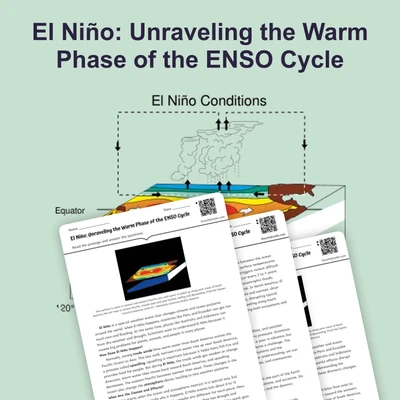
This comprehensive passage explores the El Niño-Southern Oscillation (ENSO), a crucial driver of global climate variability. Aligned with NGSS standards MS-ESS2-6 and MS-ESS3-5, it explains how ENSO events like El Niño and La Niña influence atmospheric circulation, global weather patterns, precipitation, and temperatures. The text discusses teleconnections—distant weather effects linked through atmospheric mechanisms—and highlights real-world impacts on agriculture, economies, and historical climate events. The passage also covers the uncertainty of ENSO’s future in a changing climate and describes global monitoring efforts by organizations like NOAA. With audio integration for accessibility, this resource supports middle school science instruction, providing challenging academic vocabulary, a glossary, Spanish translation, differentiated reading, comprehension questions, writing prompts, and graphic organizers. Students will gain a systems-level understanding of climate processes and their far-reaching consequences.
CONTENT PREVIEW
Expand content preview
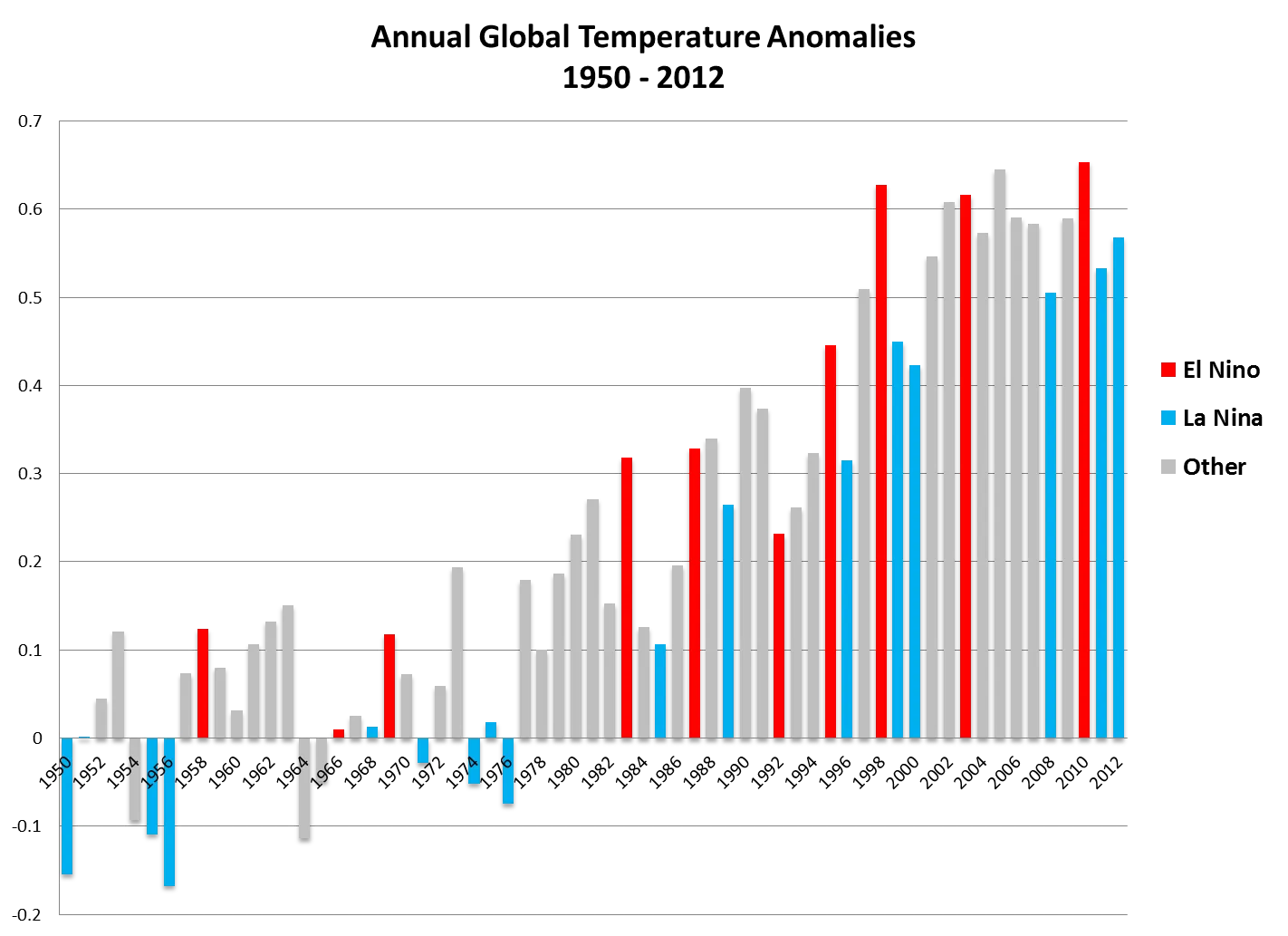
NOAA Global Annual Temperature Anomalies 1950–2012 from State of the Climate : Global Analysis : Annual 2012 by NOAA / Wikimedia Commons (Public domain).
The El Niño-Southern Oscillation (ENSO) is the largest source of year-to-year climate variability on Earth. ENSO events, which include both El Niño and La Niña, can cause dramatic shifts in weather patterns across the globe. Understanding ENSO is essential for scientists who study climate, as it affects worldwide temperatures, rainfall, agriculture, and even economies. The mechanisms of ENSO demonstrate the interconnectedness of ocean and atmosphere, with far-reaching consequences that extend well beyond the Pacific Ocean.
How ENSO Works: Ocean-Atmosphere Interactions
ENSO is driven by complex interactions between the tropical Pacific Ocean and the atmosphere above it. During El Niño, warm surface water spreads eastward across the Pacific, reducing the usual upwelling of cold, nutrient-rich water. This shift weakens the trade winds—steady winds that normally blow from east to west. As a result, the central and eastern Pacific become much warmer than average. In contrast, La Niña events strengthen trade winds, causing more cold water to rise to the surface and making the Pacific cooler than normal. These changes set off teleconnections: patterns where climate events in one region affect distant areas through atmospheric circulation. For example, El Niño years often bring heavy rain to western South America but drought to Australia and Indonesia.
Global Effects: Temperature, Precipitation, and Economic Impact
ENSO events influence global temperature and precipitation patterns. El Niño years tend to be warmer worldwide, with global average temperatures rising by about 0.1–0.2°C (0.2–0.4°F), because of the massive release of ocean heat into the atmosphere. Precipitation patterns also shift: some regions experience flooding while others face drought. For example, both Asian and African monsoons can weaken during strong El Niños, reducing crop yields and impacting food supplies. The economic effects are significant—major ENSO events have caused billions of dollars in damages due to disrupted agriculture, wildfires, and infrastructure losses. Historical El Niño events, such as those in 1997–98 and 2015–16, were among the strongest recorded, leading to widespread weather anomalies and humanitarian challenges.
ENSO in a Changing Climate: Uncertainty and Monitoring
Scientists are actively researching how climate change might affect ENSO. While some computer models suggest ENSO events could become more intense or frequent, there is still considerable uncertainty. Monitoring ENSO is a global effort, involving organizations like the NOAA Climate Prediction Center and international partners. These agencies use satellites, ocean buoys, and weather models to track sea surface temperatures, wind patterns, and rainfall. Accurate predictions help countries prepare for possible impacts—reducing risks to communities, economies, and ecosystems. ENSO remains a key focus for climate science because of its unpredictable, global influence and its relevance to understanding Earth’s interconnected systems.
Interesting Fact: The 2015–16 El Niño was so strong that it temporarily pushed global average temperatures to their highest level ever recorded at the time!
What is ENSO?
A climate pattern that causes year-to-year changes in weather worldwideA type of wind that blows from Africa to AsiaA short rainstorm in the Pacific OceanA layer of the Earth's crust
They become weakerThey become strongerThey stop completelyThey blow from west to east
What is one effect of strong El Niño events?
They always cause more snow in AntarcticaThey can weaken Asian and African monsoonsThey make the Atlantic Ocean colderThey increase trade winds
What does the term 'teleconnections' mean in the passage?
Winds that blow over the oceanPatterns where climate events in one region affect distant areasThe temperature of the Pacific OceanEquipment for measuring weather
What is the main reason scientists monitor ENSO closely?
To prepare countries for possible weather impactsTo study the Atlantic OceanTo increase rainfall in AfricaTo stop hurricanes from forming
Why do El Niño years tend to be warmer globally?
Because of massive heat release from the oceanBecause the sun is closer to EarthBecause of volcanic eruptionsBecause trade winds are stronger
Which organization is mentioned as monitoring ENSO?
NOAA Climate Prediction CenterWorld BankNational Park ServiceInternational Space Station
True or False: La Niña makes the Pacific Ocean warmer than normal.
TrueFalse
True or False: ENSO events have no effect on global economies.
TrueFalse
Perfect For:
👩🏫 Teachers
• Reading comprehension practice
• Auto-graded assessments
• Literacy skill development
👨👩👧👦 Parents
• Reading practice at home
• Comprehension improvement
• Educational reading time
🏠 Homeschoolers
• Reading curriculum support
• Independent reading practice
• Progress monitoring
Reading Features:
📖
Reading Passage
Engaging fiction or nonfiction text
❓
Comprehension Quiz
Auto-graded questions
📊
Instant Feedback
Immediate results and scoring
📄
Printable Version
Download for offline reading
🔊
Read Aloud
Voice-over with word highlighting
Reviews & Ratings
No reviews yet. Be the first to share your experience!
Related Content
Natural Disaster: Hurricanes
Hurricanes are massive storms with strong winds and rain. Tracking and preparing for them helps protect people in their ...
RI.3.1RI.4.4RI.4.2RI.5.2
How Rainforests Help the Planet
This NGSS-aligned reading passage for middle school students explains how rainforests help regulate Earth’s climate and ...
MS-ESS2-6MS-LS2-5
Understanding the Koppen Climate Classification System
This NGSS-aligned science reading passage explains the Köppen Climate Classification System, a scientific method used to...
MS-ESS2-6MS-LS2-5
How Climate Change Affects Animal Migration
This NGSS-aligned science reading passage explains how climate change affects animal migration by altering seasonal cues...
MS-LS2-6MS-ESS3-5
What Is Global Warming?
This NGSS-aligned reading passage explains global warming, the greenhouse effect, and how human activities like burning ...
MS-ESS3-5
What Causes Global Warming?
This NGSS-aligned reading passage explains what causes global warming, focusing on how human activities like burning fos...
MS-ESS3-5
How to Stop Global Warming
This NGSS-aligned reading passage helps students understand how to stop global warming by reducing greenhouse gases. It ...
MS-ESS3-5
What Is a Temperate Climate?
This NGSS-aligned science reading passage introduces middle school students to temperate climates, which have moderate t...
MS-ESS2-6
What Is the Temperate Zone?
This NGSS-aligned reading passage explains the location and characteristics of the temperate zone. Students learn that t...
MS-ESS2-6
Humid Continental Climate Characteristics
This NGSS-aligned reading passage introduces middle school students to the humid continental climate zone. It explains t...
MS-ESS2-6
Humid Continental Climate Countries
This NGSS-aligned reading passage introduces students to countries that have a humid continental climate, including part...
MS-ESS2-6
How Do Highland Climates Differ from Polar Climates?
This NGSS-aligned reading passage helps middle school students compare and contrast highland and polar climates. It expl...
MS-ESS2-6
Which Factor Controls the Water Cycle?
This NGSS-aligned science reading passage explores the question: Which factor controls the water cycle? Students will le...
MS-ESS2-6
What Is Condensation in the Water Cycle?
This NGSS-aligned reading passage introduces students to the role of condensation in the water cycle. Written for middle...
MS-ESS2-6
What Are Natural Causes That Lead to Increased CO₂ Levels in the Carbon Cycle?
This NGSS-aligned middle school science passage explains natural causes that increase carbon dioxide levels in the carbo...
MS-ESS2-6
Human Impacts: Climate Change
This standards-aligned science reading passage for grades 6-8 explains the mechanisms and effects of human-driven climat...
MS-LS2-4MS-ESS3-5
Climate Change: Vulnerable Ecosystems
This middle school science passage, aligned with NGSS standards MS-ESS3-5 and MS-LS2-4, helps students understand how cl...
MS-ESS3-5MS-LS2-4
Climate Change: Solutions and Mitigation
This passage explores scientific solutions and mitigation strategies for climate change, designed for middle school scie...
MS-ESS3-4MS-ESS3-5
Earth's Spheres
This middle school science passage introduces students to Earth's four major spheres: the geosphere, hydrosphere, atmosp...
MS-ESS2-4MS-ESS2-6
Scientific Inquiry in Earth Science
This passage explores scientific inquiry in Earth science for grades 6-8, aligned with NGSS standards MS-ESS1-4, MS-ESS2...