How Technology Made Ocean Voyages Possible — Reading Comprehension
Rate this
Premium Resource
Present
Present in classroom. No work saved
Assign
Classroom with student accounts, Track progress
Quick Play
No student accounts, assign with a link
Grades
3
4
5
Standards
D2.HIS.1.3-5
D2.HIS.2.3-5
RI.4.3
RI.4.4
W.4.2
PRINT+DIGITAL RESOURCE
This learning resource is available in interactive and printable formats. The interactive worksheet can be played online and assigned to students. The Printable PDF version can be downloaded and printed for completion by hand.
This engaging U.S. History reading passage, aligned with C3 Framework and Common Core standards, explores how new technology made ocean voyages possible during the Age of Exploration. Students will learn about inventions like the compass and astrolabe, and how these tools helped European explorers reach the Americas, impacting Native American communities. The passage highlights key events and cause-and-effect relationships, using simple language and short sentences suitable for upper elementary students. Activities include a glossary, multiple-choice quiz, writing prompts, a timeline, and a graphic organizer, all designed to foster historical thinking and literacy skills. The resource also features a read aloud audio and a Spanish translation, making it accessible for diverse learners. This passage is ideal for classroom use or independent study and supports standards-based instruction in history and ELA.
CONTENT PREVIEW
Expand content preview
[Pinta, Columbus caravel]. Source: Library of Congress - Hart, Edward H.
Technology changed the way people explored the world. In the 1400s and 1500s, European explorers wanted to find new routes to Asia. They hoped to get spices, gold, and other goods. But traveling across the ocean was hard and dangerous. New inventions helped explorers go farther than ever before.
One key invention was the caravel. Caravels were ships with strong sails and a new design. They could sail quickly and turn easily, even in strong winds. Before caravels, ships could not travel far from land. With caravels, explorers could cross the Atlantic Ocean and reach the Americas.
Better navigation tools also helped. The compass showed sailors which direction to travel. The astrolabe helped them find their place by looking at the stars. These inventions made it possible to explore open seas.
Europeans also improved their maps. Mapmakers used new information from each voyage to draw more accurate maps. This made future trips safer. Better maps helped explorers plan their trips and know what to expect.
New weapons like cannons and guns gave explorers more power. They could protect themselves from danger. But these weapons also made it easier for Europeans to take land from Native Americans. Many Native American groups had never seen such weapons before. This changed the balance of power.
When explorers arrived in North America, they met Native American cultures. Some explorers traded with Native Americans and learned from them. Others used their advanced technology to take over land. The meeting between two worlds brought big changes for everyone involved.
Technology made exploration possible. Innovations in ships, navigation, and weapons helped Europeans travel farther and faster. These changes led to new discoveries, but they also caused conflict and loss for Native Americans.
Interesting Fact: The compass, first used by Chinese sailors, became a key tool for European explorers. It helped them travel across unknown oceans.
What is a caravel?
A fast ship for exploringA type of mapA special compassA powerful weapon
Which tool shows direction at sea?
AstrolabeCompassCaravelMap
Why did explorers want new routes to Asia?
For spices and goldTo meet Native AmericansTo find new weaponsTo draw maps
How did maps help explorers?
Made trips saferHelped build shipsFound gold fasterCaught more fish
What was one effect of better weapons?
Easier to take landBetter foodFaster shipsStronger sails
What happened when explorers met Native Americans?
Trade and learningNothing changedAll became friendsEuropeans left quickly
Caravel ships could not travel far. True or False?
TrueFalse
What does 'innovation' mean?
A new idea or inventionA type of weaponAn old toolA person who explores
Perfect For:
👩🏫 Teachers
• Reading comprehension practice
• Auto-graded assessments
• Literacy skill development
👨👩👧👦 Parents
• Reading practice at home
• Comprehension improvement
• Educational reading time
🏠 Homeschoolers
• Reading curriculum support
• Independent reading practice
• Progress monitoring
Reading Features:
📖
Reading Passage
Engaging fiction or nonfiction text
❓
Comprehension Quiz
Auto-graded questions
📊
Instant Feedback
Immediate results and scoring
📄
Printable Version
Download for offline reading
🔊
Read Aloud
Voice-over with word highlighting
Reviews & Ratings
No reviews yet. Be the first to share your experience!
Related Content
Native American Tribes Across America
This engaging history reading passage introduces students to Native American tribes across America, focusing on their da...
D2.HIS.1.3-5D2.HIS.2.3-5RI.4.1RI.4.2
The Sioux: Warriors and Tribal Leaders
This history reading passage explores the Sioux Nation, focusing on their roles as warriors and tribal leaders. Students...
D2.HIS.1.3-5D2.HIS.2.3-5RI.4.1RI.4.3
Jamestown: The First Permanent English Colony
This engaging history passage explores the founding of Jamestown, the first permanent English colony in America. Aligned...
D2.HIS.1.3-5D2.HIS.2.3-5RI.4.3RI.4.4
Pocahontas and the Powhatan People
This engaging reading passage explores the life of Pocahontas and the Powhatan people and their important role in early ...
D2.HIS.1.3-5D2.HIS.2.3-5RI.4.1RI.4.3
Colonial Games and Entertainment
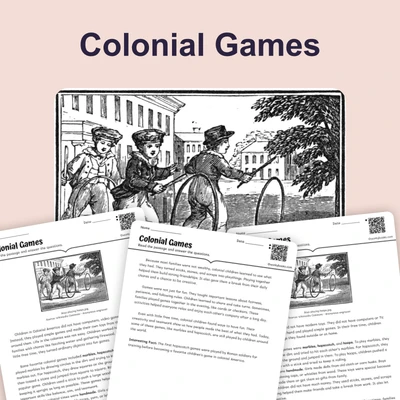
This engaging history reading passage explores the types of games and entertainment enjoyed by children and families in ...
D2.HIS.1.3-5RI.4.3RI.4.4
Colonial Towns and Village Life
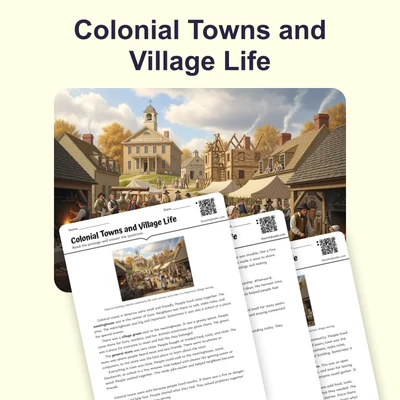
This engaging history reading passage explores the daily life, work, and unity found in colonial towns and villages. Ali...
D2.HIS.1.3-5D2.HIS.2.3-5RI.4.3RI.4.4
George Washington Leads the Army
This engaging history reading passage explores how George Washington bravely led the Continental Army during the America...
D2.HIS.1.3-5D2.HIS.2.3-5RI.4.3RI.4.4
The Battle of Yorktown Ends War
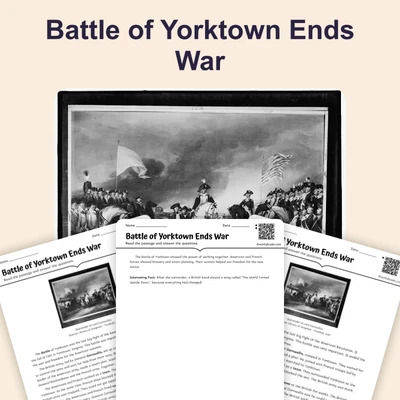
This engaging U.S. history reading passage explores the Battle of Yorktown, a key event that ended the American Revoluti...
D2.HIS.1.3-5D2.HIS.2.3-5RI.4.1RI.4.3
Life as a Continental Soldier
This passage explores the daily life of a Continental Soldier during the American Revolutionary War, highlighting challe...
D2.HIS.1.3-5RI.4.1RI.4.3
Loyalists vs. Patriots: Divided Families
This engaging U.S. history reading passage explores the division between Loyalists and Patriots during the American Revo...
D2.HIS.1.3-5D2.HIS.2.3-5RI.4.3RI.4.4
Manifest Destiny: Coast to Coast
This engaging U.S. history reading passage explores Manifest Destiny and the westward expansion of the United States. St...
D2.HIS.1.3-5D2.HIS.2.3-5RI.4.3RI.4.4
Abraham Lincoln Becomes President
This engaging U.S. history reading passage introduces students to the story of Abraham Lincoln’s rise to the presidency....
D2.HIS.1.3-5D2.HIS.2.3-5RI.4.3RI.4.4
The Southern States Leave the Union
This engaging reading passage explores the key events leading up to the Southern states leaving the Union before the Civ...
D2.HIS.1.3-5D2.HIS.2.3-5RI.4.3RI.4.4
Lincoln Assassinated at Ford's Theatre
This history reading passage explores the events of President Abraham Lincoln's assassination at Ford's Theatre in 1865....
D2.HIS.1.3-5D2.HIS.2.3-5RI.4.3RI.4.4
Juan Cabrillo Explores California
This engaging U.S. history reading passage introduces students to Juan Cabrillo, the first European explorer to reach Ca...
D2.HIS.1.3-5D2.HIS.2.3-5D2.HIS.3.3-5RI.4.3
California's Early Spanish Settlements
This engaging U.S. history reading passage explores life during the early Spanish settlements in America, highlighting t...
D2.HIS.1.3-5D2.HIS.2.3-5D2.HIS.3.3-5RI.4.1
Discovery of Gold in 1848 by James Marshall
This engaging U.S. History passage introduces students to the discovery of gold in 1848 by James Marshall and the beginn...
D2.HIS.1.3-5D2.HIS.2.3-5D2.HIS.3.3-5RI.4.1
The Gold Rush Changes California Forever
This engaging U.S. History reading passage explores how the Gold Rush changed California forever. Students will learn ab...
D2.HIS.1.3-5D2.HIS.2.3-5D2.HIS.16.3-5RI.4.3
The Golden Spike: Connecting California to the Nation
This engaging U.S. history reading passage teaches students about the Golden Spike and how the first transcontinental ra...
D2.HIS.1.3-5D2.HIS.2.3-5D2.HIS.14.3-5RI.4.3
Farms, Factories, and Growing Cities
This engaging U.S. history reading passage explores the dramatic changes in America during the Progressive Era, focusing...