King Narmer Unifies Egypt
Interactive passage with audio narration, comprehension questions, and printable PDF.
By completing this purchase you agree to our Terms of Use and Privacy Policy. Your subscription renews automatically until you cancel. You can cancel anytime from your account settings. All sales are final and non-refundable. Digital content is available for download in your account immediately upon purchase.
What's included
King Narmer Unifies Egypt preview and details
About this printable King Narmer Unifies Egypt reading passage (Grades 5-8)
Sample passage and quiz from King Narmer Unifies Egypt
Reading passage and comprehension quiz preview
King Narmer Unifies Egypt
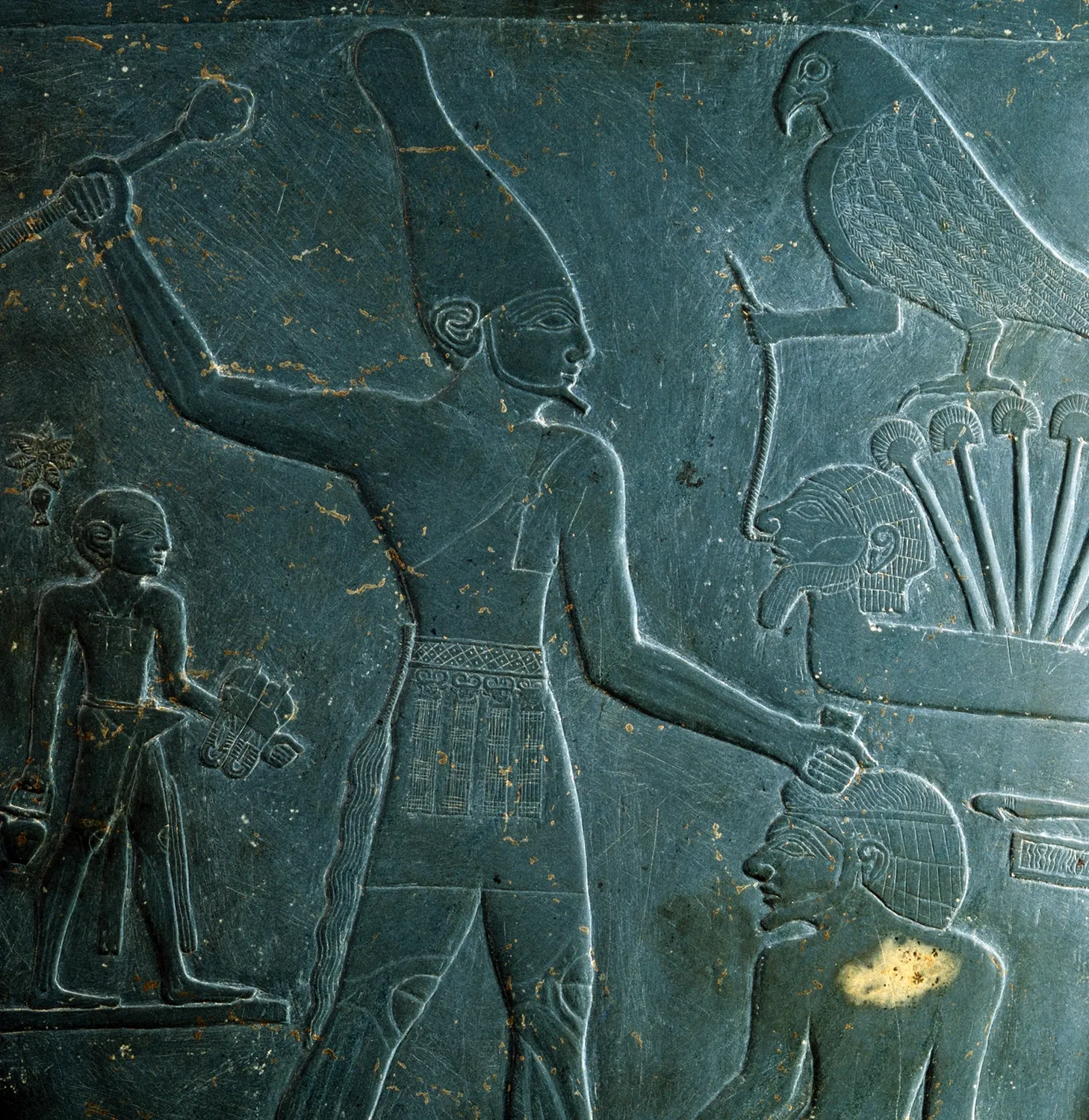
"King Narmer"
Source: Wikimedia Commons (Public domain).
In ancient times, Egypt was not always a single, united country. For centuries, two regions—Upper Egypt in the south and Lower Egypt in the north—developed along the banks of the Nile River. Around 3100 BCE, a powerful leader named King Narmer changed the course of history by uniting these lands into one kingdom, creating the foundation for one of the world’s longest-lasting civilizations.
The Nile River, which flows northward from the highlands of East Africa to the Mediterranean Sea, made life possible in Egypt’s desert environment. Its predictable flooding brought rich silt that fertilized the land and allowed people to grow crops. This geography shaped early Egyptian society, as people settled near the river and built complex communities. However, Upper and Lower Egypt developed their own traditions, rulers, and even crowns—the White Crown for Upper Egypt, and the Red Crown for Lower Egypt.
King Narmer, also known as Menes in some ancient records, is credited by many scholars as the first Egyptian pharaoh. Archaeological evidence, such as the Narmer Palette, shows Narmer wearing both crowns—symbolizing the unification of Egypt. This stone artifact is decorated with carvings that depict Narmer defeating his enemies and celebrating the merging of the two lands. The combined Double Crown, or Pschent, became a powerful symbol of the pharaoh’s authority over a united Egypt.
The unification was not only a military achievement but also a political and cultural one. Narmer established the first royal dynasty, which helped organize a strong central government. This allowed for the construction of irrigation systems, the development of writing called hieroglyphics, and the growth of cities. Social hierarchy became more defined, with the pharaoh at the top, followed by priests, officials, artisans, and farmers. Daily life in Egypt changed as trade increased and religious beliefs became unified across both regions.
The legacy of Narmer’s unification can be seen in Egypt’s later achievements, such as the building of pyramids and the flourishing of art and science. The Double Crown remained a symbol of unity and power for centuries, and Egypt’s identity as a single nation endured for thousands of years. The story of Narmer shows how geography, leadership, and culture combined to shape one of the most remarkable civilizations in history.
This event connects to broader themes in world history, including the rise of complex societies, the importance of geography, and the lasting impact of powerful leaders.
Interesting Fact: The Narmer Palette is one of the oldest historical documents in the world, and its carvings may be the earliest known use of hieroglyphic writing.
Comprehension quiz (8 questions)
1. Who united Upper and Lower Egypt?
2. What river flows through Egypt?
3. What is the Double Crown called?
4. Why was the Nile important to Egypt?
5. What did the Narmer Palette show?
6. How did unification change daily life?
7. Egypt stayed divided after Narmer. True or false?
8. What does 'hieroglyphics' mean?
Perfect for the way you teach
- Build comprehension skills
- Auto-graded quiz
- Differentiated reading
- Read together at home
- Improve fluency
- Quiet reading time
- Reading curriculum support
- Independent practice
- Track Lexile growth