Daily Life in Ancient Egypt
Interactive passage with audio narration, comprehension questions, and printable PDF.
By completing this purchase you agree to our Terms of Use and Privacy Policy. Your subscription renews automatically until you cancel. You can cancel anytime from your account settings. All sales are final and non-refundable. Digital content is available for download in your account immediately upon purchase.
What's included
Daily Life in Ancient Egypt preview and details
About this printable Daily Life in Ancient Egypt reading passage (Grades 5-8)
Sample passage and quiz from Daily Life in Ancient Egypt
Reading passage and comprehension quiz preview
Life in Ancient Egypt: Work, Play, and Family
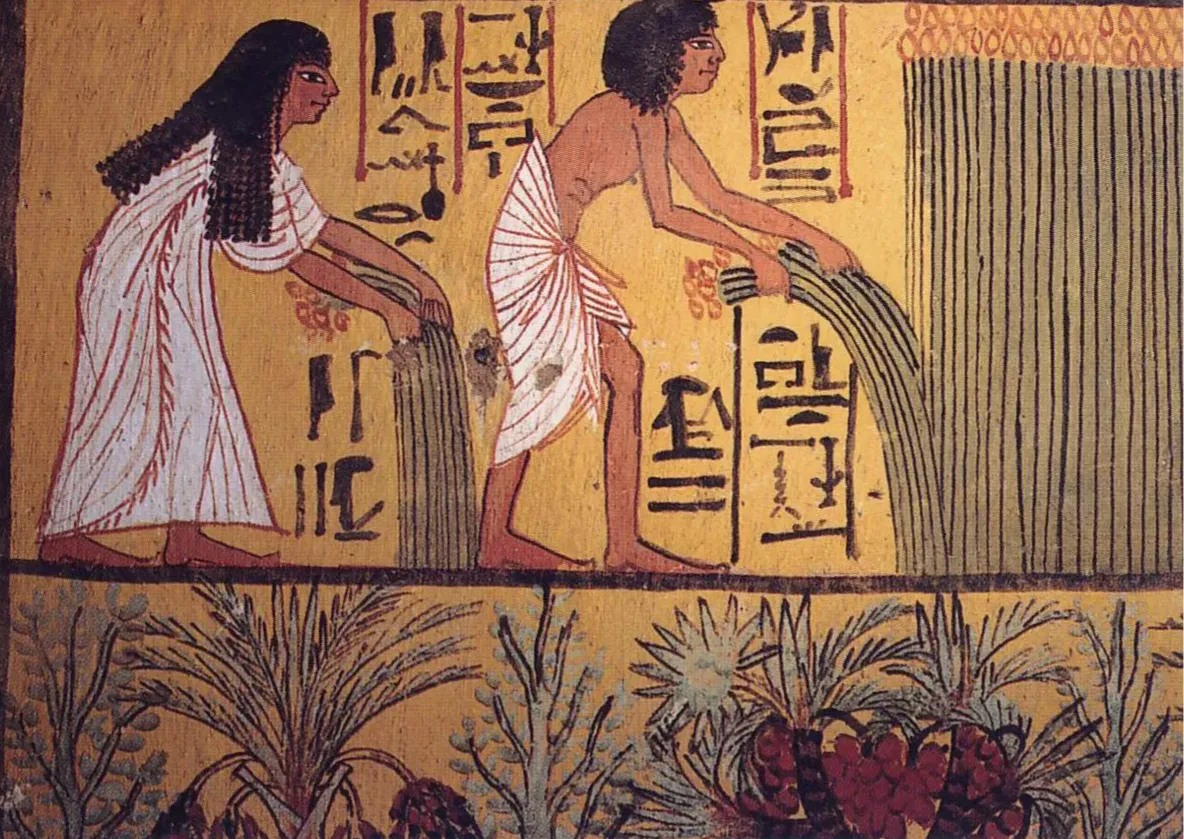
"Egyptian harvest" by Anonymous Egyptian tomb artist(s)/
Source: Wikimedia Commons (Public domain).
Ancient Egypt, located along the fertile banks of the Nile River, was one of the world’s earliest and most influential civilizations. For over 3,000 years, Egyptians developed a complex society with unique traditions, a strict social hierarchy, and impressive monuments. Daily life in Egypt was shaped by the geography of the Nile, the needs of society, and religious beliefs.
Most Egyptians lived in small villages or towns near the Nile, where the annual flooding provided rich soil for farming. The majority of people worked as farmers, growing wheat, barley, and flax. Archaeological evidence, such as wall paintings in tombs from 1400 BCE at Thebes, shows farmers using simple tools to plant and harvest crops. Their work was vital, as they provided food for everyone, including the ruling class. In return, farmers paid taxes, often in grain, to the government and temples.
Other Egyptians specialized in different types of labor. Skilled artisans crafted pottery, jewelry, and furniture, while builders constructed temples and pyramids for the pharaohs. Scribes, a respected profession, recorded information using hieroglyphics, an ancient writing system. Only a small percentage of people, mostly boys from wealthy families, could become scribes because learning to read and write was difficult. The highest position in society belonged to the pharaoh, who was seen as both a political leader and a god. Below the pharaoh were nobles, priests, soldiers, and government officials, followed by the majority of workers and farmers. At the bottom were enslaved people, who performed the hardest labor.
Family was the center of Egyptian society. Children were highly valued, and both boys and girls played games, such as senet and spinning tops, as seen in artifacts from the tomb of Tutankhamun (c. 1323 BCE). Women managed household affairs and could own property, a right not common in many other ancient societies. Marriage was a social contract, and divorce was possible. Religion influenced daily life through rituals, festivals, and beliefs about the afterlife. Temples and household shrines were important gathering places for the community.
Over centuries, Egyptian life changed with new rulers and contact with other cultures, but many traditions remained. The river’s flooding, family bonds, and social classes continued to shape Egyptian identity. Today, artifacts and monuments help historians piece together what daily life was like for ordinary Egyptians, reminding us of the human experiences behind the ancient ruins.
This study of daily life in Ancient Egypt connects to broader themes in world history, such as the impact of geography, the development of social systems, and the ways people organize work and family.
Interesting Fact: The oldest known board game, senet, was played by Egyptians over 5,000 years ago and was found in many tombs as a symbol of the journey to the afterlife.
Comprehension quiz (8 questions)
1. What river was vital to Egypt?
2. Who was at the top of society?
3. What did most Egyptians do for work?
4. Why did farmers pay taxes in grain?
5. How did geography affect Egyptian life?
6. Why was being a scribe special?
7. Pharaohs were seen as gods. True or false?
8. What does 'hieroglyphics' mean?
Perfect for the way you teach
- Build comprehension skills
- Auto-graded quiz
- Differentiated reading
- Read together at home
- Improve fluency
- Quiet reading time
- Reading curriculum support
- Independent practice
- Track Lexile growth